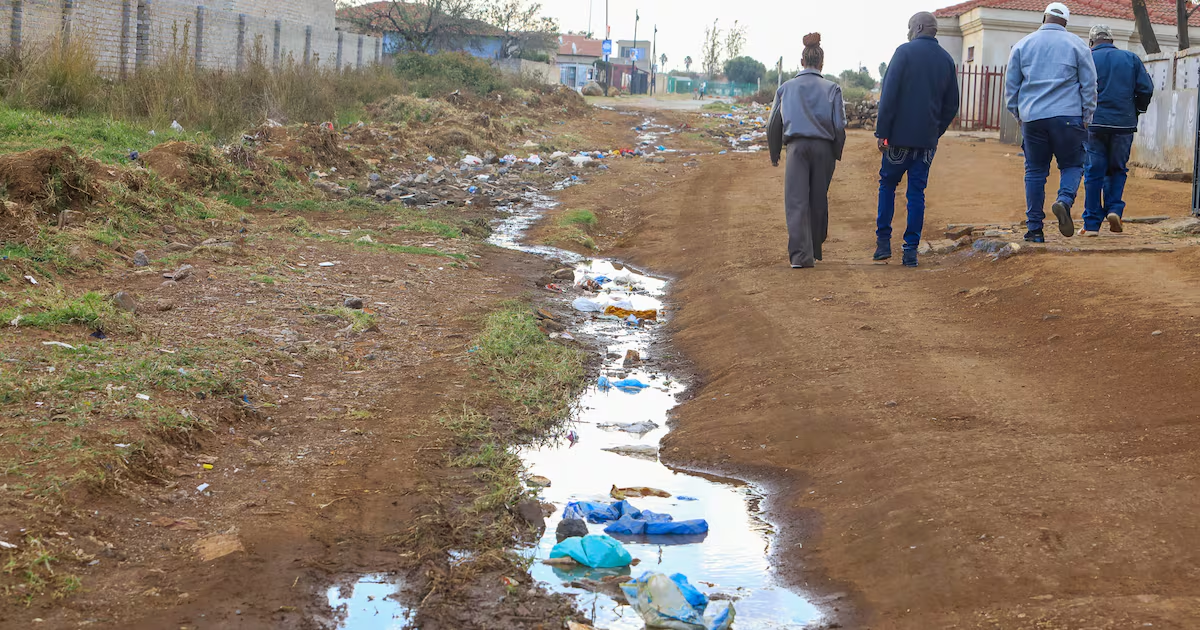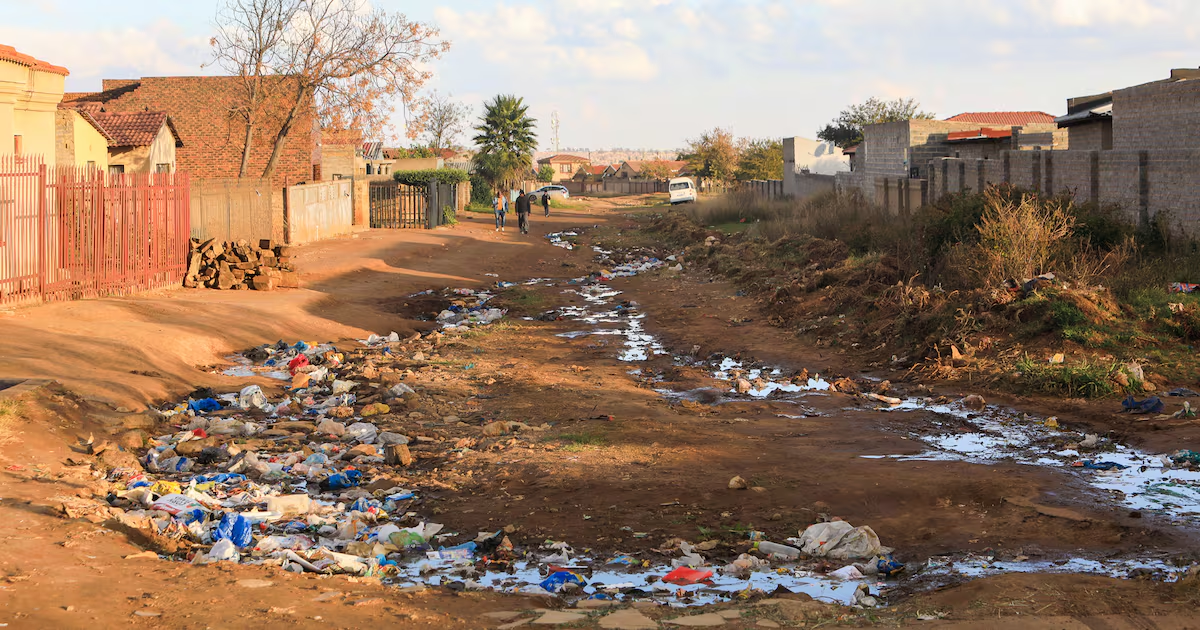
The National Treasury’s decision to withhold July’s equitable share transfer from 69 municipalities was correctly framed as a compliance measure, invoking section 216(2) of the constitution to enforce fiscal discipline where the Municipal Finance Management Act has been ignored. However, the auditor-general’s corroborating 2024/25 findings, a public protector report on Cape Town and a Constitutional Court judgment on provincial land disposal render the action a symptom of three larger, only partially connected problems:Municipalities that cannot manage the money they have;A funding formula that may not give some of them enough in the first place;A pattern, confirmed judicially, of asset and spatial-planning decisions that fail; and constitutional scrutiny even when no compliance certificate would flag them. Treating these as one problem, or fixing only one, leaves the system no more resilient than it is today.Since 2021/22 municipalities have incurred R24.12bn in fruitless and wasteful expenditure and R145.21bn in irregular expenditure, with R40.14bn in 2024/25 alone. Unauthorised expenditure totals R118.13bn, more than half of which is on non-cash budget items.Budget credibility is deteriorating: 116 municipalities (45%) adopted unfunded 2024/25 budgets, up from 113 the year before, and arrears to Eskom, water boards and other statutory bodies are mounting.The section 216 list spans all nine provinces, four metros (Buffalo City, Nelson Mandela Bay, City of Johannesburg and Mangaung), and, most strikingly, 16 Free State municipalities. When a targeted intervention captures three quarters of a province it is not exceptional — it becomes the ordinary condition of local government, raising a question the withholding statement does not answer: is section 216 the right tool for a problem this systemic, or does its scale point to something upstream that a transfer freeze cannot fix?The audit failures are only half the story. Revenue is also leaking, most visibly in electricity, where the rapid rollout of rooftop solar and embedded generation is hollowing out the cross-subsidy on which municipal tariffs were built, precisely where municipalities can least absorb the loss. An unfunded budget may reflect a revenue base shrinking faster than the cost base. Consequence management addresses only the expenditure side.The public protector’s findings on Khayelitsha and Langa Flats make the same point in reverse: a metro not on the withholding list was nonetheless found to have committed maladministration, with unrepaired sewer infrastructure, nonfunctional fire safety equipment and inadequate water access. South Africa needs a horizontal division of revenue that better weights the informal settlement scale and revenue leakage risk; a consequence-management regime with real teeth, reserving section 216 for genuine outliers; and an asset-governance standard, now judicially mandated, that treats public land as a service delivery instrument first and a revenue source only within that constraint. Cape Town’s defence leans on funding constraints and land invasions; that is a claim that the funding formula itself may be inadequate, not a defence against a compliance charge. The public protector did not dismiss it. The remedial action orders the finance minister to assess under sections 214 and 227 within six months whether the equitable share adequately funds municipalities with large informal settlements and to report back within 60 days, a formula-adequacy review converging on the same instrument as the withholding.The Constitutional Court’s judgment in Adonisi v Minister for Transport and Public Works, handed down on July 2 in the decade-long Tafelberg dispute in Sea Point, adds a third dimension: how provinces can reasonably plan, hold and dispose of their own assets. The Western Cape and the city were found to have breached sections 25(5) and 26 of the constitution: their housing programmes never delivered affordable housing in well-located areas, only on the periphery, and land scarcity cannot excuse that since it is itself the residue of apartheid spatial planning the Constitution obliges the state to reverse. The court’s reading of the Government Immovable Asset Management Act sets a stricter bar for declaring public land “surplus” than provinces have historically applied.The temptation will be to let the section 216 list dominate, to read 69 municipalities in distress as proof that discipline alone is the binding constraint, crowding out the formula question and the asset-governance standard the courts have now entrenched.That is a mistake on all three fronts. Tightening compliance without revisiting the formula overlooks that the Free State’s pattern is too widespread to be solely a governance failure. Revisiting the formula without fixing the municipal public accounts committee’s dysfunction risks pouring more revenue into municipalities that will again report it as unauthorised expenditure next year. Ignoring Tafelberg misses a channel of revenue leakage and constitutional exposure, drawing on the same institutional capacity as the other two.South Africa needs a horizontal division of revenue that better weights the informal settlement scale and revenue leakage risk; a consequence-management regime with real teeth, reserving section 216 for genuine outliers; and an asset-governance standard, now judicially mandated, that treats public land as a service delivery instrument first and a revenue source only within that constraint. Get the sequencing wrong on any one — fund without discipline, discipline without funding, or transfer reform without asset reform — and next July’s list will look much the same.None of this is uncontested. The Treasury’s own position is that the equitable share formula already carries a basic services and institutional component meant to capture backlog and poverty weighting; they argue it needs recalibrating, not that it is absent, and re-opening the horizontal division formula is not costless: without a matching increase in the national fiscal envelope, weighting it more towards informal settlement pressure means less for other municipalities, a redistribution some provinces and metros will resist.Those are real constraints on how far and how fast a review can go, but these are arguments for doing it carefully, not for not doing it.Ngozo is an independent economist, fiscal policy specialist and founder of Eoza Consultancy. Business Day
THANDO NGOZO | Local government finance is broken three ways — we keep fixing only one
Treasury’s funding freeze exposes flaws in compliance, revenue leaks and asset governance
959 words~4 min read