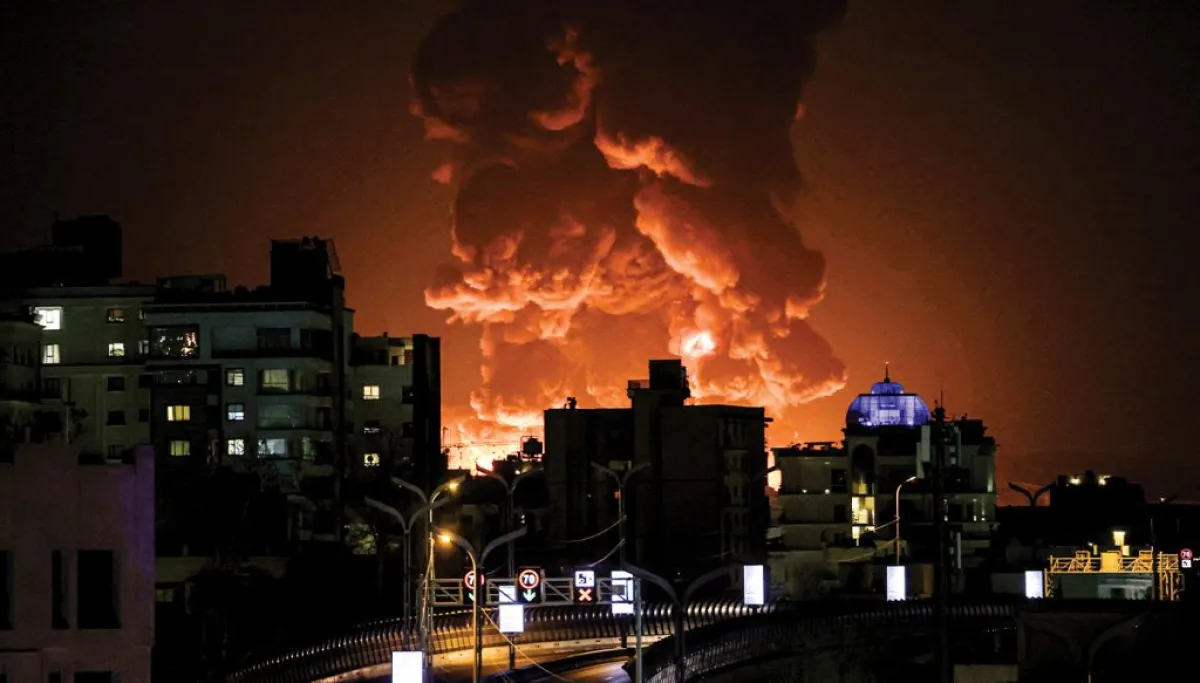
ByHANAN SHAIJULY 27, 2026 15:00The United States is wielding enormous power against Iran through cumulative warfare: another strike, another round of degradation, another punitive blow – each intended gradually to change Tehran’s will. This is the same strategic logic that prolonged the Vietnam War.Washington can control each strike’s intensity, but not how many will be required or how long the war will last. Unless the campaign shifts from cumulative pressure to military decision, four months may prove only the beginning of a conflict America cannot control.Asked whether the strikes had become the American public’s “new normal,” President Donald Trump replied: “We were in Vietnam for 19 years. We’re here for four months.” He then cited high percentages of Iranian drone- and missile-production capacity destroyed.Chronologically, Trump is right. Strategically, his answer misses the point. Vietnam became a long war because the United States employed immense force without constructing a mechanism capable of producing decision. Long wars always begin as short ones.The percentages describe degradation, not an end state. Has Iran’s war-making system been disabled? Counting targets is no substitute for answers.Iranian flags fly as fire and smoke from an Israeli attack on Sharan Oil depot rise, following Israeli strikes on Iran, in Tehran, Iran, June 15, 2025. (credit: MAJID ASGARIPOUR/WANA/REUTERS)A Washington Post report reinforces the warning. According to a US intelligence assessment led by the CIA, the strikes are not affecting the regime’s leadership or softening its position. Despite severe military damage, the regime remains structurally stable. Washington and Tehran have reached a stalemate between peace and war.Vietnam’s graduated pressureIn Vietnam, the United States followed “graduated pressure.” Instead of depriving North Vietnam of the ability to continue fighting, Washington escalated step by step. Each escalation was intended to raise the cost and persuade Hanoi to negotiate without triggering a wider war with China or the Soviet Union.The ground campaign followed the same logic through “search and destroy.” Success was measured by sorties, bombs, targets, and casualties. Washington controlled each blow’s intensity; Hanoi controlled how many it would absorb. As long as North Vietnam continued fighting, America had no mechanism for ending the war on its own terms. Gradual escalation also gave the enemy time to rebuild and adapt.Short operations thus became a long and costly war.The same logic in IranThe doctrine applied in Iran has a different name, but its practical logic is nearly identical. It gradually degrades missiles, drones, infrastructure, and command centers without disabling Iran’s war-making system as a whole. The damage is expected to accumulate until the regime decides that the price is too high and changes its will.America controls the rungs on the escalation ladder; Iran controls how many must be climbed. Washington determines how much each round will hurt. Tehran determines how many rounds there will be.Technology reinforces the illusion of control. In Vietnam, Robert McNamara’s reliance on data confused measurable outputs with strategic results.Today, precision intelligence, AI, and long-range fire enable attacks. But technology cannot determine what will decide the enemy. A target list is not a strategy; control over execution is not control over outcome.From degradation to decisionThe doctrine of decision follows the opposite logic. It does not wait for the enemy to become discouraged or choose compromise. It deprives him of the ability to operate effectively. Once that ability is lost, his will can no longer determine the outcome.Douglas MacArthur demonstrated this at Inchon. Rather than add force where North Korea was strongest, he struck its less-protected rear, created local superiority, and severed its supply routes. He did not change the enemy’s mind; he made it irrelevant to the outcome.Iran combines a political-economic system sustaining the regime with a military-strategic system comprising the Revolutionary Guards, missiles, drones, the nuclear program, and proxies. Generalship must identify the center of gravity whose disablement would weaken the whole.The United States has assembled enormous air, naval, and intelligence power in the theater. Israeli participation is not indispensable, but could multiply that power and shorten the campaign.Unlike Vietnam, Iran cannot simply be left behind. Withdrawal would preserve its ability to threaten regional states, American forces, shipping, energy infrastructure, and the global economy. It would allow Tehran to rebuild and choose when to begin the next war. Agreements and sanctions cannot substitute for decision, while the regime can violate them and recover.The CIA assessment is a red card. It warns that the war is moving down the Vietnam track: another strike, another degradation, another punishment – without a mechanism of decision or control over duration.Four months are not 19 years. But every 19-year war was once four months old.The track can still be changed. The decisive question is not how many targets have been destroyed, but what will deprive the Iranian regime of the ability to continue the war – and how the power already assembled can be concentrated to achieve it.The writer is a senior fellow at the Jerusalem-based Misgav Institute for National Security & Zionist Strategy.Follow us on Google
America’s Iran strategy risks a war without an end | The Jerusalem Post
Four months into the Iran campaign, the US risks repeating Vietnam by relying on gradual pressure over decisive victory.
822 words~4 min read