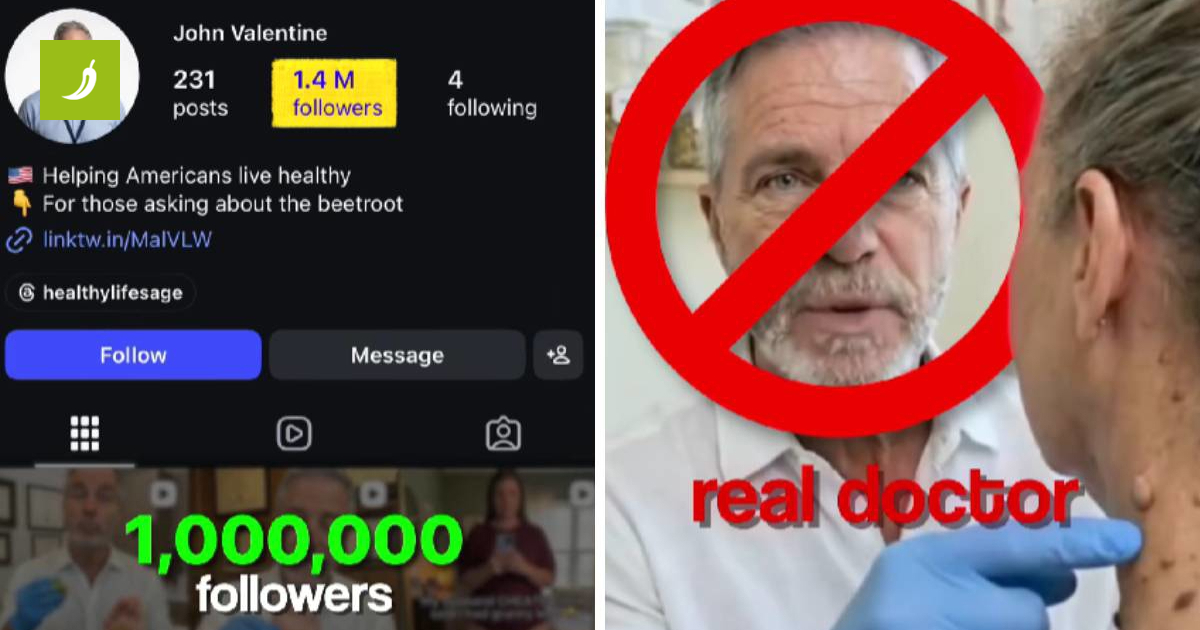
At some point during the day, most people log on to a social media platform.According to Pew Research Center, a whopping 84% of adults use YouTube, 71% of American adults use Facebook and 50% use Instagram.On these sites and others, people are fed video after video of anything from shopping hauls to recipes to more problematic content that has a goal of tricking people into believing or buying certain things.The problem? Not all of these videos are real. The “health influencer” you’re following on TikTok may actually be an AI avatar created by an unknown company trying to sell you a product.A recent New York Times investigation found hundreds and hundreds of AI videos on social media starring AI “influencers” made to look like medical professionals or health-conscious wellness advocates. The fake people in these videos are often selling supplements designed to treat chronic pain or cure diseases, and these claims are often targeted toward older women. The products aren’t FDA-approved and, in some cases, lead to more health problems for users or are just a total waste of money.AI videos and AI avatars are getting harder and harder to tell apart from real videos and real people, said Alex Hamerstone, the advisory solutions director at TrustedSec, an ethical hacking company.“It’s almost impossible these days to tell. Six months or a year ago, we talk about looking at the hands or things that AI was not as good at generating, but these days, it’s really almost impossible,” Hamerstone said, before adding that the small phone screens that many people use when accessing Facebook, TikTok and Instagram make it even harder. So, what can you do? How can you protect yourself from falling victim to an AI health scam on social media? Here’s what experts say:First, if the health promises in the video sound too good to be true, they probably are.Emily DeJeu, an assistant teaching professor of business communications at Carnegie Mellon University in Pittsburgh and expert in AI for business communication, said there’s one test she likes to use when considering any kind of health solution — “this economics principle that people learn in high school; there’s no such thing as a free lunch, which captures that idea. If it sounds too good to be true, then it’s definitely not true.”“Or it’s true, but the good part is much more fraught,” DeJeu added.For instance, if you have a chronic health condition that hasn’t been cured by medical interventions, but someone (or an AI avatar) on social media says a pill or supplement can fix it, it is not true.“If it sounds miraculous, immediately activate extreme skepticism ... [that’s] probably a good way to go,” said DeJeu.Actual health solutions tend to be the boring things you’ve heard a million times, noted DeJeu: things like exercise, a healthy diet, quality sleep, regular doctor visits, health screenings and taking your prescriptions. Alina Barilo via Getty ImagesFake AI influencers can be found in hundreds of videos on social media sites like TikTok and Instagram.If there’s pressure to buy something quickly, that’s another red flag.There are a few red flags you should look out for when faced with health advice online. One is the pressure to immediately buy something, said Shannon Kooker, the vice president of clinical excellence and patient safety at ECRI, an independent patient care and health care quality organization.“Like ‘limited-time offer,’ or ‘for the first 20 people.’ This is buyer-beware advice that you could apply to anything you’re going to buy online, but especially when it comes to your health,” added Kooker.More, if you’re seeing testimonials on social media without real names or medical credentials, the claims also likely aren’t true, Kooker said.“And I know it’s hard to validate medical credentials, but just [look] for those things,” she said. You can use sites such as Certification Metters to check and see if someone is board-certified. AI can play a role in your health, but it should never be treated as a decision-maker. Always talk to a medical professional before starting any health treatments.Kooker said she supports AI and believes it can be a “reasonable starting point for general education, but [AI] should never be the final word on anything that affects real treatment decision.”Kooker recommends “that the public treat any AI-generated or influencer health claim the way you treat a stranger’s advice.” “So — ‘yes, that’s interesting. It’s given me a lot to think about,’ but it’s not a substitute for professional medical opinion,” she added.You should talk to your doctor about the claim you saw online, or, if you don’t have access to a doctor, talk to your local pharmacist, Kooker said.If you do fall for some AI-backed health scam online (or any scam, for that matter), report it, added Hamerstone.If you come across these fake videos on social media, report it to Meta, for example, he noted.“Unfortunately, that doesn’t mean they’ll be taken down. But really, if you fall for something, make sure you report it, whatever that means to you,” Hamerstone said.“So, whether it’s letting your friends know they shouldn’t do this ... when people fall for some kind of scam, they never want to talk about it because they feel embarrassed,” he said, “and I just think it’s important people know that you’re the victim and you should make sure you get help.”“Treat any AI-generated or influencer health claim the way you treat a stranger’s advice.- Shannon KookerDeep levels of mistrust in authority, and health care in this case, allows these AI influencers to take off.We’re living in times of “historic, unprecedented levels of mistrust in conventional authority,” said DeJeu.Trust in experts, such as doctors and scientists, has been undermined for decades and is being felt today in many ways, not the least of which being the anti-vaccine rhetoric making its way to the most powerful parts of health care in this country as Robert F. Kennedy, Jr., who has a history of being anti-vaccine, sits at the head of the Department of Health and Human Services.We’re now at a point where people listen to what their doctor says, but then go on to do their own research online. That isn’t always a bad thing and things like second opinions can be valuable, but only if that second opinion is from a medical professional, not an avatar on TikTok.“I think maybe the rise of the AI grift fake influencers is an opportunity to revisit that and really have people think about that,” DeJeu said, referring to the distrust in doctors and health care professionals. Doctors were once seen as beacons of truth and the best place to go for our health, and while they still are that for many people, that isn’t the case for all.“I feel like we’ve moved away from that because the internet democratizes information and everyone can do their own research, but I do think AI just greatly complicates that because even the smartest people can be duped because we are emotional and we’re afraid,” added DeJeu.Again, these AI avatars on social media often prey on people who are in pain or suffering from other health issues.“I think this certainly offers an opportunity to return to recognizing that we have credible voices around wellness and health, especially in the U.S. where we’ve got world-class medicine here,” DeJeu said.“We could take advantage of that and lean into those experts — and AI maybe would provide an incentive to do that again,” said DeJeu.Kooker added, “healthcare is really complex, but the bottom line is we’re humans caring for humans. Chatbots ... or these AI personas out there, they can’t replace the expertise, the education and the experience of medical professionals.”We don’t currently have federal regulations for AI, which some experts say is dangerous in terms of privacy and safety. (The supplements industry is also not regulated by the FDA.)“This could be different,” said DeJeu, “We could regulate this differently than we do, but we already have a more hands-off approach to regulating the internet.”“This hands-off approach to the internet, I think especially in 2026, we could say this has not borne great fruit,” she added.“And, we have a pretty hands-off approach when it comes to wellness ... the whole supplements industry ... you can sell a lot of stuff and say whatever you want, and it’s not until it really hurts somebody or kills somebody, that you get in trouble,” DeJeu noted.
That Wellness Influencer You Follow May Be AI. Here’s How To Tell.
These avatars are often dressed up like doctors or fitness advocates and try to sell unproven supplements and products to social media users.
TL;DRAI
New York Times uncovers hundreds of AI avatars impersonating health professionals selling unapproved supplements, targeting older women. Growing indistinguishability signals critical governance gaps and trust deficits, raising compliance and regulatory risks for platforms.
1,397 words~6 min read