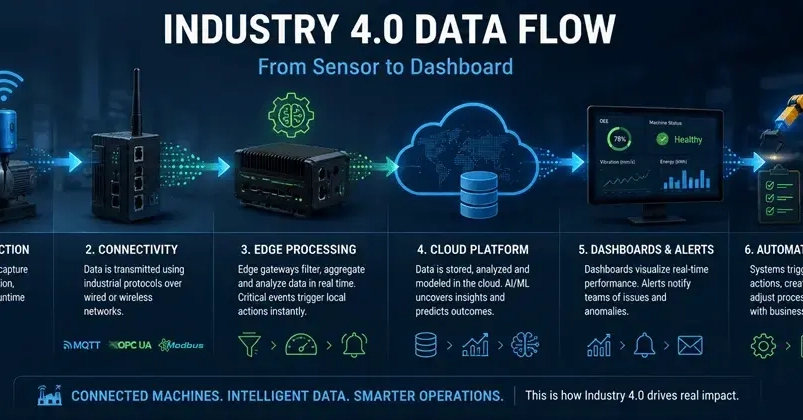
Lessons from hooking up stamping presses, welding cells, and MES without dropping a single byte of data.
If you’ve ever been tasked with trying to feed live sensor data from industrial gear into a modern app architecture, you’ve no doubt learned quickly that the shop floor is not exactly a cloud-native paradise. Automotive component manufacturing, in particular, is where we often get our toughest, most revealing stress tests. Think about it: there’s metal in abundance, wreaking havoc on our wireless signals; machinery hums 24/7, brooking zero downtime; and just one slipped event (like a WIP scan, a worker’s badge swipe, or a machine fault) can break the entire traceability chain, and only get noticed too late.
Here’s what truly matters in architecting a factory data layer.
MQTT for the Noisy Middle Layer
MQTT isn’t the default for industrial IoT for nothing - it's light, robust against shaky connections, and its pub-sub architecture aligns naturally with the many independent units spewing events on a floor (think stampers completing cycles, RFID readers snagging racks, BLE beacons logging worker badgetoes). Where teams often falter is with their QoS configurations. While QoS 0 is perfectly adequate for high-frequency stuff like vibration measurements where a dropped packet can be considered an unfortunate rounding error, you need QoS 1 or 2 for tracing operations - anything part of a genealogy record you can't afford to be incomplete.