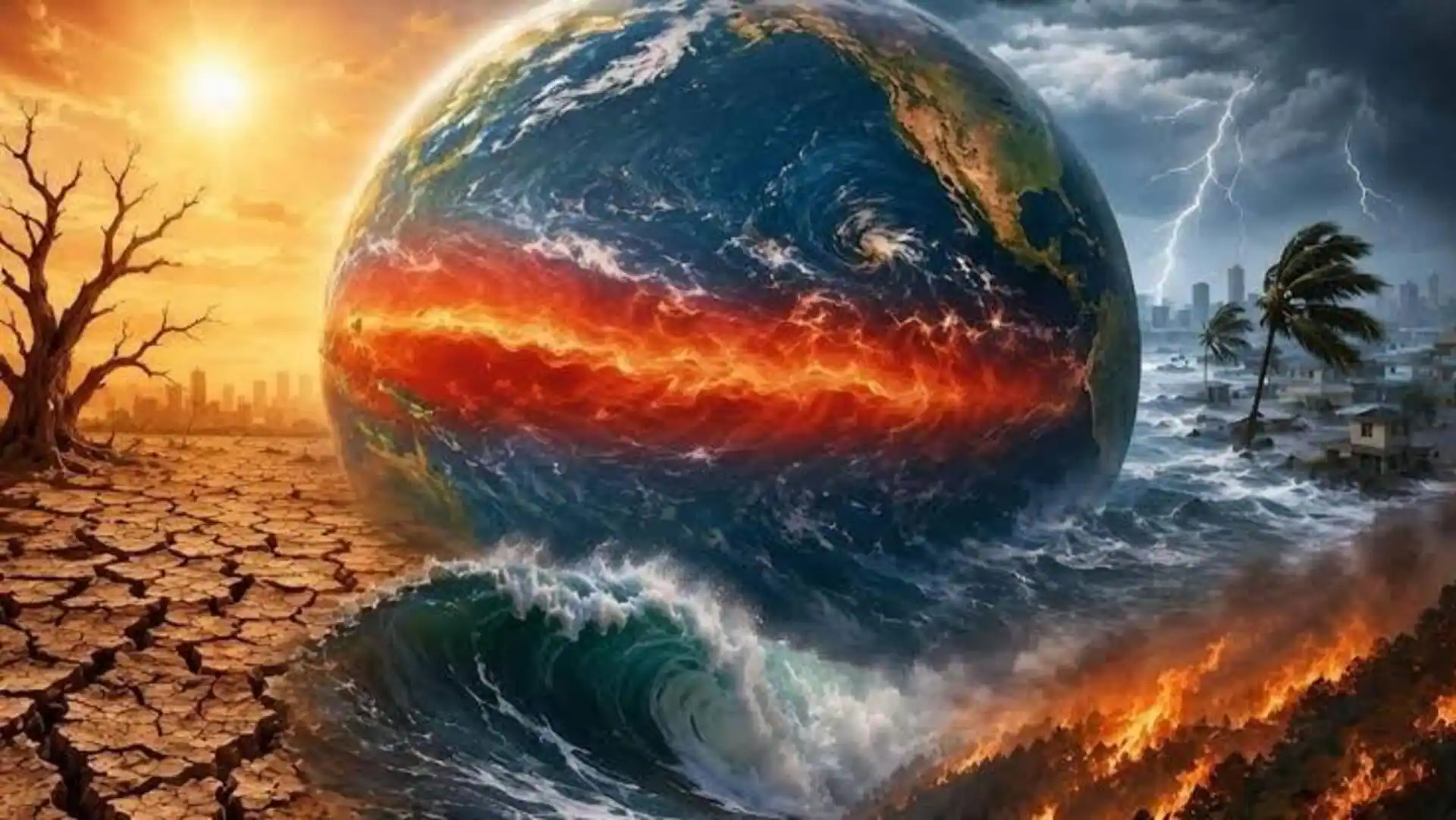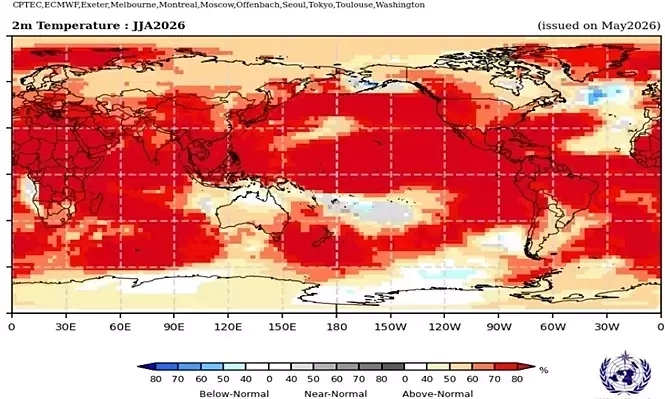
A powerful El Niño already beginning to roil weather around the world may push the monthly global average temperature past 2C of warming for the first time on record, according to projections published by a University of Miami-based ocean and atmospheric research center.The probability that a single month in early 2027 passes 2C has reached 35% to 40%, said Ben Kirtman, dean of the Rosenstiel School of Marine, Atmospheric, and Earth Science at Miami. “That’s a large probability,” he said. “That’s really large, and maybe that’s what people don’t appreciate.”The odds of a month that’s 2C hotter than pre-industrial levels increased significantly in recent weeks as meteorologists upped their estimates for the current El Niño, which is likely to be the strongest in modern history. The hot El Niño is coming on top of a possible acceleration of global warming that scientists are still trying to unpack. This summer has brought record heat and severe wildfires to Europe. As well as pushing up temperatures, the building El Niño is expected to worsen drought and strain food production in some parts of the world.The earliest suggestion that 2C might be a reasonable upper limit for manageable climate change goes back to the mid-1970s. Four decades later, nearly 200 countries agreed in Paris to set it as their goal to limit climate change — while striving to keep heating below 1.5C as a long-term average of 20 years or so.The world may eclipse that stretch goal by the end of this decade, according to the EU’s Copernicus Climate Change Service.“Climate models nail the long-term temperature rise, but aren’t designed to get the exact sequence of year-to-year, and even decade-to-decade, variations,” said Kate Marvel, a climate scientist and the author of Human Nature: Nine Ways to Feel About Our Changing Planet. “The last couple of years have been extremely hot. My hunch is that we’re cleaning up pollution [from aerosols that have a cooling effect] — ‘we’ mostly being China these days — faster than expected and therefore unmasking a lot of the warming caused by greenhouse gases. This explains a lot, but not all of the discrepancy.”Passing 2C of warming for a single month, or 1.5C of warming for the foreseeable future, may be largely symbolic. But as the UN Intergovernmental Panel on Climate Change concluded in its most recent reviews, every increment of warming changes temperatures, precipitation and soil moisture. “Crossing that threshold is important, because very soon we’re going to be measuring: How many months per year are we crossing?” Kirtman said. “The global mean temperature doesn’t seem to move smoothly.”Published on July 27, 2026
El Niño may push global warming to 2C or higher in the short term
El Niño could push global temperatures past 2C in early 2027, raising significant climate change concerns, researchers warn.
435 words~2 min read