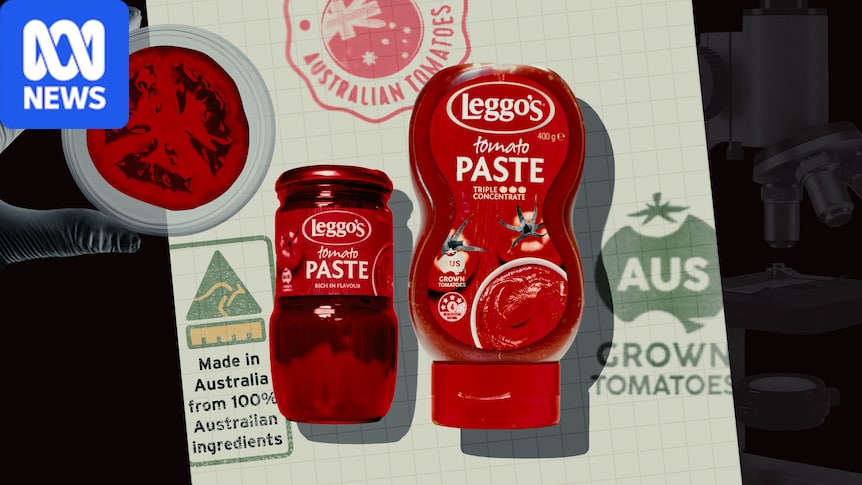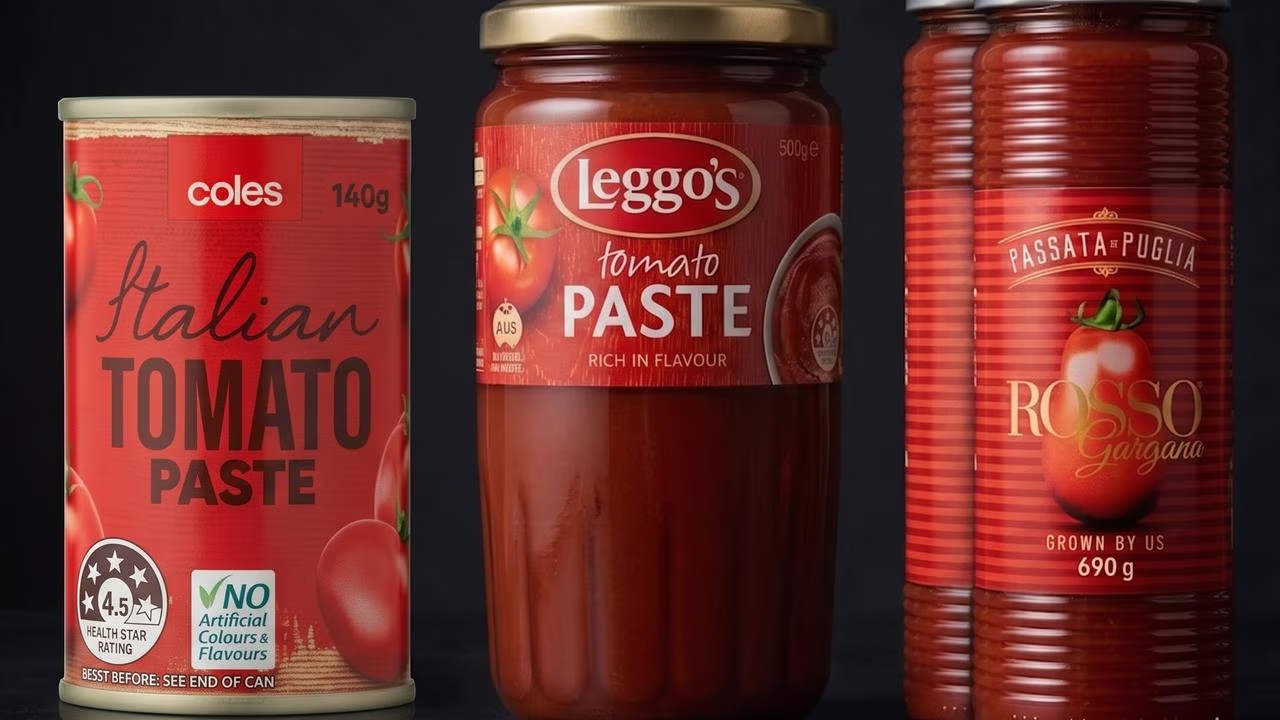
Two supermarkets and one of Australia’s biggest tomato brands have a “major problem” on their hands, after a “disturbing” discovery was made about their products.Tonight, the ABC’s Four Corners will air a story showing how independent scientific testing reveals dozens of tomato paste and passata products in Aussie supermarkets do not match the country of origin stated on their labels.Looking at 221 processed tomato items from 39 brands, the research shows dozens of products that claim to be from Australia or Italy are actually from China, and that roughly half of those are sourced from Xinjiang, an area known internationally for its use of forced labour.Despite prominent claims on its packaging that it sources tomatoes from Australian farms, the research shows the majority of Leggo’s tomato paste products were found to have misleading labels.Coles Italian tomato paste also failed the testing, along with Aldi’s home brand Remano paste.The ABC reports that 22 per cent of the products failed country-of-origin testing, while a further 6 per cent were flagged for further testing. Another product that failed was Rosso Gargano passata, available in Coles.All of the items that failed testing came from China. Of those, the lab traced 53 per cent to Xinjiang — a major global tomato-growing region which has allegations of forced Uyghur labour.The US has already banned imports of tomato products from Xinjiang over forced labour concerns and is pressuring the rest of the world to follow suit.Last week the Trump administration slapped a 12.5 per cent tariff on Australian goods, citing Australia’s failure to effectively ban forced-labour imports.Well-known tomato brands that passed country-of-origin testing include Mutti, SPC, Woolworths, Providore D’Italia and Annalisa. Diced tomato cans and passata from Leggo’s and Coles also passed.In statements sent to news.com.au, US food giant Simplot (which owns Leggo’s), Aldi and Coles have all rejected the findings in the report by calling into question the testing method. ‘Deeply disturbing’: Expert says brands face backlash Professor Jana Bowden, a consumer trust expert at Macquarie University, said the brands highlighted in the report will now face a “major backlash” as customers will be “deeply disturbed” by the findings, particularly over the links to forced labour in China.She told news.com.au that country of origin claims are a critical shortcut shoppers use to evaluate whether a product is ethical, safe and worth their money.“Country of origin deeply affects consumer choice and trust in a product and their perceptions, because it’s used as a heuristic (a mental shortcut) to make a quick judgement: ‘Do I believe in that product? Has it been made ethically? Should I be buying it?’” Prof Bowden said.“The brand has a strong country image associated with it... When consumers are evaluating these elements of a brand’s packaging, they are making assumptions about what that product represents — whether it’s the brand name, the quality stamp, or the ‘grown-in’ stamp on the front.“If a consumer feels like they have been given some form of mistruth about the product — particularly if that consumer is ethically orientated or orientated towards ‘Made in Australia’—elements such as this information will significantly change that consumer’s perception about that brand and whether or not they implicitly trust it.”Even if the product with overseas ingredients is cheaper, she said Aussies will generally be drawn towards the homegrown products at a higher price point.“The interesting thing about country of origin is it’s also tapped directly into consumers’ willingness to pay,” she said. “Consumers do have a preference for Australian-made products, and they are also willing to pay a premium for them if they trust that brand and believe that it is of Australian origin.“Everything about the brand indicates that it is Australian-grown and Australian-made as a product. It has on its front, for example, a logo of Australia and it says ‘Australian grown tomatoes’ — that’s the leading indicator on the front of the Leggo’s pizza sauce product. Then if you flip it over, it’s got the ‘Made in Australia’ logo and says ‘Made from at least 96 per cent Australian ingredients’.”“Consumers use small indicators around the brand — its image, its text, its logos, the extrinsic kind of factors you can see on the packaging — to make their judgments. Leggo’s pizza sauce gives you all of the indicators that it is Australian, and a consumer would know no better if it wasn’t for investigative research.“The fact that this information has come out is going to be deeply disturbing to consumers, who will feel like they have been misled in their judgments of the origins of the ingredients in these particular brands.”Why Gen Z will be put offProf Bowden said Aussies had also become highly ethical buyers in recent years, especially the younger generations, and that links to forced labour would turn them off a product.“If consumers sense that this product is not being ethically produced, or there is a challenge with management of ethical production throughout the supply chain, this will also significantly damage the brand,” she said.“Consumers in Australia are hyper-aware of modern slavery. For example, 75 per cent of Australian consumers agree that their purchasing behaviours—the way that they choose to spend and allocate their dollars — will help eradicate modern slavery and reduce the risk of supply being from an unethical source.“There has been a shift over time... the younger generation, particularly Gen Z, who are the next massive purchasing-power segment of the market, are hyper-ethical. They look to support ethical practice, look for ethical production, and support buying locally made.She said consumers are voting with their feet to support ethical practice. “If there is any sense that these companies are not producing from ethical sources, then that leads to significant brand reputation damage and will lead to market share loss,” she said. “These brands will have to try to claw back consumer trust, and trust is very difficult to gain and very easily lost.“From a consumer psychology perspective, negative information about anything — including a brand or its attributes — weighs much more strongly in the consumer’s mind than positive information. It has a recency effect that tends to stay in the consumer’s mind, affecting their Judgement of that product and any other products made by that brand.”Companies reject findings, testing questionedSimplot, Aldi and Coles have all rejected the findings made in the Four Corners investigation.They all took issue with the testing method used and stood by the claims on their packaging.Four Corners said the testing was conducted by Source Certain, a leading forensic laboratory that has worked with the FBI, Scotland Yard, Interpol and the Australian Federal Police.The company has spent years developing forensic techniques to find out where products such as food, timber and cotton are grown.It analyses a food’s unique chemical fingerprint, left behind by the soil, water and climate where it was grown.Four Corners said absolute certainty is not possible in forensic science, but the laboratory only reports an origin finding when it is sufficiently confident in the evidence.Source Certain said it had more than 98 per cent certainty that the failed tomatoes came from China.Leggo’s owner Simplot said in a statement it takes product integrity, provenance and responsible sourcing “extremely seriously”. “Any impact on the reputation of the Leggo’s brand arising from being named in this program is a matter of significant concern to us,” a spokesman said.“We are confident our Australian Grown claims are accurate and there is nothing in our records to indicate these products are anything other than Australian grown.“We have carefully considered the matters raised by ABC in relation to its upcoming Four Corners program regarding our supply chain and traceability records for tomato paste products. “Our records do not align with the limited information we were provided by the ABC related to their study. We have also engaged with our supplier, who maintains sophisticated traceability capabilities and stands by its Australian grown produce.“To date, despite several requests, neither the ABC nor Source Certain has provided Simplot with access to the underlying testing data, methodology, analytical framework or detailed results of their tests. Without this data, and being presented only with conclusory results, we’re unable to assess the testing approach, or fully understand the basis on which the conclusions were reached.“For all batch codes provided by the ABC, our traceability records and procurement transaction records confirm the tomatoes used in those products were grown in Australia. “We have verified this by tracing the relevant batch codes to their date of manufacture, the individual tomato paste inputs used in production, the supplier’s verified records of those inputs, and down to the very paddock locations where the tomatoes were grown.”He said Simplot maintains comprehensive traceability, supplier verification and audit processes across its supply chain. “We work closely with our suppliers through quality assurance, sourcing verification and compliance programs to ensure our products meet our quality, sourcing and regulatory requirements,” he said.“Leggo’s has been part of Australian homes for more than 100 years and remains a brand Australians know and trust. Simplot is proud to support Australian growers and local manufacturing, and we stand by our Australian Grown credentials. We remain committed to maintaining our high standards of product quality, responsible sourcing and transparency.”Coles and Aldi also rejected the test results, saying they backed their suppliers.“Coles takes food integrity, food labelling and the protection of customers extremely seriously.Coles has no evidence that Chinese tomatoes, including tomatoes from Xinjiang, were used in the Coles Italian Tomato Paste products identified by Four Corners,” a spokesman said.“We strongly reject any suggestion that Coles knowingly misled customers, engaged in food fraud or profited from food fraud.“We do not accept that the testing results presented by Four Corners establish that Coles Italian Tomato Paste contains tomatoes sourced from China or Xinjiang.“Coles has had a trusted relationship with the supplier in question for over 20 years. The product specification requires the tomatoes used in this product to be sourced exclusively from Italy, and the supplier has advised that the product is manufactured in accordance with that specification. “Our supplier has provided detailed batch-specific traceability records, production documentation and supporting evidence to confirm the Italian origin of the tomatoes used, supporting the confidence we have in the integrity of the product and its manufacturer.“As we take food integrity seriously and to confirm the provenance of our own brand tomato paste, we will be commissioning independent testing.”Aldi also issued a statement.“ALDI rejects the claims of Four Corners and Source Certain,” a spokesman said. “ALDI partners with reputable suppliers, who we require to have full evidence of traceability of both raw materials and production of these two products, which are sourced from Italy and Australia. “Our suppliers have assured ALDI that the batch numbers provided contain tomatoes that are sourced from these locations.”The importer of Rosso Gargano also rejected the findings and said it had access to detailed traceability data.Read related topics:Aldi
‘Deeply disturbing’: Expert says Leggo’s, Coles and Aldi have a ‘major problem’ after shock find in tomato products
Two supermarkets and one of Australia’s biggest tomato brands have a “major problem” on their hands, after a “disturbing” discovery was made about their products.
1,803 words~8 min read