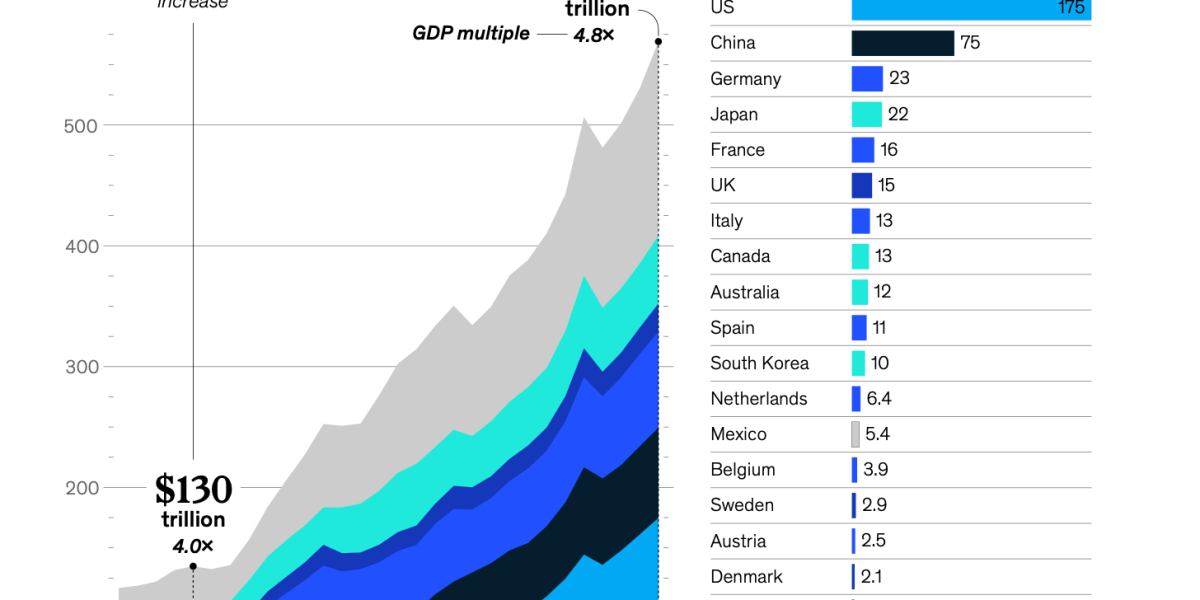
Global households added a record $40 trillion in wealth in 2025, pushing total household net worth to $570 trillion—a 7.3% jump that outpaced the 5.9% average growth rate seen since 2000—as the world’s overall balance sheet of assets swelled to nearly $1.8 quadrillion, according to the McKinsey Global Institute’s newly released “Global Balance Sheet 2026: Imbalance and Divergence” report. These are both record levels, it’s almost needless to say.
This is more than quadruple the value from 2000, at nominal values and market exchange rates, and a faster growth rate than GDP, “posing questions about its health and stability,” McKinsey drily noted, and it’s not uniform across countries.
Household wealth per capita is growing in most countries, but largely not keeping pace with GDP, which the institute attributed to slowing real-estate values, as real estate is the largest component of household wealth in most economies. The U.S. and Australia have the highest wealth per capita and saw household wealth expand by at least 20 percentage points of GDP.
The AI-fueled paper wealth problem
The headline finding is this wealth surge was overwhelmingly a “paper” phenomenon rather than genuine economic expansion. Only about 20% of the new household wealth came from real capital formation—actual investment in productive assets—while equities alone accounted for 57% of new wealth versus just 15% from real estate. That marks a sharp reversal from the historical 2000–2024 pattern, when real estate drove the majority of wealth gains.