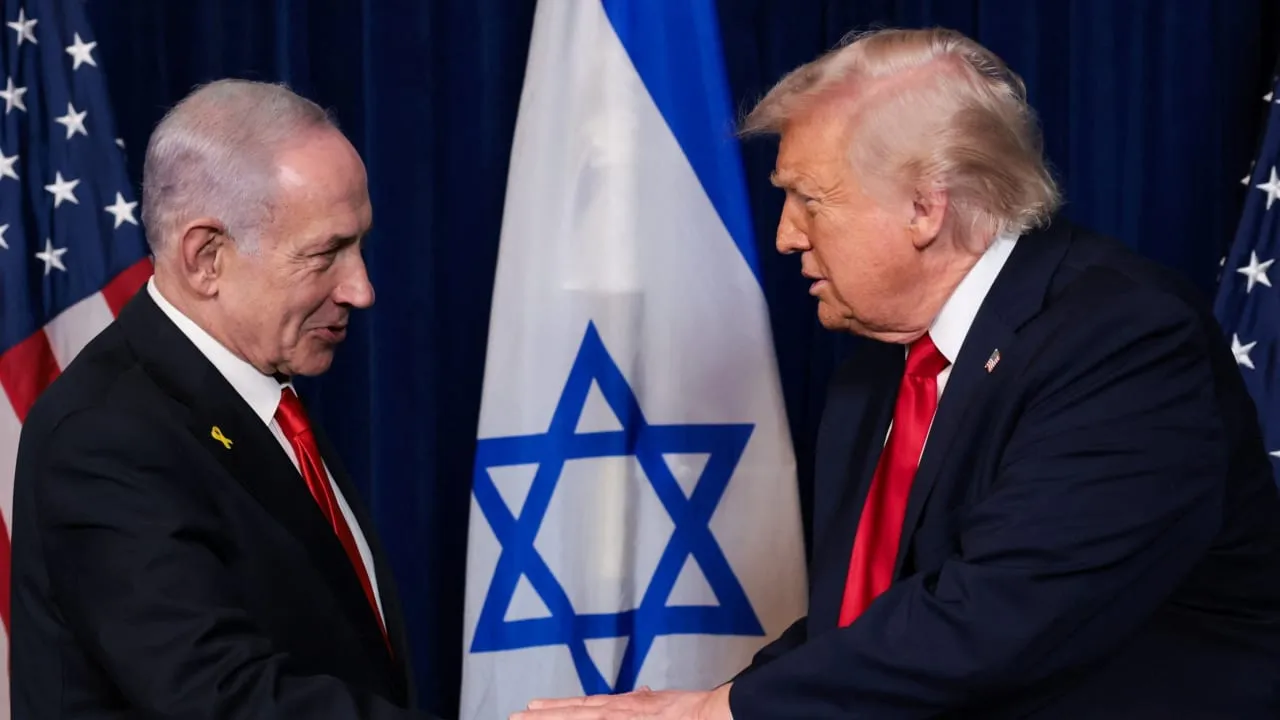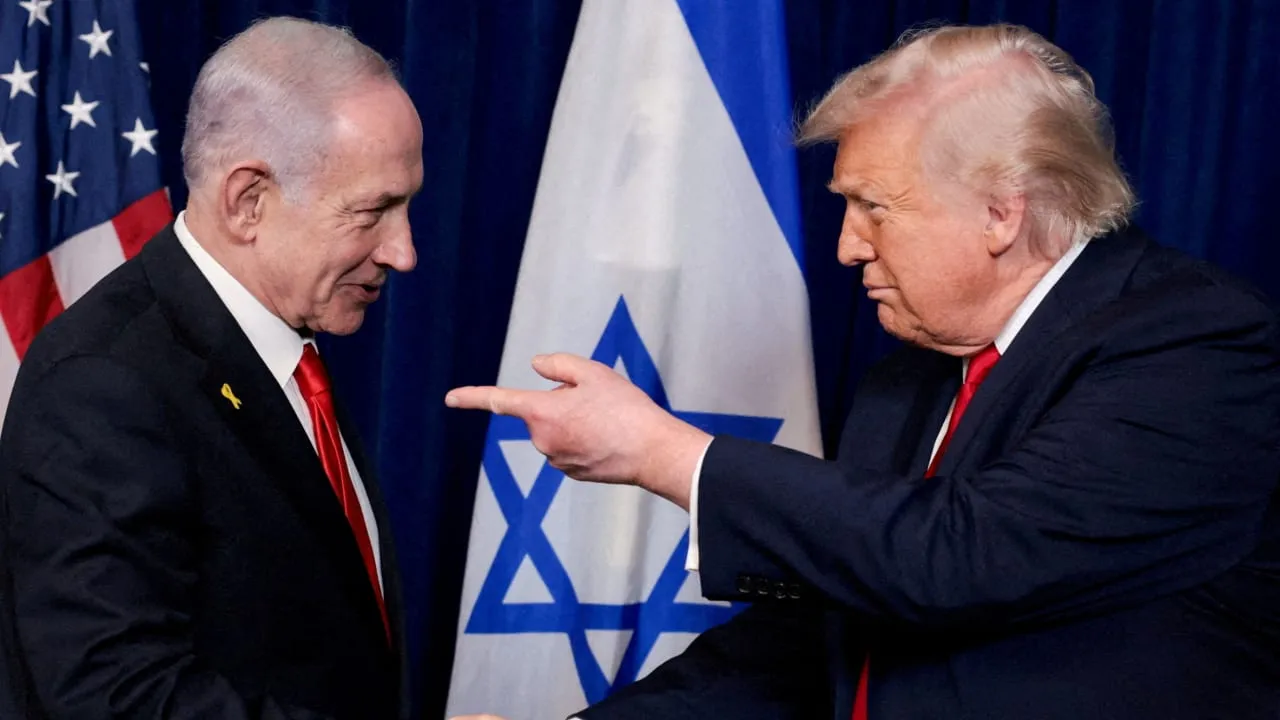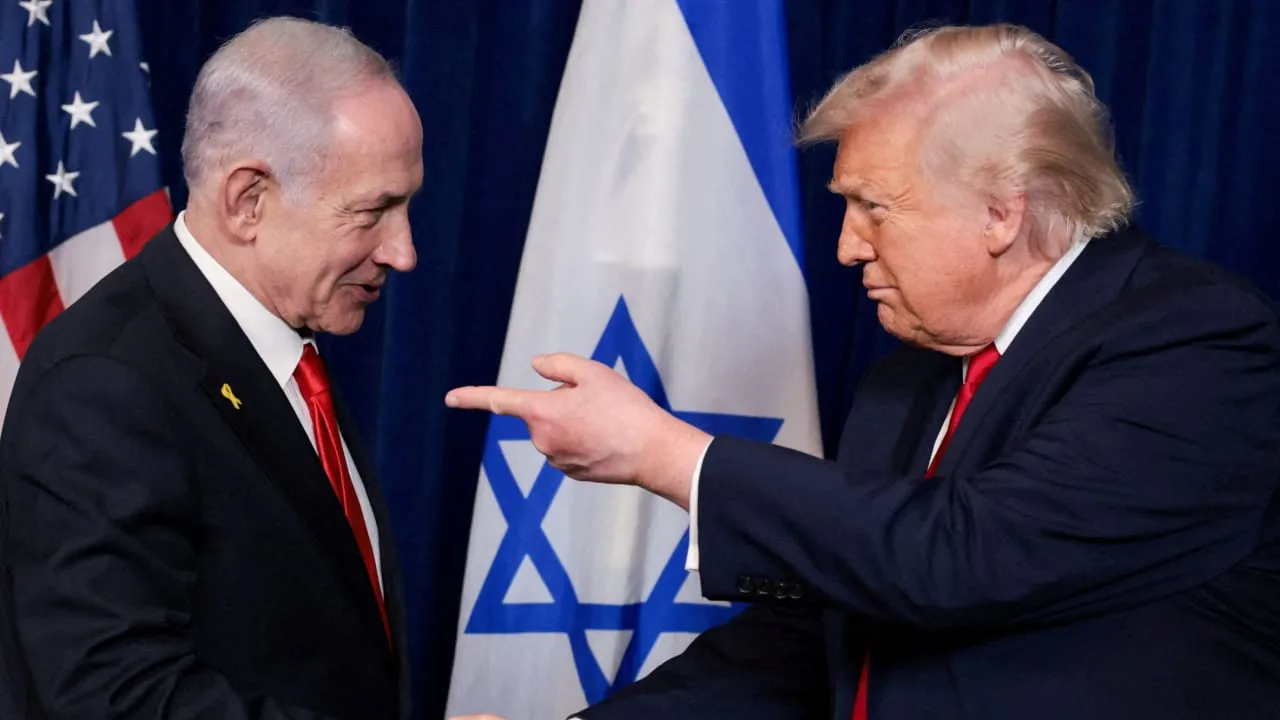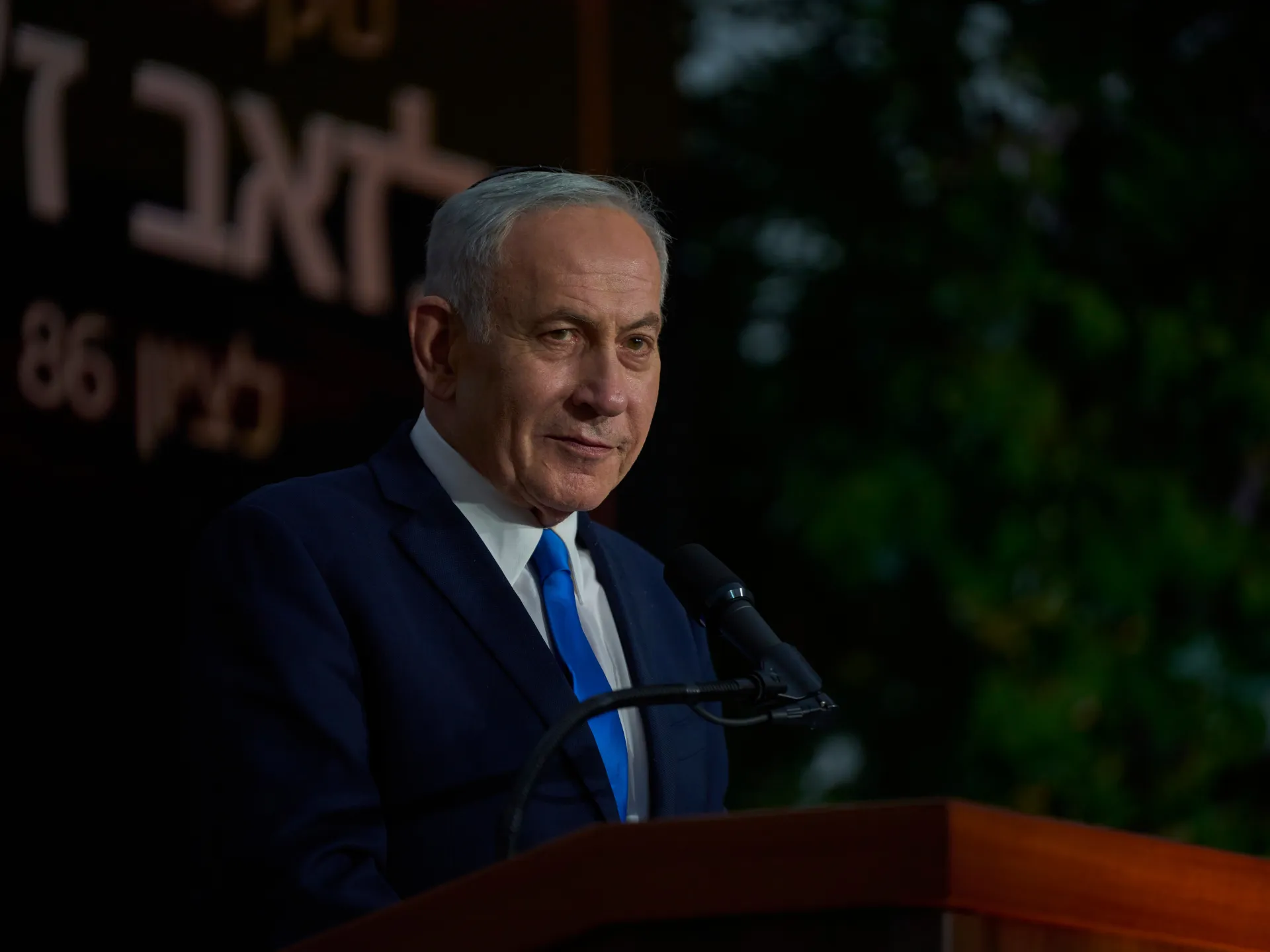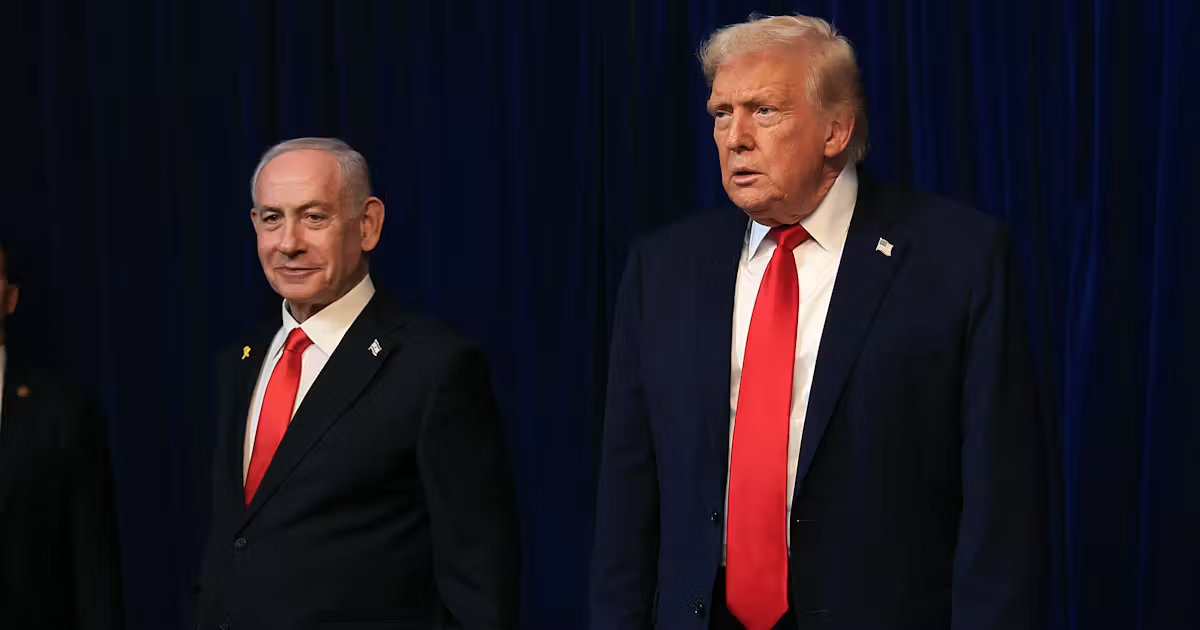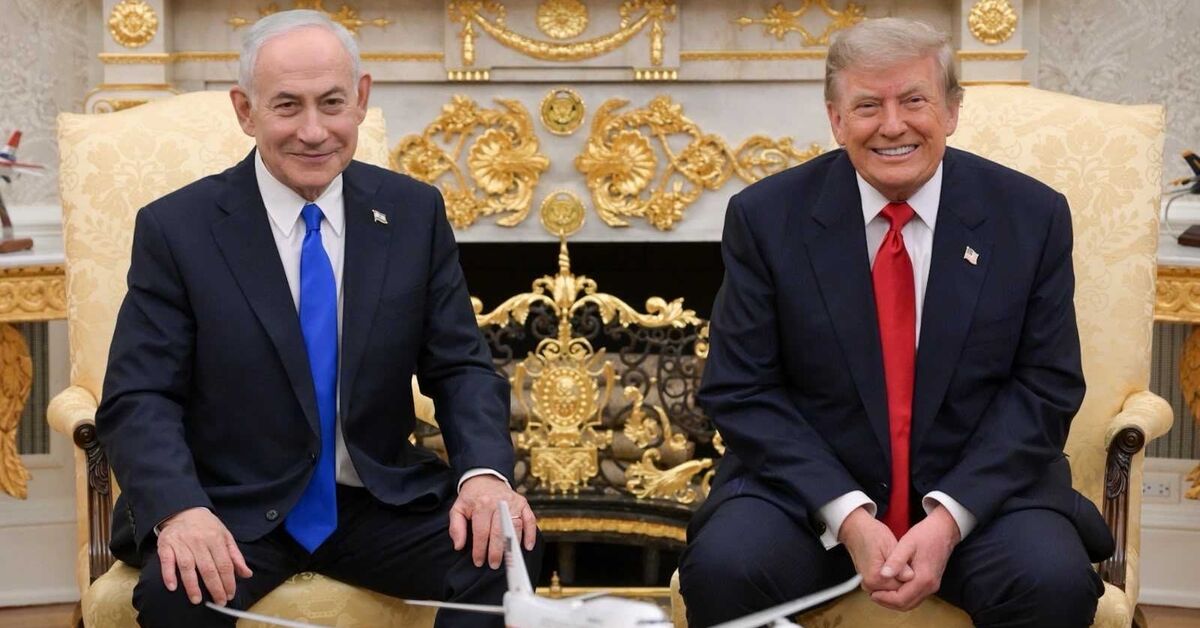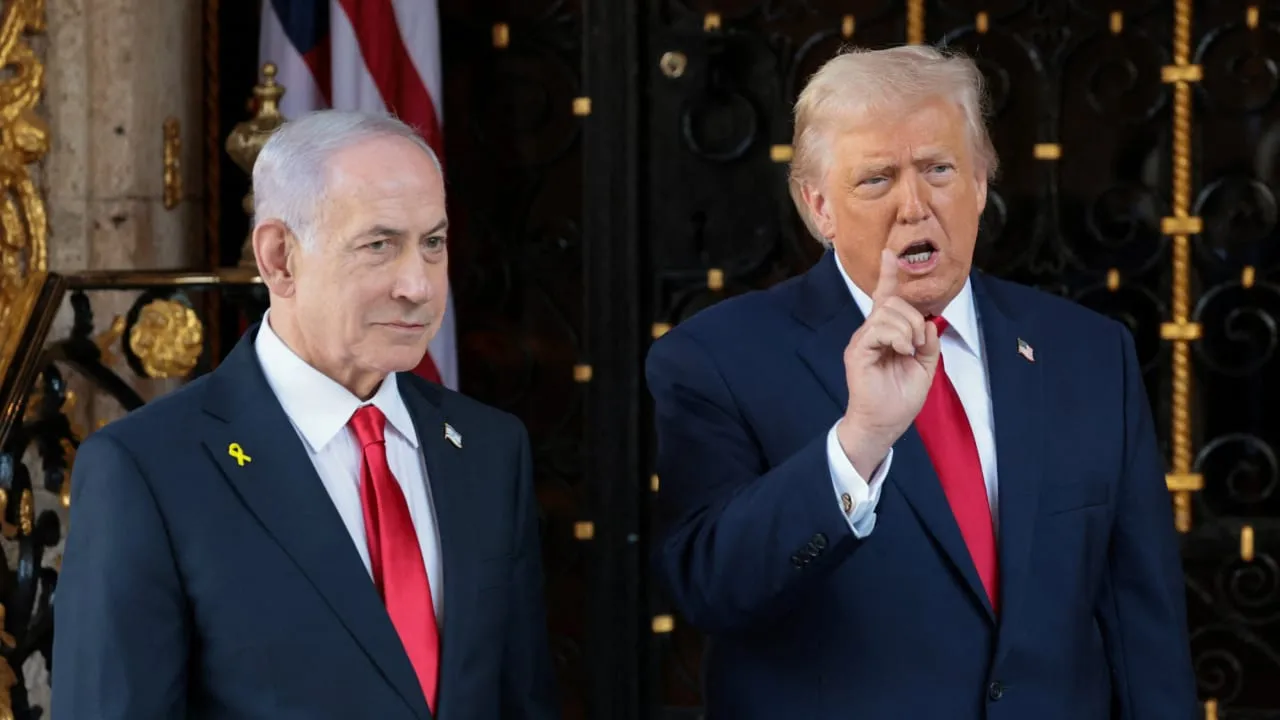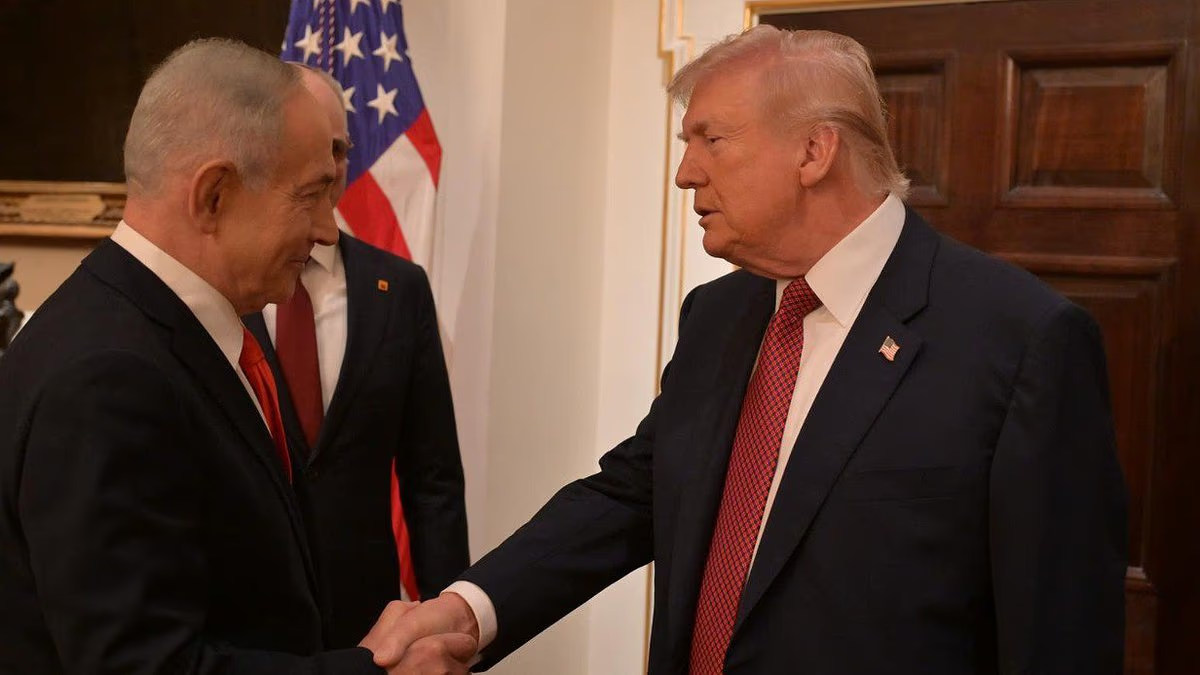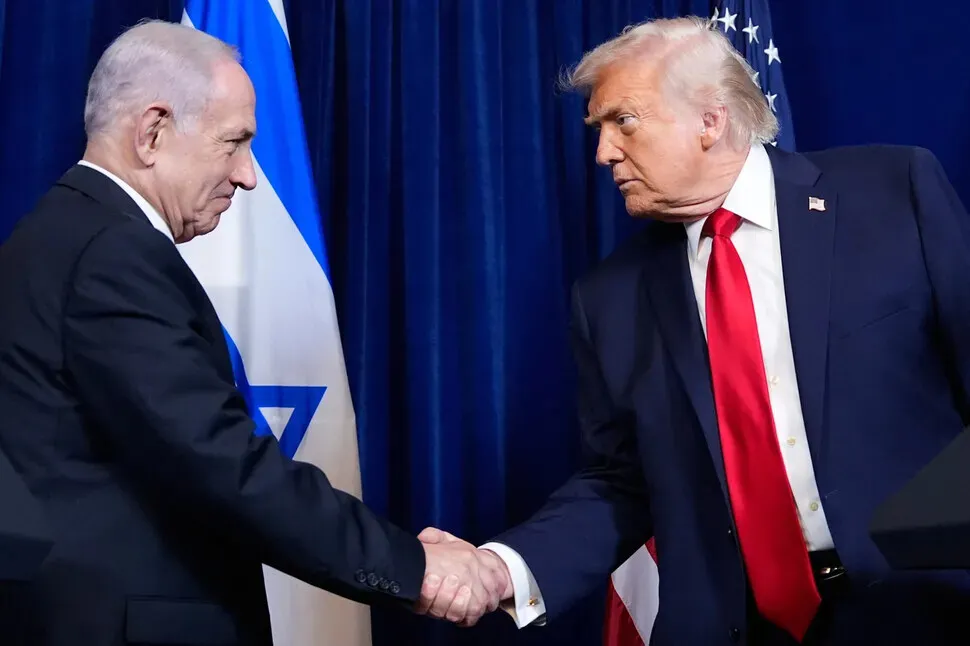
Prime Minister Benjamin Netanyahu shakes hands with US President Donald Trump following a joint press conference after a summit at Mar-a-Lago in Palm Beach, Florida, on Dec. 29, 2025. (AP/Yonhap)
How was Israeli Prime Minister Benjamin Netanyahu able to persuade US President Donald Trump to go to war with Iran?Netanyahu didn’t seal the deal all at once. Rather, that was the outcome of a meticulous scheme that involved supporting Trump’s bid in the 2024 presidential election with the help of conservative Zionists and Israeli companies. The scheme centered on exercising the political influence of those conservative supporters of Israel to insert a new class of neoconservatives into the foreign policy and national security teams in Trump’s second administration.Those same figures were among the writers of Project 2025, the policy primer for a potential second Trump administration that the Heritage Foundation, a conservative think tank, prepared before the 2024 election.As soon as Trump returned to the White House last January, a Washington-based think tank called the Vandenberg Coalition released a report proposing a new approach to foreign policy. The report was titled “Deals of the Century: Solving the Middle East.”The report amounted to a neocon manifesto for Trump’s second term, arguing that the US should provide Israel with even more military aid and adopt a fundamentally different stance toward Iran.This was a hardcore roadmap calculated to nudge Trump away from his isolationist campaign pledge to stay out of foreign military adventures.The report said the US’ top priority is to “deter Iran’s nuclear weapons ambitions” and raised concerns about China’s growing influence in the Middle East, while pushing for China to be named America’s chief adversary. In short, the Vandenberg Coalition emphasized that Iran and China were the main foreign policy challenges for Trump’s second term.The Vandenberg Coalition’s reports have been repeatedly consulted at the highest levels of the US government over the past year. Notably, concrete measures for implementing its proposals were prepared for Trump’s consideration by White House deputy chief of staff Stephen Miller, Secretary of State Marco Rubio, UN Ambassador Mike Waltz, former deputy national security adviser Alex Wong, and Elbridge Colby, the undersecretary of defense for policy. In the end, the coalition’s strategic focus is on containing China. It has asserted in reports that bringing the government of Venezuela into the American sphere of influence could weaken Chinese influence in the Western Hemisphere, for which Venezuela had served as a foothold.The US believes that if its diplomatic and military resources are concentrated in other areas, the US can effectively check the expansion of Chinese influence in critical areas such as the Middle East. That’s part of a multi-phase initiative for undermining China’s global influence. Some analysts think that Trump’s war on Iran was intended to lay the groundwork for his visit to Beijing.Trump’s power-oriented approach to foreign policy has been formalized in a “destroy and deal” model of behavior that’s even more aggressive, and less predictable, than before.The Vandenberg Coalition, established in 2021, advocates interventionist foreign policy and increased defense spending. In 2025, the organization published numerous reports on Venezuela and Iran, encouraging the arrest of Venezuelan President Nicolás Maduro and attacking Iran. Elliott Abrams, a prominent neoconservative, is the founder and chairperson of the Vandenberg Coalition. He is an enthusiastic proponent of interventionism, believing that establishing US-friendly regimes in the Middle East is the best, most surefire way to rid the world of terrorists, and a core figure of the neoconservative movement who doggedly supported the US’ invasion of Iraq in 2003. He was also convicted for his involvement in the Iran-Contra scandal. Throughout Obama’s eight years in office, Abrams was a senior fellow of the Council on Foreign Relations, during which time he argued that Obama’s foreign policy doctrine of “leading from behind” was weakening US influence. He strongly criticized Obama’s attempts to normalize relations with Cuba and Iran, accusing Obama of reaching out to enemies. Even after the blowback of the Iraq War became impossible to ignore, Abrams continued to pontificate on the civil war in Syria and the Israel-Palestine conflict, regrouping the neocons that had been scattered after Iraq. In 2019, during Trump’s first term in office, Abrams was appointed as the US special representative for Iran and Venezuela, making a comeback to public office. Abrams shares a special bond with Israeli Prime Minister Benjamin Netanyahu. I once had the opportunity to meet Abrams in person at the 2007 APEC forum. Upon learning that I was Korean, Abrams said, “Since China, Iran and North Korea are working together, the US, Israel and South Korea need to work together when it comes to national security.” When Trump championed isolationism during his 2024 presidential campaign, claiming that there would be no new wars, Abrams brought on various neocon strategists at the Vandenberg Coalition, making them join the Heritage Foundation’s Project 2025 planning team. Abrams holds no official position in Trump’s second administration but nonetheless enjoys influence as a behind-the-scenes adviser and analyst providing theoretical guidance on Middle East policy. Above all else, the new class of neoconservatives that serve in key roles in the Trump administration under Abrams’ leadership, wields formidable power. Many close Trump aides are among the new neoconservatives who align with Abrams — Stephen Miller, Michael Waltz, and Marco Rubio. In the Senate, Sen. Ted Cruz (R-Texas), Sen. Lindsey Graham (R-South Carolina), and Sen. Tom Cotton (R-Arkansas) are new neocons who support Abrams’ agenda. Other notable new neocons include US Trade Representative Jamieson Greer, Brian Cavanaugh (nominee for undersecretary of homeland security), Earl Matthews (Defense Department general counsel), Morgan Ortagus (deputy US special envoy to the Middle East), and US Ambassador to Israel Mike Huckabee. David Milstein, a senior adviser to Huckabee who is a staunch supporter of Israel and an influential figure in the White House as the pillar of the MAGA movement, is also the stepson of Fox News host and conservative commentator Mark Levin, whom Trump has shown unwavering trust in. Furthermore, Elbridge Colby, a familiar face in Korea, is the son of Abrams’ sister-in-law. While neocons once greatly influenced US foreign policy, they appeared to have vanished from Washington following the catastrophe of the Iraq War, with John Bolton being the last of his kind. However, they have quietly burrowed their way deep into the heart of the Trump administration by championing the long-standing strategy of an Israel-centric Middle East policy. These new neocons have combined Trump’s “America First” principle with their staunch belief in interventionism to forge a new hawkish policy. They no longer advocate for the spread of democracy, a slogan championed by old neocons. Instead, they are leading Trump’s second-term foreign and security policies by focusing on subjugation and deals sealed with overwhelming force. By prioritizing pragmatism over values, they have captured Trump’s attention by setting the goal of effectively neutralizing adversaries — in other words, China.