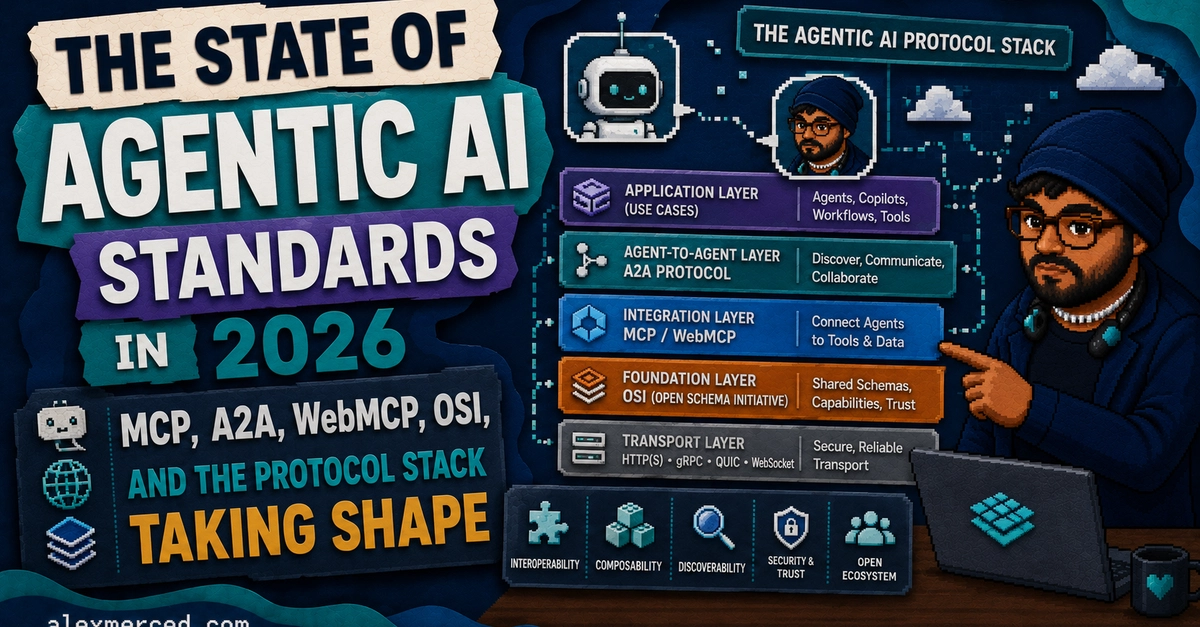
TL;DR:Modern AI agents rely on shared protocols to connect with tools, apps, APIs, data, users, and other agents. AI-native standards such as MCP, A2A, AG-UI, ACP, and ANP define how agentic systems communicate and collaborate, while established technologies like OpenAPI, OAuth 2.0, JSON Schema, OpenTelemetry, LSP, and JSON-RPC provide the underlying infrastructure. Together, these protocols form the interoperability stack behind today’s AI applications, multi-agent systems, coding tools, and enterprise workflows.The reality today is that AI agents can't work in isolation anymore. They need tools, they need to “talk” to and work with other agents, and they need access to your apps, APIs, and files.To make all of that work together, every system needs to speak the same language. And protocols solve this problems. An AI protocol is a shared set of rules that lets AI systems communicate, exchange information, and work together in a standardized way. Together, many protocols form the communication stack that powers modern AI agents. Some, like MCP, A2A, and AG-UI, were built specifically for AI. Others, such as OpenAPI, OAuth, JSON Schema, and JSON-RPC, weren't originally designed for AI but have become the foundation that today's agentic systems are built on.In this guide, we'll explore the 11 most important protocols every AI builder should know ‒ and where each one fits in the modern AI stack.AI Protocols at a GlanceProtocol or standardWhat it connectsPrimary purposeBest suited forMCP ‒ Model Context ProtocolAIapplication ↔ tools and dataStandardized access to tools, prompts, resources, files, APIs, and servicesTool-using agents, AI applications, coding tools and enterprise integrationsA2A ‒ Agent2Agent ProtocolAgent ↔ agentAgent discovery, messaging, task delegation and cross-platform collaborationMulti-agent systems and interoperable agent servicesAgent Control ProtocolAgent ↔ existing application UIAllows agents to understand and operate application interfaces through structured manifests and commandsConversational application control and UI automationAG-UI ‒ Agent–User Interaction ProtocolAgent backend ↔ frontendReal-time streaming, shared state, UI events, interrupts and multimodal interactionInteractive agent applications and human-in-the-loop workflowsANP ‒ Agent Network ProtocolAgent ↔ open agent networkDecentralized identity, discovery, secure messaging and cross-domain collaborationOpen agent networks and the proposed Agentic WebLSP ‒ Language Server ProtocolCode editor ↔ language serverCode intelligence such as diagnostics, navigation, completion and refactoringAI coding tools, IDEs and repository navigationOpenAPIAgent or application ↔ HTTP APIMachine-readable descriptions of API endpoints, parameters, authentication and responsesTool generation and API integrationOAuth 2.0Agent or application ↔ protected serviceDelegated, scoped and revocable authorizationSecure access to user accounts and external servicesOpenTelemetry for GenAIAI system ↔ observability backendStandardized traces, metrics and events for model and agent activityDebugging, monitoring, evaluation and cost analysisJSON SchemaSystem ↔ structured dataDescribes and validates the expected shape of JSON dataTool arguments, structured outputs and configurationJSON-RPC 2.0Client ↔ remote procedureLightweight request, response and notification messagingProtocol foundations, including MCP and agent communicationAI-native protocolsMCP ‒ Model Context ProtocolMCP is an open protocol created by Anthropic that standardizes how AI models and agents connect to external tools, APIs, databases, files, and services through a common interface. MCP has become the de facto standard for tool use and is an absolute must-have for anyone building AI agents. It is actually one of the most widely used and in-demand protocols, supported across numerous AI apps and tools, such as Claude, ChatGPT, VS Code, and Cursor.A2A ‒ Agent2Agent ProtocolAgent2Agent Protocol initiated by Google standardizes how independent AI agents discover one another, exchange messages, delegate tasks, and collaborate securely across different frameworks and vendors. A2A enables seamless agent-to-agent communication and interoperability. That’s why it is an essential protocol for anyone building multi-agent systems. A2A is like the next step beyond single-agent applications and build collaborative multi-agent systems that can work together across platforms without sharing the same underlying framework, model, or provider.ACP ‒ Agent Control ProtocolACP standardizes how AI agents interact with existing applications through their user interfaces. With ACP, you can automate workflows across applications that were never originally designed for AI. It is because ACP allows agents to understand an application’s UI through a structured manifest, without any dedicated integrations, and perform actions much like a human user would.AG-UI – Agent–User Interaction ProtocolAG-UI protocol standardizes how AI agents communicate with frontend applications and interact with users in real time. It handles things like streaming responses, syncing state, reacting to UI events, and supporting multimodal interactions through a common interface. It helps developers build more responsive and interactive agent experiences, allowing agents and application interfaces to stay coordinated throughout complex, multi-step workflows.ANP – Agent Network ProtocolANP is an open protocol for discovering, identifying, and connecting AI agents across the open internet. It haven't reached the same level of adoption as MCP or A2A but it is very promising, because it aims to create a decentralized "Agentic Web," where agents can securely find each other, exchange messages, and collaborate across platforms.Standards that became essential for AILSP – Language Server ProtocolLSP is the protocol that lets code editors talk to language servers and get features like autocomplete, error diagnostics, go-to-definition, documentation on hover, and refactoring. Originally developed by Microsoft, it means the same language server can work across multiple editors instead of rebuilding these features for every tool. Overall, LSP gives AI coding tools a much better way to understand and navigate your code.OpenAPIOpenAPI is the industry-standard specification for describing HTTP APIs. AI agents use OpenAPI documents to automatically discover and understand available endpoints, parameters, authentication requirements, and response formats, making it easier to integrate with external services.OAuth for AgentsThe OAuth 2.0 authorization framework isn't AI-specific, but it has become a foundational protocol for AI agents. It is what lets AI agents securely access third-party services on a user’s behalf without ever seeing or storing their password. The user grants limited access through a token that can be scoped and revoked. As agents increasingly connect to external tools, OAuth has become a key building block for ecosystems like MCP and A2A.OpenTelemetry AIOpenTelemetry AI extends OpenTelemetry to LLMs and AI agents, giving you a standard way to collect traces, logs, and metrics across your AI applications. It lets you see what your agents are doing, spot bottlenecks, and debug complex workflows, all without being tied to a specific observability platform.JSON SchemaJSON Schema gives AI systems a shared way to describe and validate structured data. It defines what fields are allowed, which ones are required, and what format each value should follow. It is very useful in practice, because it helps models return reliable structured outputs and lets agents call tools with the right parameters, keeping data consistent across different systems.JSON-RPC 2.0It is an open protocol for remote procedure calls that defines how applications exchange requests, responses, and notifications using JSON. Its simplicity and transport-agnostic design have made it a popular foundation for AI systems, including the Model Context Protocol (MCP), where it standardizes communication between clients, servers, and tools.FAQWhat are AI agent protocols?AI agent protocols are shared technical rules that define how agents communicate with tools, other agents, applications, users, and external services. They standardize areas such as discovery, message formats, tool calls, authentication, streaming, task state and structured outputs.What is the most important AI protocol for developers?MCP is currently one of the most important protocols for developers building tool-using AI applications because it provides a common interface between AI hosts and external tools or data sources. However, it does not replace every other protocol. Builders may also need A2A for agent collaboration, AG-UI for frontend interaction, and OAuth for secure authorization.What is the difference between MCP and A2A?MCP primarily connects an AI application or agent to tools, resources and external context. A2A connects independent agents to one another. In practice, an agent could use A2A to delegate a task to another agent, while each agent uses MCP to access its own tools and data.Can MCP, A2A and AG-UI be used together?Yes. The three protocols address different layers of an agent system. MCP can connect agents to tools, A2A can coordinate work between agents, and AG-UI can stream progress and state to the user interface. A production agent application may use all three.Are OpenAPI, OAuth and JSON Schema AI protocols?They were not created specifically for AI, but they have become essential parts of the agentic stack. OpenAPI helps agents understand APIs, OAuth provides delegated authorization, and JSON Schema defines reliable tool parameters and structured outputs. These established standards often support or complement newer AI-native protocols.to get unique content on every social media
AI Protocols Every Builder Should Know
From MCP and A2A to OAuth, OpenAPI, and JSON-RPC - 11 protocols and standards powering AI agents, tools and infrastructure.
TL;DRAI
MCP is the de facto standard for AI agent tool-use, adopted by Claude, ChatGPT, VS Code, and Cursor. These 11 protocols form the interoperability stack for agent systems—builders ignoring them risk isolated infrastructure without cross-vendor collaboration.
1,379 words~6 min read