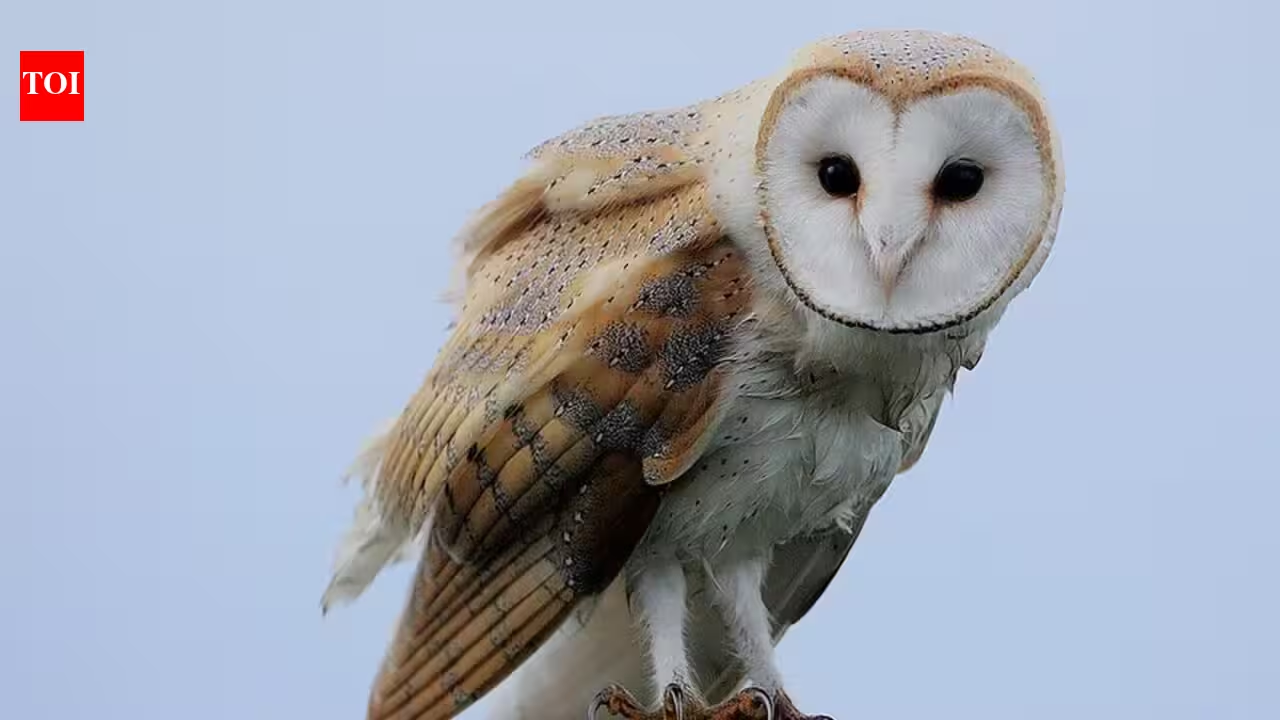
In 1958, Hawaii introduced barn owls to control rats in sugarcane fields; the owls spread across the islands and began killing endangered seabirds. Image Credits: Wikimedia Commons.In the late 1950s, Hawaii brought in a predator to fight a pest. Barn owls were introduced to the islands as a biological-control measure against rats, which were considered a serious threat to the sugar industry. The plan appeared straightforward: release a natural hunter and allow it to reduce the rodent population.But the owls did not remain focused on rats. They established breeding populations, spread across the Hawaiian Islands and began hunting native seabirds. Some of their victims included endangered species whose populations were already under pressure from introduced predators, habitat loss and other threats.A study published in Marine Ornithology documented 379 cases of barn owl predation involving eight seabird species in Hawaii between 2011 and 2018. The victims included Newell’s Shearwaters and Hawaiian Petrels, both protected under the US Endangered Species Act. More recent research using DNA analysis has suggested that conventional monitoring may underestimate how frequently the owls prey on seabirds.An owl released to protect the sugar industryAccording to the above research, barn owls (Tyto alba) were introduced to Hawaii in the late 1950s by the Hawaii Department of Agriculture as a biological control for rats, which were seen as a threat to sugarcane production. The initial introductions were done on Kauai, Oahu and Hawaii islands; and after that on Molokai. The idea was simple: instead of relying entirely on chemicals to control pests, introduce their natural predators.Barn Owls appeared to be a logical choice. They are skilled nocturnal hunters and commonly prey on rodents. But island ecosystems can be particularly vulnerable to introduced predators. Native species that evolved in isolation may have little experience with newly arrived hunters, while predators introduced for one purpose can encounter prey that was never part of the original plan. The owls also proved capable of moving beyond the areas where they had been released.From rats to endangered seabirdsLater research showed that the problem was not limited to isolated incidents. A study published in Marine Ornithology also notes that researchers from the Kaua‘i Endangered Seabird Recovery Project examined records collected during seabird monitoring on Kaua‘i and the nearby islets of Lehua and Moku‘ae‘ae. Between January 2011 and October 2018, they recorded 379 cases of Barn Owl predation involving eight seabird species. The most frequently recorded victims were Wedge-tailed Shearwaters, Black Noddies and Bulwer’s Petrels.But the records also included Newell’s Shearwaters and Hawaiian Petrels, two species listed under the US Endangered Species Act. Most of the birds were adults, which matters because the loss of breeding adults can have serious consequences for vulnerable populations. The researchers observed Barn Owls hunting adult seabirds in flight, entering burrows and killing birds near nesting sites. The owls also appeared capable of targeting areas where seabirds gathered. On Lehua Islet, researchers found numerous dead Black Noddies in an area near a sea cave where the birds bred. On another islet, 21 adult Bulwer’s Petrels were found dead during one survey.In a more recent study published in the Journal of Heredity, researchers used DNA metabarcoding to analyse swab samples from 55 Barn Owls captured on Kauai and Lehua. They detected DNA from six seabird taxa, including the endangered Hawaiian Petrel and Newell’s Shearwater. DNA from the two endangered species was found in 12 swabs from 11 owls. By comparison, conventional examination of stomach contents detected seabird remains in only one owl. The researchers said the results suggest that traditional methods may underestimate how often barn owls prey on seabirds.Newell’s Shearwaters and Hawaiian Petrels being hunted down by Barn owls. Now these two species listed under the US Endangered Species Act. Image credits: Wikimedia Commons.A biological-control plan with an unexpected target The Hawaii case shows that a predator introduced for one purpose may not remain focused on its intended pest or habitat. Introduced predators can also interact with local wildlife in ways that were not anticipated at the outset. The problem is especially acute on islands, where many seabirds nest in burrows or on small islets and may have few defences against an introduced aerial predator. Barn Owls can also move between islands and breeding areas, making it difficult to protect individual colonies by controlling owls in only one location.Another complication involves the relationship between rats and Barn Owls. Removing rats can benefit seabirds by reducing predation on their eggs and chicks. However, if rats form part of the owls' available prey, their removal could also alter the food available to Barn Owls and potentially affect what other prey they target. This makes predator management particularly complex in island ecosystems, where efforts to control one introduced species can influence the behaviour and ecological effects of another.
In 1958, Hawaii introduced barn owls to control rats in sugarcane fields; the owls spread across the islands and began killing endangered seabirds
In the late 1950s, Hawaii brought in a predator to fight a pest. Barn owls were introduced to the islands as a biological-control measure against rats, which were considered a serious threat to the sugar industry.
793 words~4 min read