Most developers spend nearly half their working hours debugging. That's not a productivity failure — it's the nature of software. But modern debugging has evolved far beyond adding console.log statements and hoping for the best. Today's systems are distributed, asynchronous, and layered in ways that make traditional debugging habits feel painfully inadequate against the complexity they were never designed to handle.
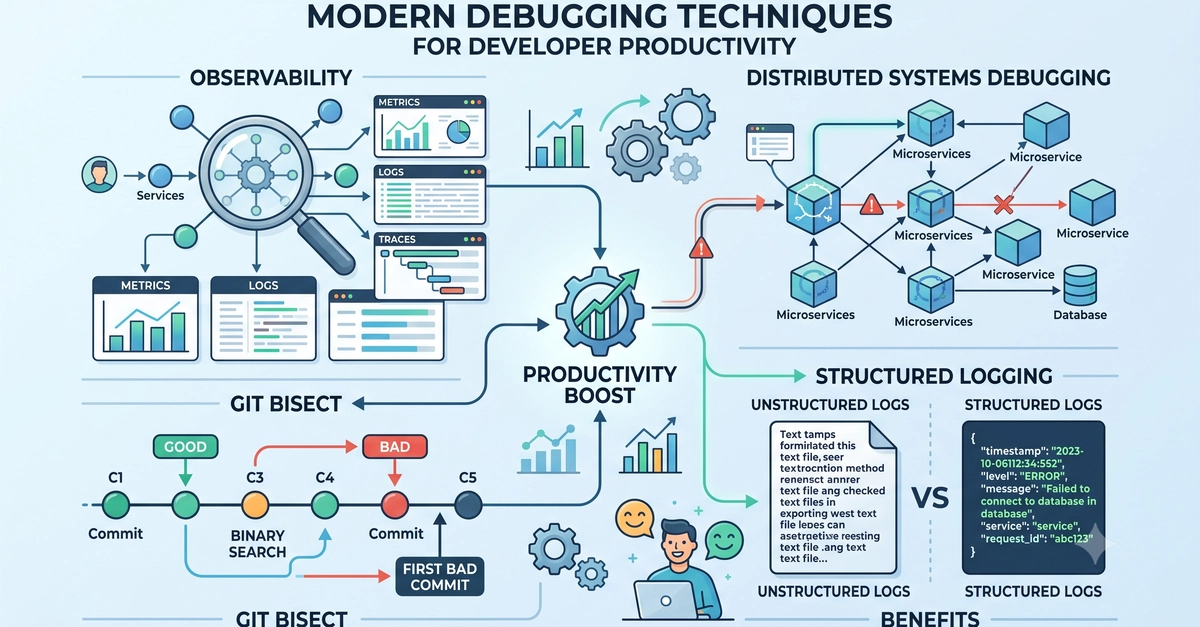
This article walks through practical, proven techniques for tracking down bugs in both development and production environments — from structured logging and binary search strategies to distributed tracing and using debuggers the way they were actually designed to be used.
Why Bugs Hide Better in Modern Systems
Bugs don't just hide in your code anymore. They hide in network latency, race conditions, configuration drift, and the emergent behavior that surfaces when three microservices communicate under load. A defect that's perfectly reproducible on your laptop might vanish entirely in a staging environment and reappear two weeks later in production under a specific, hard-to-replicate sequence of user actions.
This isn't a bug in your system — it's the nature of complexity. The more moving parts a system has, the more surface area bugs have to hide in. State becomes harder to reason about, causality becomes harder to trace, and the mental model you hold in your head inevitably diverges from what's actually running. That gap is where bugs live.