Show Caption
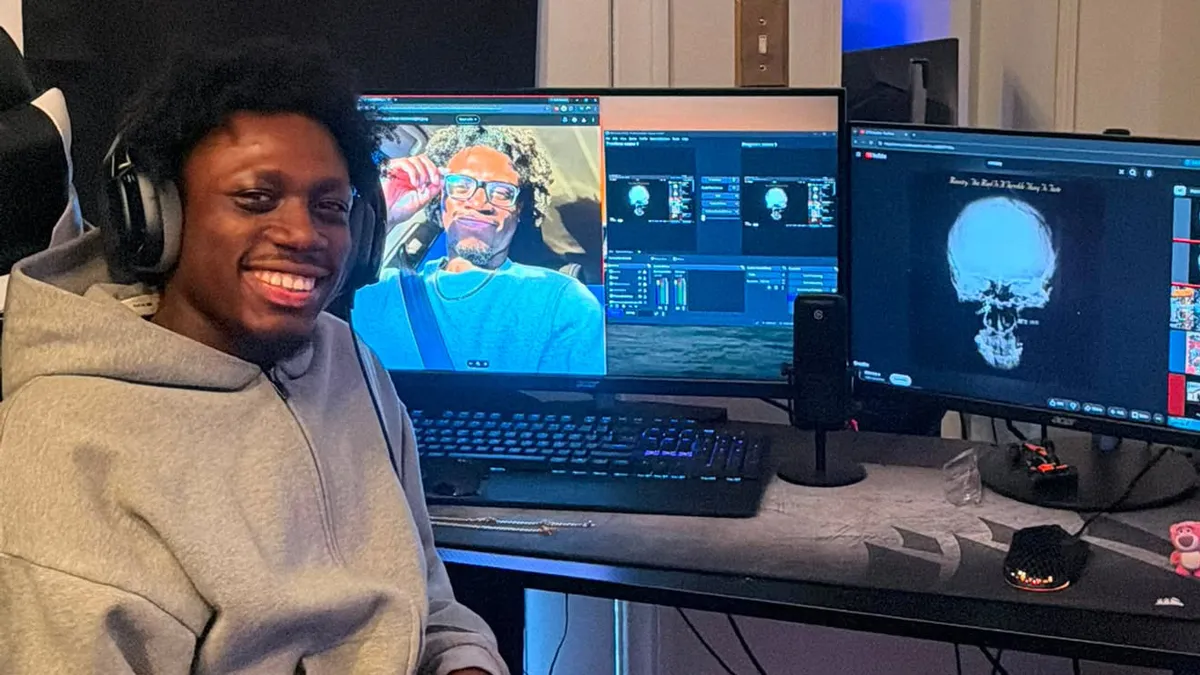
On Jan. 19, 2026, Isaiah Turner posted a simple Instagram video of himself listening to Slipknot for the first time.The caption was just a few words: "Who's next?"Fans of the band flooded the comments with recommendations, launching Turner on a crash course in music history that stretched from metal and punk to electronica and indie. The 22-year-old became an unlikely traveler through genres that many spend decades discovering.What began as reaction videos evolved into something larger: a community where strangers swap memories, recommend favorite songs and find common ground across generations and backgrounds."Music transcends race, age and culture," Turner says. "Music brings everyone together."Within months, Turner, better known online as ThatKidZayy, had amassed more than 100,000 followers eager to join the journey. As a young Black creator exploring genres often coded as white, Turner has become a reminder that music's boundaries are far less rigid than culture sometimes suggests.A musical universe outside InglewoodTurner was born and raised in Inglewood, California, a Los Angeles enclave that’s roughly 40% Black. The neighborhood has featured prominently in the history of West Coast hip hop, helping launch the careers of some of the genre’s most iconic artists, from Snoop Dogg and Dr. Dre to Mack 10 and D Smoke.Turner tells me his music taste prior to posting his reaction videos was primarily '90s and early 2000s R&B, adding that Michael Jackson is his “all-time favorite.”"So my dad, when it comes to music, he's the one that's more, he's Funkadelic, Parliament, he likes a lot of jazz, so he likes Buddy Miles. He likes instruments more than words, so I listen to Marcus Miller," Turner says of the legendary bass player. "But on my mom's side, we have The Temptations, Michael Jackson, James Brown."Now, ThatKidZayy is being guided by his followers into subgenres and communities historically created and consumed by white folks. As one person commented on a video of freak folk hero, Joanna Newsom, "This dude is getting a PhD in white people music."Bridging music's manufactured racial divideAccording to Dr. Reiland Rabaka, a faculty affiliate in the University of Colorado Boulder's musicology department and professor of African, African American, and Caribbean Studies, Turner's identity as a young Black man is part of the allure.“Part of what makes Zayy’s videos so compelling is that viewers are watching someone cross a boundary they have been taught to regard as natural,” Rabaka tells me. “Rock, punk, hardcore, metal, and indie music have become culturally coded as White, even though rock and roll grew substantially from the blues, jump blues, rhythm and blues, boogie-woogie, and gospel,” all of which belong to the pantheon of Black music history.Rabaka says that Turner’s “presence quietly exposes the instability of those racial categories,” which have historically been manufactured by record labels and marketing executives.“The music industry helped teach Americans to hear music racially,” Rabaka says. “Earlier in the 20th century, companies marketed ‘race records’ toward Black consumers and ‘hillbilly’ music toward White consumers, even though musicians regularly borrowed from one another and often drew on overlapping Southern traditions.”Turner similarly recognizes that both his race and his age play into his appeal. He may be 22, but the older factions of his community have taken him in as one of their own. "You are a 80's baby at heart I just know it!" someone commented on a Blondie song. A Fleetwood Mac reaction got another to share, "My first 45 when I was a kid. Loved this song the second I heard it on the radio. I think I was 10. She's been my no 1 fave ever since.""We don't see a lot of people my age, my race listen to Heart or Dillinger Escape Plan or Ministry," Turner says. "And so I think that plays a role to where it's like, they appreciate how I'm willing to give something they have a chance, at least. And I love that because like I said, we need more of that in the world."When 'curiosity carries political meaning'There’s something almost transgressive about Turner’s identity set against this sonic backdrop. Rabaka argues this is because Turner actively eschews the “narrow script that assigns racial identity a predetermined soundtrack.”“He is not necessarily making an overt political declaration, but his curiosity carries political meaning,” Rabaka says. “He demonstrates that Black identity is not diminished by musical exploration.”But there’s a historical, and some might argue insidious, irony to all of this. The very foundation of rock and roll –– and by extension, much of the music Turner is reacting to –– was laid by Black artists, including Sister Rosetta Tharpe, Chuck Berry, Bo Diddley and Little Richard. The modern history of rock, punk and metal is similarly full of Black pioneers. Most notably the D.C. hardcore punk outfit, Bad Brains, as well as Pure Hell, Death, Poly Styrene and ESG.“Scholars have argued that treating punk as an essentially White subculture erases a far more complicated and multiracial history,” Rabaka says. “This means that Zayy appears to be crossing a racial boundary, but he is also revealing that the boundary was historically manufactured.”An authentic, organic communityOf course, it would be a gross oversimplification to chalk Turner’s success up to race alone. He has built an organic community, essentially inviting strangers into his room and offering anyone the aux cord who wants it.“Race creates an element of surprise because American culture has trained audiences to expect young Black men to identify primarily with rap and R&B. But surprise alone cannot explain his success,” Rabaka says. “People remain because he appears curious, emotionally available, humorous, and willing to listen without condescension. His openness gives viewers permission to experience familiar music as new again.”Rabaka adds: “They are watching someone encounter music that shaped their identities, perhaps music that helped them survive adolescence, loneliness, anger, alienation, or grief. When he responds enthusiastically, their private attachment feels publicly affirmed.”The response can be deeply personal.After Turner danced his way through a Stereolab song, one viewer shared that his joy reminded them of two friends who loved the band and later died of cancer."Thank you for bringing me those happy memories," the commenter wrote.It’s a phenomenon that Turner is well aware of, and something he enjoys tapping into.“The intent behind my content is to share my experience listening to these new songs with people, while at the same time giving them a similar experience to when they first heard it,” he says. “Sometimes it's other people's first time hearing it with me so it's a fun learning experience as well."Turner's joy when discovering new music is undeniable and his genuine reactions contrast starkly with the carefully curated "authenticity" of social media. Sometimes he’ll spring out of his chair in a fit of ecstasy, jump on the bed or do an impromptu headstand. Other times he’ll brace himself in his chair, as if the track's raw, unadulterated emotion threatens to knock him over. If the song is particularly "fire," in the parlance of the day, he'll flick on a lighter.While the majority of the comments on Turner's videos are people recommending new artists and songs, or sharing their love of whatever is featured, others pay respect to the content creator and community he's fostered."I really enjoy watching you on your musical journey," wrote one follower on a video of Turner reacting to The National. "Love this for you" wrote another as he dug into Bright Eyes.His reaction to Stereolab was nothing short of infectious. "That's how you bring the joy of Stereolab to dance," "Yeah baby!" "You're an awesome guy," "This account gives me so much joy.""Honestly, I never thought it would be what it is right now," Turner tells me. "It feels like I have the influence to bring different ages, races, generations together. And that's a very wholesome, warm feeling."He adds, "Just for me listening to music, I'm able to create such a positive thing on the internet or out in the world where today, there's not a lot of that –– especially Instagram, that's very not positive at times –– so I just feel very, yeah, just like I'm able to bring people together."A place where everyone participatesFor how unequivocal his reactions are, Turner's community is equally democratic, and everyone has a part to play.“The way I pick the songs can vary,” Turner explains. “It can be based on if the comment has a lot of likes, how many times the song or band has been commented, sometimes I'll randomly pick or sometimes I'll go through direct messages and choose.”These methods, Rabaka says, transform Turner’s Instagram profile into a “digital record store, listening party, oral history, and neighborhood conversation all at once.”“Zayy’s account turns musical recommendation into a form of communal participation. His followers are not simply consuming his content; they are helping construct its direction. Each recommendation says, in effect, ‘This music matters to me. Enter this world and tell me what you hear.’”It's not just fans who recognize the value of what Turner's created. Numerous artists and bands have reposted the content or left a comment on it, including Jack Black, Erykah Badu, singer-songwriter Cat Power and Pete Kember, aka Sonic Boom of the proto-shoegaze group, Spacemen 3.Simon Raymonde, who co-founded the seminal Scottish indie band Cocteau Twins, reached out personally after Turner started listening to his work.“As Instagram (the only social media I mildly enjoy) has now become a cavalcade of talking heads reviewing new music, discussing latest releases, etc., it is doubly refreshing to come across Zayy’s unique profile,” Raymonde tells me. “Unique because we, the watcher, are seeing his ‘live’ reactions to each piece of music he lines up to digest. What we see therefore is 100% authentic, unscripted, unedited reaction to someone truly listening.”He went on to say, “Zayy’s reactions reminds us of why we love to listen to music, discover something new, to expand our minds and our emotions, and for those of us lucky enough to make music too, it is the greatest affirmation for why it is so important.”Invitational vs. exclusionaryTurner’s forays into increasingly obscure genres and bands also carries significant weight, especially considering the elitism and gatekeeping that pervade some underground scenes.“Subcultural knowledge often carries social value. Knowing a little-known band or an obscure subgenre can establish credibility inside a scene,” Rabaka says. “But Zayy makes that knowledge invitational rather than merely exclusionary. His followers can demonstrate expertise while also welcoming someone else into the community.”It's a response that Turner never expected."I genuinely love the community that came from this," Turner says. "When I was doing this, I didn't expect them to take me in so easily because like we said, I'm a young Black kid from Inglewood listening to dominantly white music, older music. So for them to be open arms, as much as I am to their music, is all full circle. I appreciate them a lot."Drew Pittock covers national trending news for USA TODAY. He can be reached at DPittock@usatodayco.com.