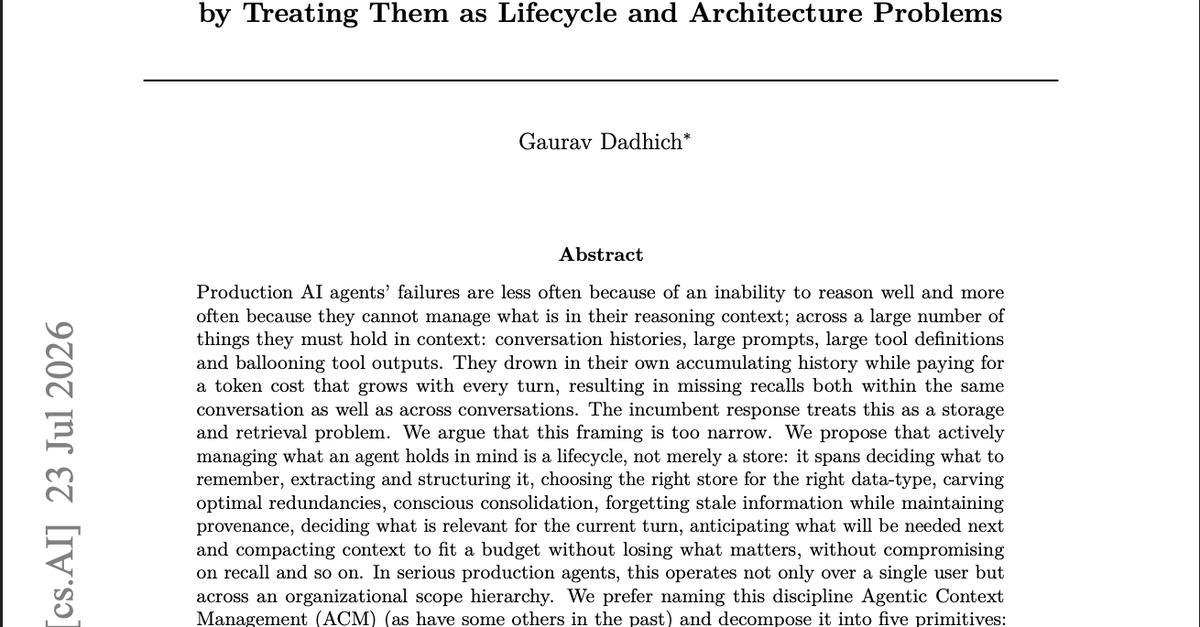
Most teams building AI agents are treating memory and inference cost as something the next model release will eventually fix. They believe that a bigger context window, a smarter retriever, a cheaper token rate, etc. would absolve the need for a system for solving agent memory.
This posture is convenient but it is wrong. What an agent remembers, when it forgets, and how much it costs to reason are architectural decisions. They get made long before any model is involved, and no amount of model improvement fixes a bad architecture underneath it.
Memory is a lifecycle, not a buffer
Most agent systems today treat context as one shared blob: everything goes in, nothing meaningfully comes out, and the "solution" to running out of room is a bigger window. That is not a memory system, it is a pile.
A lifecycle approach breaks this into stages that each need their own design: