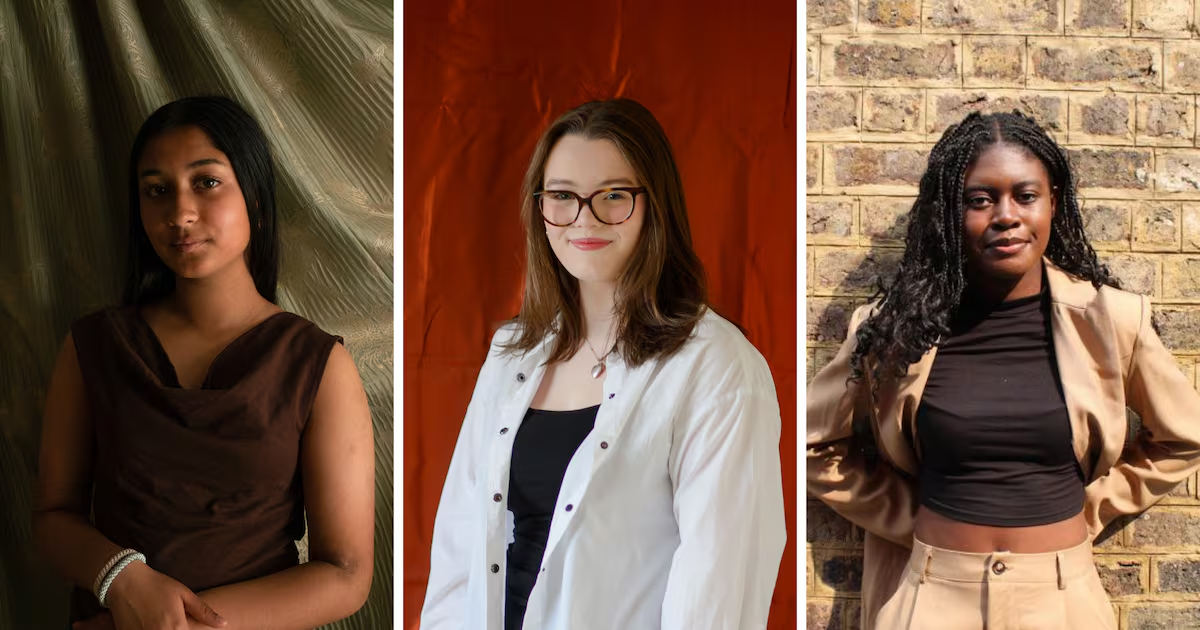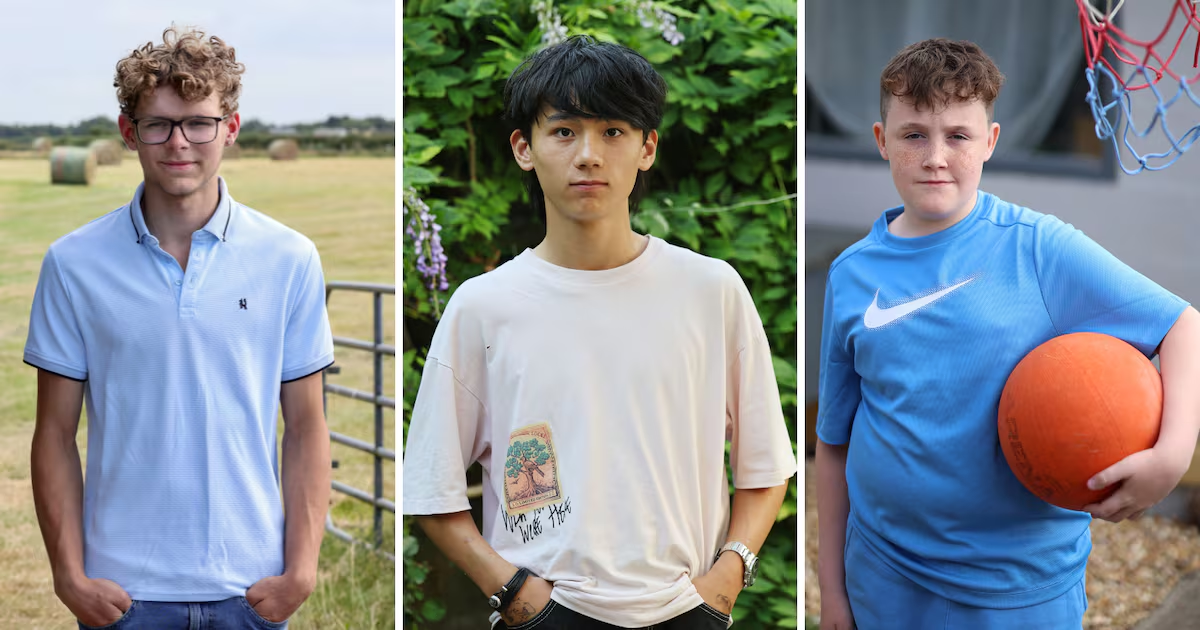
It is an otherwise average day in a secondary school in Tallaght, Dublin and a 14-year-old boy is cowering in the bathroom stalls as a group of three boys stand outside taunting him. They claw at the door of his stall trying to open it, and tell him they will rip the mushroom-shaped earrings out of his ears when he comes out.Richard McKeever-Burke, who is now 18 and has since identified as nonbinary, recalls that it was a “scary, claustrophobic” experience waiting for the boys to leave.However, Richard doesn’t blame those boys now. “They were kids. They thought they were different to me, and that meant something was wrong when it wasn ’t. Richard McKeever-Burke (18): 'The idea of manhood that was instilled in me was don’t talk about your feelings, be the brave man.' Photograph: Dara Mac Dónaill “I don’t hold them to it because I think it’s based on their surroundings, who they had growing up, their parental figures, and their points of view are very much put on to them,” Richard says. While time has given Richard the luxury of perspective and forgiveness, these casual acts of cruelty among teenage boys are something that come up quite frequently in the ones we spoke to. Routine name-calling, squaring up physically and threats of violence, however vacuous, are reported by most of the teenage boys we speak to. Nothing new there, you might think – except now, they cannot escape it.When they come home from school the bullying continues in the social media worlds of their phones. On top of that, they are pushed a particularly toxic version of masculinity by the pervasive manosphere influencers whom they do not necessarily seek out. [ Where is Ireland’s manosphere?Opens in new window ]In the midst of all this turmoil, there is one common denominator: they tell no one about how they feel, what happens in the school corridors, their confusion over what some social media influencers are telling them and their perception of what it means to be a man. The experience of being a teenage boy in Ireland appears to be a particularly lonely one.Loneliness/isolationJamie White (18): 'Most of the time I just kind of deal with it myself.' Photograph: Joe O'Shaughnessy Jamie White (18), from Corofin in Co Galway, has just finished fifth year at a coeducational school in Tuam and is working in construction for the summer. He says he gets “picked on a lot” by other boys because he has more friends who are girls than boys. “I have got called gay lots of times” because of this, he says, by “everyone”. “I don’t really care because deep down I know what I am. I’m straight male.” Does he talk to anyone about this so-called “slagging”, which appears to happen frequently?“Most of the time I just kind of deal with it myself. I don’t like to be bothering people with my mental health issues. I would feel like I’m just annoying them, or just like bothering them sometimes,” Jamie says.This propensity to protect other people from his own suffering is exemplified over the course of our interview when he only reveals, 40 minutes into the conversation, that his father died following a workplace accident just over two years ago when Jamie was 15.“I don’t make a big deal of it. It’s kind of just a part of me at this point,” he says, before acknowledging the huge impact of this trauma on him: “I’m such a different person than I was those two years ago.”Nathanael Wei Cassidy, a 16-year-old from Ballymitty in Co Wexford, says boys “definitely talk less about how they feel than girls do”.“I have friends who are girls, and I remember telling them, ‘No, we don’t talk about our feelings,’ and they were all very shocked, saying we must be very lonely.”When boys see things on their phones that might be confusing, such as influencers spouting certain world views, they do not talk among themselves about the merits of those opinions, he says.“It’s not that boys don’t ever talk, it’s just that they don’t talk as much [as girls]. They certainly don’t talk about those things like what they watch. They don’t really question it with other people. They question it with themselves, but not with other people.”It is in this vacuum of debate and discussion that boys are often targeted with toxic ideas around masculinity, sexuality and the different expectations they should have of men and women. Over the course of these interviews, three out of four boys bring up Andrew Tate without being directly asked about him. Tate is a British-American influencer and self-proclaimed misogynist who targets young men and boys with his sexist ideologies on social media platforms. This week Tate and his brother Tristan were arrested in the US in connection with a British police investigation into a number of alleged sexual offences.The pervasiveness of his content is apparent in the stories these teenagers tell.Social mediaNathanael Wei Cassidy (16): 'I remember [Andrew Tate] had a certain charisma, and I could see why people would fall for it.' Photograph: Alan Betson Nathanael first got a TikTok account in sixth class of primary school. It started with a lot of “harmless stuff” coming up on his feed, such as videos on history and music. But there was also “the odd Andrew Tate video”, which increased in frequency as he got older. While he believes many other boys he knew would have been presented with Tate’s content at the same time as him, none of them spoke about it to each other.“A lot of it was him talking about how things should be, like how the man should work and the woman should stay at home and cook or whatever, and I didn’t agree with that. But I remember he had a certain charisma, and I could see why people would fall for it,” he says.“I wasn’t influenced by him, but I feel like I was close. I could have been, very easily.” He recounts a period when he was a young teenager and struggled to get his head around the idea of men being gay, and for a time believing it was wrong. “I began consuming that kind of media, a lot of the right-wing media saying [homosexuality] was wrong, and I also have a religious background, so I thought was it wrong then to be [gay],” he remembers. He also admits to feeling “confused” about it at the time, and receiving “mixed messages” about it. “It was a very unhappy, very confusing time,” he says.[ Teenage boys ‘bombarded’ with misogynist content within minutes of signing up to TikTok and YouTube ShortsOpens in new window ]“You’re in a vulnerable position. You’re young and you’re alone. I feel like that’s where people start to get hateful ideas.”Now he can see his negative thoughts about gay people were “distorted and one-sided”. This became apparent when he went to a bigger secondary school, and later made friends with people who were gay, bisexual and transgender.“I think if I consumed more Andrew Tate media or more of that manosphere right-wing stuff, I could have been a very different person,” he says.Jacob O’Keefe (13): '[Some friends] began to act tougher around different people, and they were just more mean.' Photograph: Dara Mac Dónaill In an effort to keep him away from social media, Jacob O’Keeffe’s parents have promised him a sum of money on his 17th birthday if he stays off it until then.The 13-year-old, who has just finished first year in secondary school in Corduff, west Dublin, is quite happy with that deal – for now, at least.“There’s nothing special about social media, in my opinion. You don’t need it. If you want to have it, and you’re allowed to have it, then go ahead and have it. But there’s no need to have it,” he says.He has a group chat with his friends on WhatsApp, and he is allowed to watch YouTube and play Fifa on PlayStation with his friends online.‘He’s not changing who he is. He’s not being a negative person just to please other people, and that makes me very proud’— Linda, Jacob's motherMost of his peers use Snapchat and TikTok, and he has noticed they use “more slang words” which he doesn’t understand. Other than that, he doesn’t see any difference between their lives and his, and thinks it “hasn’t really changed them”. Many of Jacob’s closest friends live in the same estate as him, and they meet up regularly after school and over the holidays. Some of his friendships have changed over the past couple of years, when he noticed a difference in how some of his friends behaved. “They began to act tougher around different people, and they were just more mean,” Jacob says. He thinks some older groups of teenage boys influence some of the younger boys into behaving this way. He calls them “yup bros”.“They usually wear tracksuits, and they have a buzz-cut haircut. They all have them e-scooters and e-bikes,” Jacob says.[ E-scooters: The proposed ban, the penalties, the mandatory equipment explainedOpens in new window ]The huge prevalence of e-scooters and e-bikes among children in Jacob’s area led his school to email all parents saying they were banned from the school grounds. Jacob’s mother, Linda, says she is very proud of him for “removing himself away from people that are making these wrong choices” and she feels “very lucky”.“He’s not changing who he is. He’s not being a negative person just to please other people, and that makes me very proud,” Linda says.EducationJacob O’Keefe: 'There’s nothing special about social media.' Photograph: Dara Mac Dónaill While navigating friendships and social hierarchies was an issue for some of these teenagers, others struggled with the academic demands of school.For Jacob, he was nervous about going into secondary school because he feared the work would be much harder, the exams more onerous and the subjects too vast.“I hate exams because I don’t like studying. I feel like studying’s boring, but I have to do it, and then if I don’t I’ll do badly in exams, then I’ll be worrying about the exams over the summer or the winter,” he says.In Jamie’s case, his dyslexia “made the experience of school definitely a little bit worse” because “my reading and writing is very difficult,” he says.[ Netflix hit Adolescence gets a lot wrong about the reality of boys’ strugglesOpens in new window ]While he got a dispensation from Irish, and could use a laptop in his Junior Cycle exams, the focus on written exams in the curriculum did not suit him and led to some frustration.“I think school is meant for a certain group of people, the people that can actually sit and do writing-down work, like taking stuff off the board and into their brains. I’m definitely not one of those people. I learn by doing. One of my favourite subjects would be woodwork. I’m good at that because it’s a hands-on subject. You make things. You can see the physical project of it,” Jamie says. MasculinityJamie White: 'I feel like there’s a bit of responsibility that I should be there for my mother.' Photograph: Joe O'Shaughnessy When asked what attributes they associated with being a man, these teenagers use similar descriptors, words and phrases: brave, strong, tough, don’t ask for help, don’t share your feelings, provide for your family.For Jamie, that urge to be financially self-sufficient became much stronger after his father died.“I feel like there’s a bit of responsibility that I should be there for my mother. That I have to take care of her. I wanted to get a job and earn money so I wasn’t taking [money] from her,” Jamie says. For Jacob, being a man means “having a job and paying bills,” though he admits he’s still “figuring it out”.When he looks to his father, Kevin, he admires “how mature he is. He’s very wise”.“He’s a nice fellah,” Jacob says.Meanwhile the classic markers of masculinity never resonated with Richard, who grew up largely around women.“The idea of manhood that was instilled in me was, like, don’t talk about your feelings, be the brave man ... but being a masculine person never really fit with me,” Richard says.It wasn’t until transition year in school that Richard began to put a name to this feeling, and “kind of realised that I wasn’t uncomfortable with being a guy, but I was more comfortable having the freedom of expression to be on both sides”.“I learned what the term nonbinary meant, and really liked the idea of not having to force myself to be one or the other, and just being able to be who I want to be.”Consent/relationshipsNathanael Wei Cassidy: 'Now that everyone has a phone, the bullying never stops.' Photograph: Alan Betson When it comes to consent, all of them give an answer along similar lines.“It’s mutual and it’s clear, and it can be withdrawn at any time, and when it’s withdrawn, it doesn’t matter if they said yes before,” Nathanael says.“Make sure they’re comfortable with it. Don’t peer pressure them into doing anything they don’t want to do,” Jamie says.“Consent is active, specifically verbal,” Richard says.But do they think all of the other boys in their lives have a good understanding of consent?“I hope so,” Richard says. “I think, unfortunately, it could be that case of believing that implied consent is consent. That is an unfortunately common enough perception, and that is changing, but it’s worrisome.”Nathanael says that while boys might know what consent is, implementing it in their own lives is another thing. “Whether that’s in practice, then it would be a different question and a different answer. I hear stories from friends where that wouldn’t be everyone’s experience. It would be a select few, but there will definitely be stories of people getting assaulted, people doing things that they don’t fully want to do,” Nathanael says. Jamie echoes this experience, saying “most of them do [understand consent], yes. But there’s a few that definitely don’t”.“I think they ignore it, because, like, being ignorant of it, like they just don’t care for some reason,” he says. ‘My dad didn’t have social media when he was growing up, so if you were bullied at school, you could go home and it would be over’— Nathanael Wei CassidyOver the course of these interviews it has been striking how lonely the experience of being a teenage boy today is. While we can say there is nothing new about boys bottling up their feelings, posturing as brave men or bullying on school corridors, there is certainly the added pressure of a world of misinformation and extreme ideologies on the phones in all of their pockets that did not exist for previous generations. Nathanael sums this up when asked if he thinks life is easier or harder for him than it would have been for his dad growing up as a teenager in Ireland.He admits his father may have had different struggles, such as being hit in school or a lack of healthcare or social support from the State, that Nathanael doesn’t have to worry about. “But my dad didn’t have social media when he was growing up, so if you were bullied at school, you could go home and it would be over. You could pack it away in a box, and not have to open the box again until the morning. “But now that everyone has a phone, the bullying never stops. The bullying is 24/7 and even you could be in your bedroom and in your safe spot, and you could still be getting bullied. I think that’s very difficult.”
Teenage boys in Ireland: ‘You’re in a vulnerable position. You’re young and you’re alone’
Four Irish teenagers talk about navigating friendships and social hierarchies in the era of social media and the manosphere
2,610 words~12 min read