A good review agent needs a bias toward silence, a validation pass against its own findings, a context budget, and a definition of "correct" that comes from the repo instead of from the industry. This walks through rules I encoded in a review agent skill, with the prompt examples, and why each one exists.
The twenty-comment review
Here is what happens when you point a competent model at a diff and ask it to review.
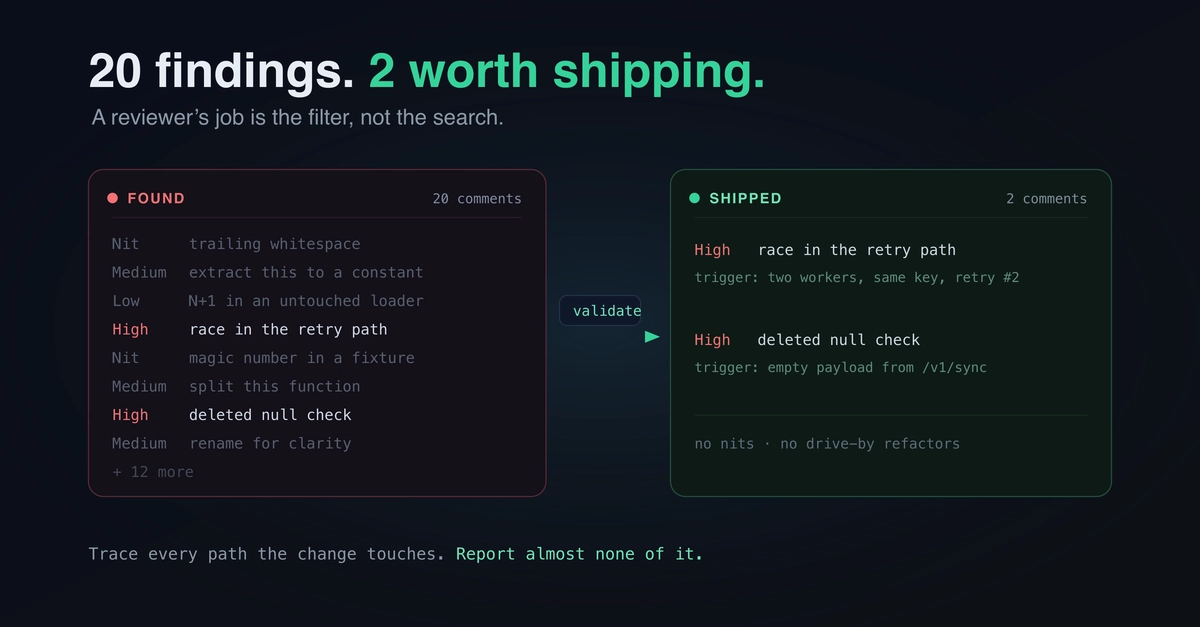
It comes back with twenty comments. Two are real: a race in the retry path, a check that got deleted along with the code it was guarding. Four are true but irrelevant, a magic number in a test fixture, a function that could be split. Six are opinions dressed as findings, "consider extracting this to a constant." Five are about code the PR never touched. Three are wrong, because the model didn't read the caller that already validates the input.
Every one of them is formatted beautifully. Severity label, file and line, a code snippet, a suggested fix.