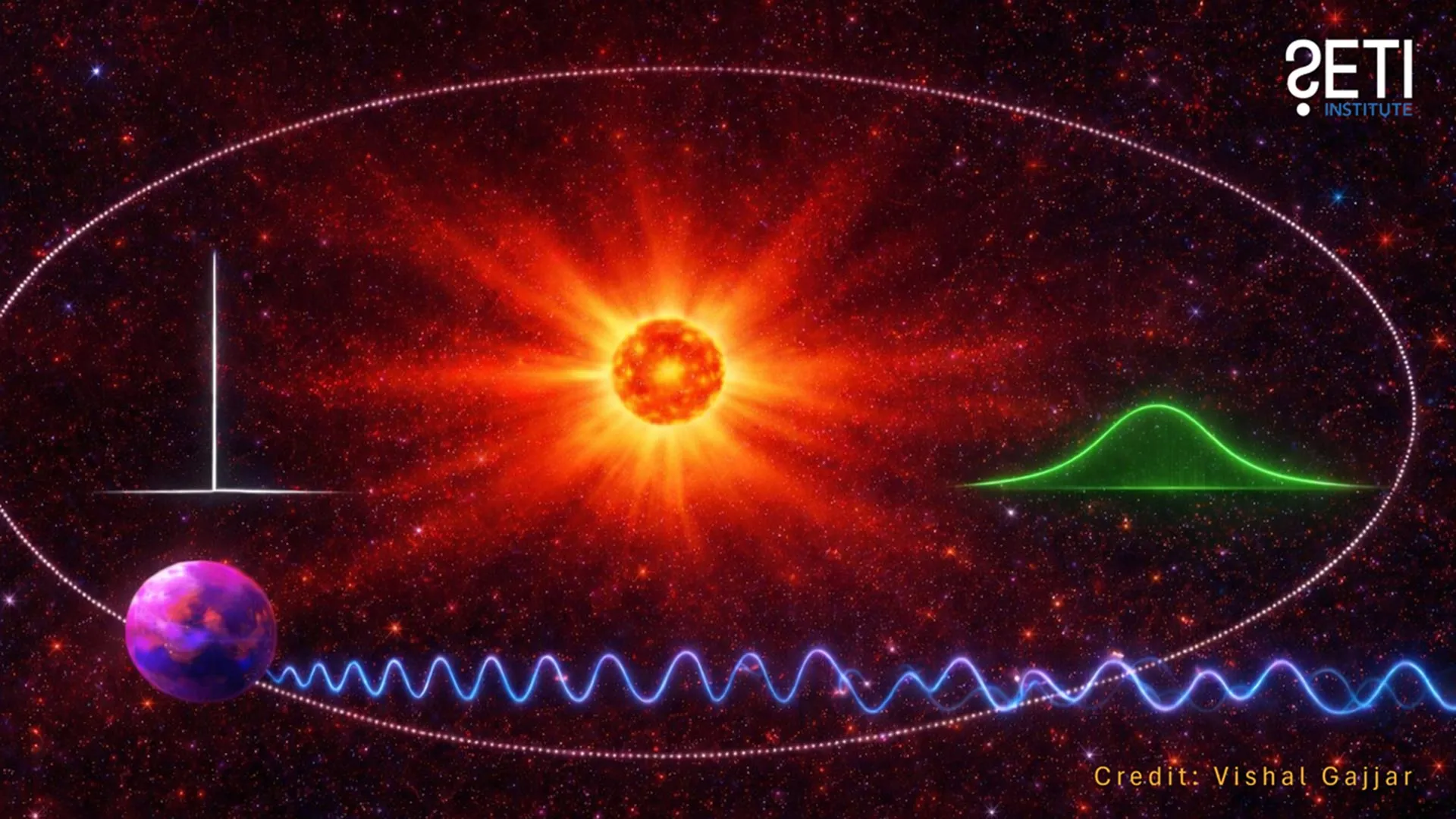
For over half a century, the astronomers and astrophysicists pursuing the search for extraterrestrial intelligence (SETI) have called it the “water hole.” The water hole is a quiet little gap in the cosmic background noise between 1.42 and 1.66 GHz, overlapping with the natural microwave-band frequencies emitted and absorbed by hydrogen and hydroxyl molecules, which react to form water. Researchers have long theorized that our fellow water-loving, carbon-based lifeforms might use this range to broadcast—both due to these frequencies’ obvious symbolic implications and because widespread hydrogen and hydroxyl in interstellar gas absorbs the static cosmic noise in this range. The water hole is not only a clear channel for communication, in other words, but one with real poetic resonance. But SETI scientists’ infatuation with this notion seems to be fading. New research presented by academics in the UK this Friday instead looks beyond the water hole, focusing on narrow-band signals that may be more likely to come from deliberate, directed transmissions. This new search for concentrated narrow-band emissions, they argue, unlocks “an entirely new frequency window for technosignature detection.” It might even catch “accidental leakage or relic signals from extinct civilizations.”
SETI Scientists Think Alien Signals Could Be Hiding in Old Telescope Data
Researchers are zeroing in on more deliberate “narrow-band” alien signals, well outside the radio frequencies SETI has focused on for decades.
658 words~3 min read