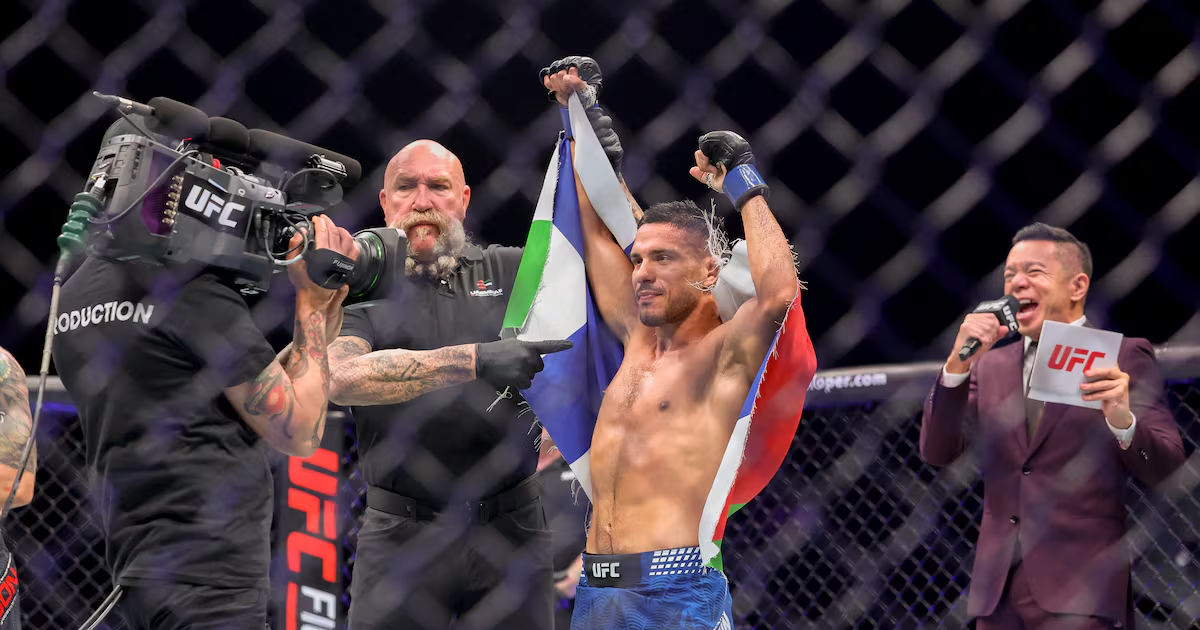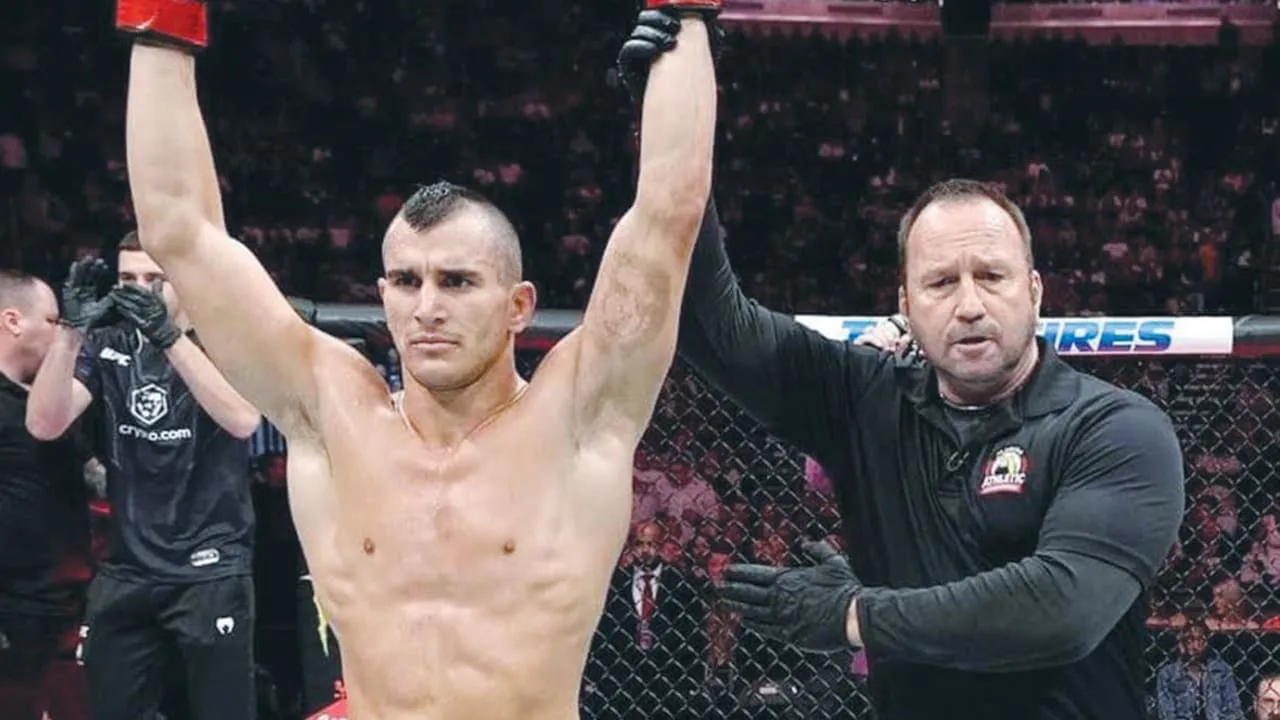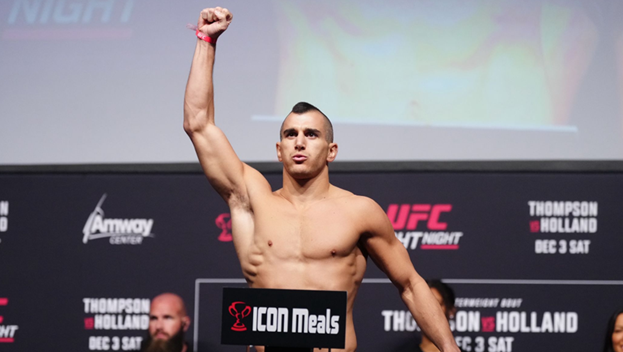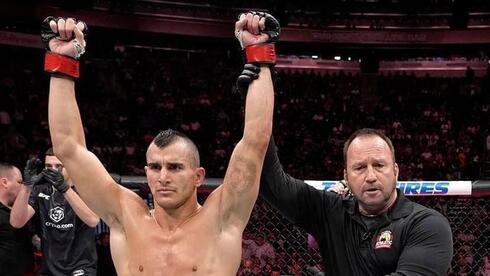
He saved up every shekel and took brutal beatings, literally, to get to the UFC, but Nathan Levy’s toughest battle is outside the cage, confronting a wave of hatred threatening to derail his careerGuy Leiba|Natan Levy was the second Israeli to reach the UFC, but the road to the top included much more than fights: grueling training in Japan, nights working as a security guard, rides of dozens of kilometers in Las Vegas and nine times in which his debut fight was canceled.Now he speaks about the antisemitism threatening to harm his career, the sponsors who disappeared, the crowd that shouted “baby killer” at him and the ugly harassment of his wife: “Jews are seen as easy prey. We need to show that we are strong and proud and that we are not hiding.”GalleryNatan Levy: 'There are organizations that tell me I am too political, or that they do not want me to walk out with an Israeli flag.'(Photo: Yuval Chen)Natan Levy is used to taking blows. In fact, he says a punch to the face hurts far less than people think. “It is more frightening and insulting than painful,” he explains. “In a fight, you are full of adrenaline. If the punch lands well, you feel dazed, lose your balance a little and see black. Body shots and leg kicks hurt much more.”But even a fighter who has reached the top of his sport and beaten opponents in the cage struggles to get used to the blows that come from outside it. In recent years, Levy, the second Israeli ever to compete in the UFC after Noad Lahat, has discovered that on the international stage he is not always judged only by his abilities. Sometimes a small Israeli flag turns him from a professional fighter into someone “too political.” Sometimes a Star of David in the crowd is enough to ignite a confrontation. And sometimes the mere fact that he was born in Israel causes sponsors and organizations to distance themselves from him.“The problem is that I have not been able to get many fights outside the UFC," Levy explains. "There are organizations that tell me I am too political, or that they do not want me to walk out with an Israeli flag. There are sponsors that do not want to work with me. Some say, ‘We don’t want to because you are Israeli and we don’t like what you are doing.’ Others say, ‘We have no problem with you, but right now it is not good for business to work with Israelis.’ At least in the second case they are honest. I can respect that, but I cannot stop being who I am.”What did you say that made you “political”? “I said Jews need to learn to defend themselves against bullies who want to attack them in the street. Is that political? I said I want civilians who were kidnapped from the Nova festival to be released. Is that political? I did not tell anyone whom to vote for. In their view, the very fact that you are Israeli makes you political. Another fighter can walk out with a Palestinian flag and that is fine, but when I walk out with an Israeli flag, they say I am mixing politics with sports.”Natan Levy: a punch to the face hurts far less than people think(Photo: Private abum)Levy, 34, has lived in Las Vegas in recent years. On July 27, he will enter the ring at Menora Mivtachim Arena as part of GFN — Gordon Fight Night, a Muay Thai and kickboxing event whose organizers promise it will be the largest of its kind ever held in Israel. The event, led by the brothers Ahavat Gordon, Ruach Gordon and Kibedy Gordon in cooperation with Yaniv Kaminski, will combine kickboxing and Muay Thai bouts with MMA gloves. The three brothers will enter the ring on the same night for the first time and face international opponents in main bouts, while several of Israel’s top fighters will compete against opponents from around the world. Levy will face Lando Vannata, an American with a UFC background, in a kickboxing bout.Levy arrived in the United States before the discourse around Israel became so extreme, and he has felt firsthand how attitudes have changed. “The situation in the U.S. is very bad and it is getting worse,” he says. “There used to be boos here and there. Today, when I accompany fighters like Shimon Smotritsky and Ilay Barzilay, the moment they take out an Israeli flag before or after the fight, the amount of booing and hatred is something I have never seen in my life. Over the past year it has become insane. People with a Star of David or an Israeli flag in the crowd have to worry that someone will try to start a fight with them.”Levy will soon get to fight in Israel, before a home crowd(Photo: Yuval Chen)The antisemitism, he says, no longer stops in the stands. At one recent event, while he and a fighter he was accompanying were backstage, a group approached his wife and the fighter’s wife.“A few Chechens jumped on them and started shouting that they were murderers,” he says. “We were backstage, so those cowards allowed themselves to verbally attack our wives. This has already become an extreme and disgusting situation.”Even in a fight he held in South Korea last year, he could not disconnect from the war, not even during the minutes when all his concentration was supposed to be on his opponent. “There was a group in the crowd that kept shouting throughout the fight, ‘baby killer’ and ‘genocide in Gaza.’ Luckily, the fight lasted only two minutes, because I won by knockout. That is the best answer: to win in a way that does not allow the judges to intervene, to raise the flag and show them that we are not silent, that we are not hiding and that we are strong and proud.”That determination has been with Levy almost his entire life. As a child, he fell in love with martial arts films from the 1980s and 1990s, but struggled to stick with classes. “I went to taekwondo and karate, and every time I got bored or it was too hard for me and I quit,” he recalls.The change came at 15, when several friends from school invited him to spar on the grass and beat him up. That evening, he showed up at the gym where they trained.The welcome was far from pleasant. “I opened the door and the first thing I saw was someone getting a spinning kick to the face, with a puddle of blood or fluids that came out of him. The coach said I was late and told me to do 200 pushups. I said I couldn’t, and he answered: ‘Do 200.’ I did not stop until I finished. After that I got beaten up in sparring, did fitness drills and conditioning. Compared with everything I had done before, that training amounted to abuse.”At the end of the workout, the coach performed an especially painful butterfly stretch on him and stood on his knees. The young Levy screamed and begged him to stop, but the coach demanded that he calm down and count to 10. “When I finished counting, he got off me and my knees were already touching the floor. Suddenly the pain disappeared. I understood that pain is temporary, but the result remains, and that sometimes you need to calm down and go through something difficult in order to improve.”Natan Levy: 'Before every workout my knees shook and I was scared to death, but I showed up'(Photo: Private album)Before he left, the coach told him that 99% of people who come for a trial session do not return. “At that moment I told myself: ‘I am the 1% that comes back.’ Before every workout my knees shook and I was scared to death, but I showed up.”At 16, Levy flew with his coach to Okinawa, Japan, in pursuit of a karate master they had seen in a documentary. The two bought bicycles and set out to find him. When they found him, they discovered that he refused to teach foreigners. They learned how to approach him with a request in Japanese, bought him an expensive mango and returned to him every day for a week. Eventually he agreed to test them and accepted them as students. Levy returned to Israel, finished his studies, went back to Japan and by age 18 already had a black belt and an instructor’s certificate.He opened groups and trained students, but then he discovered the UFC. “When I saw Frank Mir submit Brock Lesnar, I was insanely excited. Slowly, it started burning in me that I also wanted to do MMA,” Levy explains. He closed the groups, transferred the trainees to other coaches and flew alone to Las Vegas, without knowing anyone there and with a dream of reaching the UFC.In Las Vegas, Levy met coach Jimmy Gifford, who had worked with some of the biggest names in the sport. After an introductory training session, Gifford told him the truth to his face: His karate was impressive, but nowhere near enough.“He threw it at me: ‘Right now you know nothing. It will take you 10 years to reach the UFC, and even then it is not certain. Are you willing to work hard for 10 years?’ I said yes.”When Levy asked how he would pay for the private sessions, the coach surprised him. “He told me: ‘You don’t pay. If one day you succeed and make a lot of money, give me 10%.’ He took me under his wing and taught me from the stage where I knew almost nothing all the way to fights.”MMA fighter Ahavat Gordon(Photo: Dana Kopel)For four years, Levy lived between Israel and Vegas. His visa allowed him to stay in the United States for three months at a time. He trained hard, returned to Israel for six months, worked nights in security and saved for the next trip. In Las Vegas, he rode about 40 kilometers each way by bicycle every day to reach the gym, in addition to five training sessions a day. To save money, he bought the cheapest tuna and took flights that sometimes included eight stops.“I would train alongside UFC champions and then return to Israel and work in a booth or at the entrance to a club,” the fighter recalls. “The hardest moments were not when I got hit in the gym, but when I sat on guard duty in the cold and rain and knew I had to do it for another six months so I could fly again. Many people told me to let it go, that it would not happen and that I should go back to coaching. Sometimes I tried to convince myself to stop, but I knew I would continue.”Even when he was ready to compete, luck refused to cooperate. Nine fights were canceled before he made his debut. Once, an opponent arrived with an infection. Another time, one ran away and did not show up for weigh-ins. Each time, Levy completed a three-month training camp and returned to Israel without a fight. “People started asking: ‘Natan, didn’t you say you were going to fight?’ It began to sound as if I were making up stories,” he said.After three years, the big moment finally arrived. In his first amateur fight, in front of 18,000 spectators, Levy won by submission in about 50 seconds. “For three years I sacrificed my entire life. I closed the businesses, sat in the rain, ate all the crap in the world and did everything to get to that moment. Suddenly the referee told me to let go, I saw my opponent collapse, and I felt: finally, fucking finally.”He won all four of his amateur fights and turned professional. During the coronavirus pandemic, when gyms were closed, Levy trained five hours a day in a park. Then came the big opportunity: a fight on two days’ notice against an undefeated opponent, taller and heavier than him, as part of a television program in which candidates competed for a UFC contract. Levy won by submission, and UFC President and CEO Dana White signed him. A checkmark on the dream.Levy finished his UFC run with two wins and two losses, and has not given up on the possibility of returning. But now he feels that a new opponent has been added to his professional record, one that cannot be choked out.“If there were a punch so strong that the moment you give it to someone he stops being antisemitic, I would hand out a lot of those punches,” he says. “But unfortunately there is no such blow and there is no cure for it. When someone talks nonsense, I will correct him. When someone speaks badly about my country or my people, I will not stay silent. But my real focus is not to say to antisemites, ‘Please, stop hating us.’ I want to say to Jews in the U.S. and Israel: 'Be strong, learn martial arts and know how to defend yourselves.'”Levy also conducts self-defense training for Jews in the United States. He stresses that the use of force is only a last resort, but believes that readiness itself changes the way others perceive a person.“The best thing is to avoid and not be in a dangerous place. But when you are ready to fight, people see it on you and do not come to mess with you. The antisemites are bullies looking for an easy target. Right now they see some Jews in the U.S. as easy prey, as a wounded animal that can be attacked. When we show strength, we will not have to ask to be loved. They will understand that we must be respected and that anyone who tries to touch us pays a heavy price.”Levy will soon get to fight in Israel, before a home crowd. For him, it is a rare experience, after years in which every appearance with an Israeli flag became a test.“There were already fights in Las Vegas where 100 or 200 Israelis came with flags, and that moved me like crazy," he said. "But now, especially in the face of all the hatred, it is a completely different level. I wanted to go further in my career, but there is no doubt that I reached the moon. The thing I am happiest about is that I went all the way and did not let anything stop me. Not losses, not money, not visas — and now not antisemitism either.”
'The crowd called me a baby killer. I won by knockout, and that's the best answer'
He saved up every shekel and took brutal beatings, literally, to get to the UFC, but Nathan Levy’s toughest battle is outside the cage, confronting a wave of hatred threatening to derail his career
2,439 words~11 min read