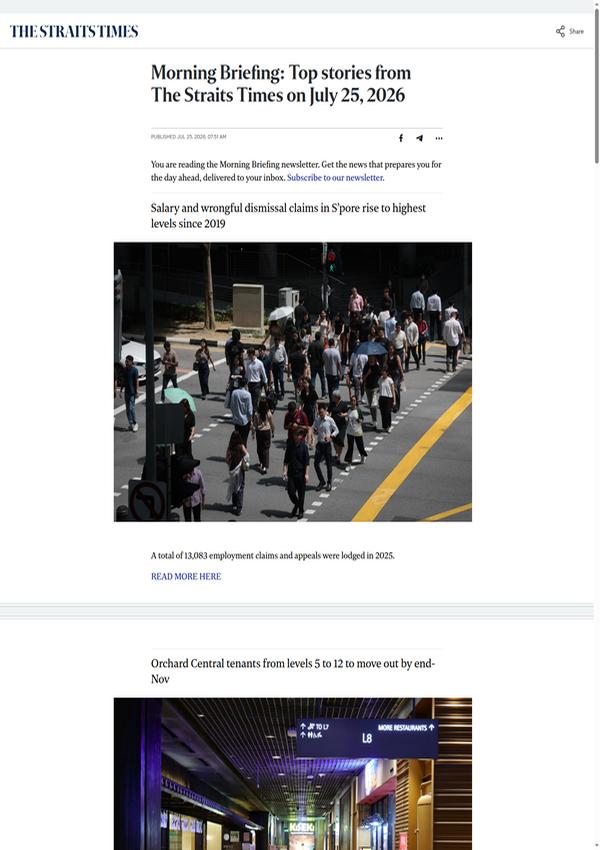
SINGAPORE - The rates of salary and wrongful dismissal claims rose in 2025 to their highest levels since 2019 amid more retrenchments, dismissals and business closures.A total of 13,083 employment claims and appeals were lodged in 2025, equivalent to about 3.44 claims per 1,000 employees, according to the Ministry of Manpower (MOM) and the Tripartite Alliance for Dispute Management’s (TADM) joint Employment Standards Report, which was released on July 24.Salary claims accounted for the majority, at 10,801 cases, up from 9,848 in 2024. This translated to 2.84 salary claims for every 1,000 employees, up from 2.63 a year earlier – the highest level shown in the report’s data series that began in 2019.The rise was driven mainly by foreign employees. Their incidence of salary claims increased from 4.64 per 1,000 employees in 2024 to 5.16 in 2025. For local employees, the figure was largely stable, edging up from 1.59 to 1.61.Construction continued to account for the largest share of salary claims lodged by foreign employees, at 46 per cent. Food and beverage services accounted for 10 per cent, while professional, scientific and technical activities made up 9 per cent.Among local employees, the sectors with the most salary claims include administrative and support services; professional, scientific and technical activities; food and beverage services; and wholesale trade.Most salary disputes arose when employment ended, including disagreements over final salary payments and cases involving employers facing financial difficulties, according to the report.The median amount claimed by local employees has trended upwards in line with the rising median gross monthly income of full-time resident workers.Over the past five years, the typical claim remained steady at the equivalent of one month’s pay for local employees and about two months’ pay for foreign employees.Despite the rise in cases, 88 per cent of salary claims were resolved at TADM, while the remaining 12 per cent were referred to the Employment Claims Tribunals (ECT).About 92 per cent of employees fully recovered the salaries owed to them, down from 94 per cent in 2024.About 5 per cent recovered their salaries partially through settlement payments from security bond insurers and main contractors, or received financial assistance through TADM’s short-term relief fund or the assistance fund administered by the Migrant Workers’ Centre.The remaining 3 per cent of employees, mainly high-income earners, did not recover their owed salaries.The total sum recovered rose to $22 million in 2025, up from $19 million in 2024.MOM said that non-payment of salary is an offence, and it limits access to foreign employees for bosses who do not fully pay their employees’ salaries.Meanwhile, there were 2,168 wrongful dismissal claims in 2025, up from 1,720 in 2024. The overall rate rose from 0.46 per 1,000 employees in 2024 to 0.57 in 2025.The incidence was higher among locals, rising to 0.64 claims per 1,000 local employees, compared with 0.44 for every 1,000 foreign employees.Of the wrongful dismissal claims made in 2025, 67 per cent of cases were resolved at TADM, down from 71 per cent in 2024. The remaining 33 per cent were referred to the ECT.Overall, employers paid about $2.71 million to employees in wrongful dismissal cases in 2025, up from $2.14 million in 2024.In one case shared by TADM, an information technology employee identified as Jason (not his real name) believed he had been wrongfully dismissed after his employment was terminated with salary in lieu of notice in July 2025.He said that he had not been given an opportunity to address his employer’s concerns, and was worried that the termination letter could harm his future job prospects.He brought his case to TADM in August 2025, seeking compensation and a retraction of the termination letter.During mediation, the employer shared documentation about the poor performance and explained why it dismissed him.The discussions helped both parties better understand each other’s positions, allowing them to reach a resolution they could accept amicably and expeditiously without the need for prolonged court proceedings.MOM and TADM said employment claims are closely linked to job turnover due to dismissals, retrenchments, and business cessations.“The increase in employment claims is likely driven by labour market conditions amid business reorganisation and restructuring rather than a broad-based deterioration in employment standards,” they added.
Employment claims and wrongful dismissal rise in 2025
Discover the rise in employment claims and wrongful dismissal cases in 2025, reaching their highest levels since 2019. Read more at straitstimes.com. Read more at straitstimes.com.
693 words~3 min read