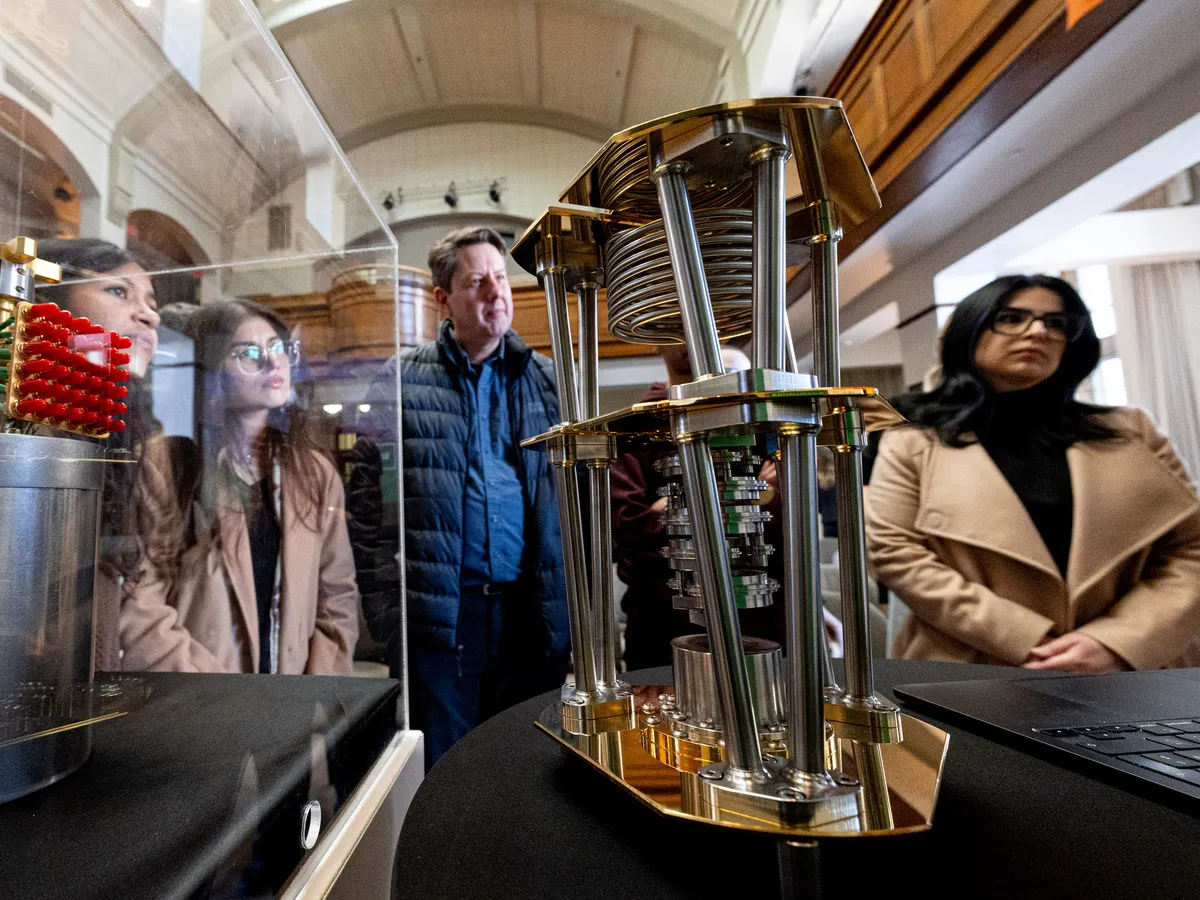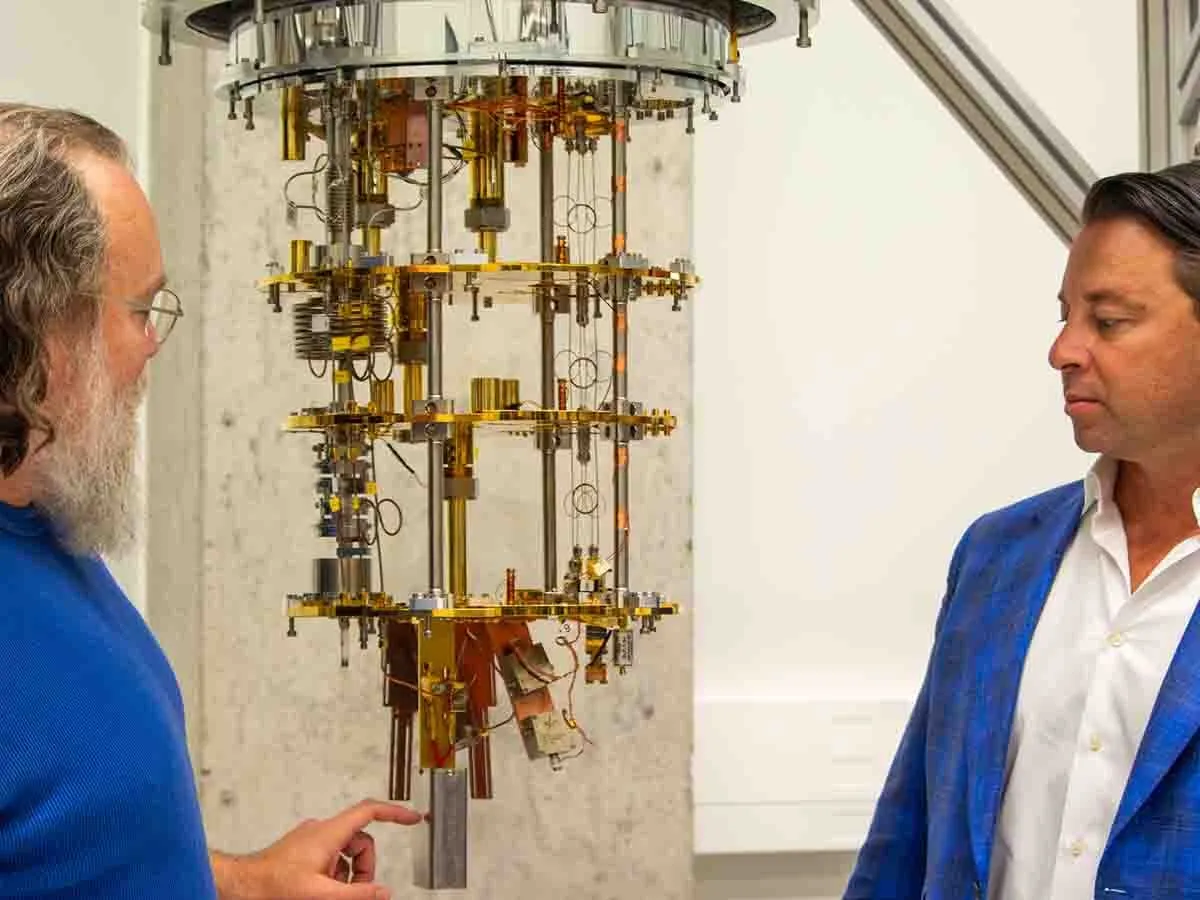
Skip to Content News Archives Economy Energy Oil & Gas Renewables Electric Vehicles Mining Commodities Agriculture Real Estate Mortgages Mortgage Rates Finance Banking Insurance Fintech Cryptocurrency Work Wealth Smart Money Wealth Management Investor Personal Finance Family Finance Retirement Taxes High Net Worth FP Comment Executive Women Puzzmo Newsletters Financial Times Business Essentials More Innovation Information Technology FP500 Podcasts Small Business Lives Told Tails Told Shopping Financial Post Store Obituaries Place a Notice Advertising Advertising With Us Advertising Solutions Postmedia Ad Manager Sponsorship Requests Classifieds Place a Classifieds ad Working Profile Settings My Subscriptions Saved Articles My Offers Newsletters Customer Service FAQ News Economy Energy Mining Real Estate Finance Work Wealth Investor FP Comment Executive Women Puzzmo Newsletters Financial Times Business Essentials HomeEntrepreneurInnovationThere's a problem holding back quantum computer growth and this Ontario startup aims to solve itA device developed by Waterloo-based QuantumCore Inc. may help Google and IBM to scale up their quantum computingLast updated 1 hour ago You can save this article by registering for free here. Or sign-in if you have an account.Waterloo-based QuantumCore Inc.’s chief technology officer, Christopher Wilson, points to a quantum processing unit, above which the company’s amplifier attaches, as chief executive, Eugene Profis, watches. Photo by Institute for Quantum Computing at University of WaterlooAn Ontario startup tackling one of quantum computing’s biggest bottlenecks says it is building devices that have caught the eye of companies such as International Business Machines Corp. and Alphabet Inc.’s Google.Subscribe now to read the latest news in your city and across Canada.Exclusive articles from Barbara Shecter, Joe O'Connor, Gabriel Friedman, and others.Daily content from Financial Times, the world's leading global business publication.Unlimited online access to read articles from Financial Post, National Post and 15 news sites across Canada with one account.National Post ePaper, an electronic replica of the print edition to view on any device, share and comment on.Daily puzzles, including the New York Times Crossword.Subscribe now to read the latest news in your city and across Canada.Exclusive articles from Barbara Shecter, Joe O'Connor, Gabriel Friedman and others.Daily content from Financial Times, the world's leading global business publication.Unlimited online access to read articles from Financial Post, National Post and 15 news sites across Canada with one account.National Post ePaper, an electronic replica of the print edition to view on any device, share and comment on.Daily puzzles, including the New York Times Crossword.Create an account or sign in to continue with your reading experience.Access articles from across Canada with one account.Share your thoughts and join the conversation in the comments.Enjoy additional articles per month.Get email updates from your favourite authors.Create an account or sign in to continue with your reading experience.Access articles from across Canada with one accountShare your thoughts and join the conversation in the commentsEnjoy additional articles per monthGet email updates from your favourite authorsSign In or Create an AccountorFounded by researchers at the Institute for Quantum Computing (IQC) at the University of Waterloo in 2025, QuantumCore Inc. is developing a device to tackle the heat that is generated when translating quantum calculations done under frigid conditions to room temperature systems for processing. As quantum computers get bigger, the devices currently available to translate those calculations will generate too much heat, according to QuantumCore, creating a bottleneck to developing more powerful quantum computers.Quantum processors run at ten millikelvin temperatures, which is a hundred times colder than space. To get those signals up to something useful for us at room temperature that I can plug into my regular computer, I have to make those signals much bigger, and that’s what we’re doing,” said QuantumCore’s chief technology officer, Christopher Wilson.Get the latest headlines, breaking news and columns.By signing up you consent to receive the above newsletter from Postmedia Network Inc.A welcome email is on its way. If you don't see it, please check your junk folder.The next issue of Top Stories will soon be in your inbox.We encountered an issue signing you up. Please try againQuantumCore’s KI-TWPA amplifier, short for kinetic inductance travelling wave parametric amplifier, uses superconducting materials to boost extremely small quantum signals with less heat generation.“We’ve gotten to a place where the device we built is actually amplifying the signal to where big quantum computing companies will start testing out product and co-developing it because they realize that heat is the biggest problem in the cryostat (frigid unit), so they will have to replace what they have now,” said QuantumCore’s co-founder and chief executive, Eugene Profis.“We can now be one of the default suppliers of kinetic inductance traveling wave parametric amplifiers to the big platforms. These aren’t our roadmaps, Google and IBM are telling us what to do. Our job is to help them do it, so our product serves to help them scale,” said Profis.While existing semiconductor amplifiers, such as the ones used in phones, can power small 50-100 qubit quantum computers, they won’t be suitable for larger machines in the future. Current amplifiers act like tiny heaters that overwhelm the cooling capacity of the quantum system and destroy the tiny pieces of data that these computers process, called qubits.“At one, ten, or 100 hundred qubits, existing amplifiers are just fine, the heat doesn’t kill the system. But once you get through 1,000 cubits, then all of a sudden, heat does kill it,” said Profis.Heat management will become an issue within the next three years, said Profis, as quantum computers are expected to scale up to 1,000 qubits by 2027 and 1,000,000 qubits by 2030.QuantumCore expects to deploy evaluation units of their hardware to major customers in the next five weeks for testing, Profis said, and expects to move through prototyping, collaboration agreements and purchase sales within the next year.QuantumCore is also working with foundries such as Taiwan Semiconductor Manufacturing Company Co. Ltd. (TSMC) in 2027 to prepare manufacturing processes for scale.“There are new foundries being built for the purpose of quantum computing,” said Profis. “Those are the manufacturing arms and that’s how you get scale and build hundreds of thousands of units right away.”The 14-person company raised $10.7 million in external funding within the past year.One grant, worth $1.7 million, was awarded through the Natural Sciences and Engineering Research Council of Canada (NSERC) Alliance Quantum grants program as an IQC industry partner. The funding supported the development of QuantumCore’s superconducting traveling-wave parametric amplifier (TWPA) platform.QuantumCore also raised $9 million in private funding across two rounds of financing. The company recently listed on a lower-cost stock market, the Canadian Securities Exchange, designed to grow startups. Quantumcore chose to list publicly to give investors more liquidity than private investing often provides, Profis said.In the multibillion-dollar global quantum-computer race, Profis said that Canada is well positioned in the sprint.“People are spending $20 million on a computer because they believe that 100,000 qubits will be next,” said Profis. If development progresses as expected, “These computers will be more powerful by orders of magnitude than the biggest supercomputers in the world today. This should happen within the next three years,” said Profis.“If you’re not at the table, then you’re on the menu. Success doesn’t mean Canada ending up with the dominant quantum computer, but success is Canadian companies making things that are crucial to quantum computers. That’s what puts Canada at the table, and it’s critical to be at that table,” said Wilson. Join the Conversation This website uses cookies to personalize your content (including ads), and allows us to analyze our traffic. Read more about cookies here. By continuing to use our site, you agree to our Terms of Use and Privacy Policy.
There's a problem holding back quantum computer growth and this Ontario startup aims to solve it
A device developed by Waterloo-based QuantumCore Inc. may help Google and IBM to scale up their quantum computing. Find out more.
1,254 words~6 min read