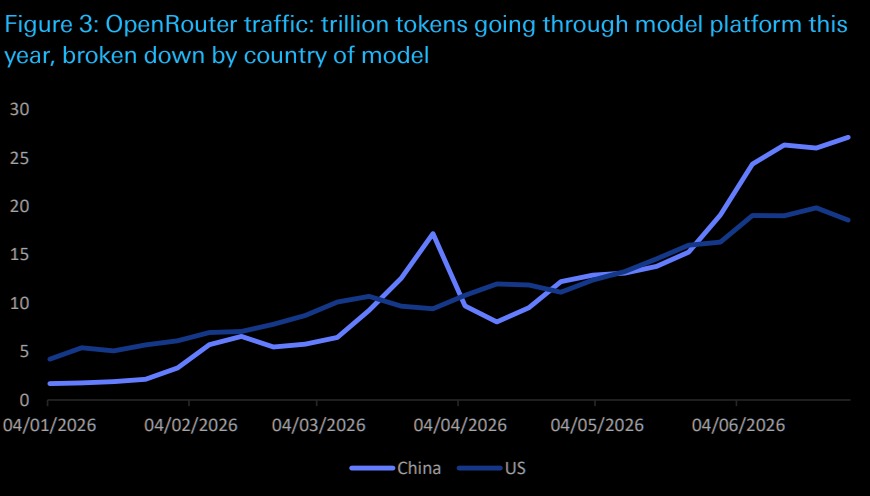
1. [para. 1] The United States and China are neck and neck in the global artificial intelligence race, but a significant divergence in capital expenditure has emerged, with China’s investment falling behind that of the U.S. This gap reveals fundamental differences in funding approaches and carries profound implications for global AI leadership.2. [para. 2][para. 3] The AI era is fundamentally different from the internet boom. The internet economy was based on light-asset platforms with network effects, where user expansion brought marginal costs close to zero. In contrast, generative AI is a heavy-asset endeavor requiring massive continuous investments in computing power, data, and electricity. AI models incur substantial variable costs with each query and undergo rapid hardware depreciation, with maintaining technological parity demanding exponentially increasing resources.3. [para. 4] AI’s value creation far exceeds its value capture because large models lack the monopolistic network effects of traditional platforms. Their economic benefits spill over into the broader economy, creating a positive externality that leads to underinvestment by private entities, as societal return outweighs private return.4. [para. 5][para. 6] In the U.S., AI capital expenditure has exploded, bypassing traditional cost-benefit constraints. In the first quarter of 2026, AI-related capex accounted for nearly half of U.S. GDP growth and two-thirds of total demand growth. Despite high interest rates, American markets are gripped by “animal spirits,” with equity risk premiums dropping to zero, signaling investors’ willingness to fund massive cash-burn operations on the promise of future breakthroughs.5. [para. 7][para. 8][para. 9] China’s AI investment engine is sputtering, with AI-related capex contributing merely a fraction of a percentage point to GDP growth in early 2026. This sluggishness stems from several factors: U.S. export controls on advanced GPUs creating procurement bottlenecks; subdued capital markets with a noticeable risk premium; lower labor costs reducing the immediate incentive to replace human labor with AI; and a broader macroeconomic environment burdened by a prolonged property slump and weak domestic demand, which has compressed corporate profit expectations.6. [para. 10][para. 11] These divergent paths present different challenges. The U.S. faces the risk of overinvestment and a potential bubble burst if euphoric expectations fail to materialize quickly enough, leading to massive capital destruction similar to the dot-com crash. China, conversely, faces the risk of underinvestment and permanent technological obsolescence if the investment slump persists.7. [para. 12][para. 13][para. 14] For China, the imperative is to catch up in AI capital expenditure urgently. The U.S. stock market bubble is currently serving a vital economic function by correcting the natural private underinvestment in AI, which has massive social externalities. Lacking a comparably hyperactive equity market, China must rely on industrial policy, mobilizing state-backed financial resources and integrating bank credit to fund AI infrastructure, such as advanced computing centers. While direct government investment carries risks of inefficiency and redundant projects, these are acceptable costs compared to the dangers of technological stagnation. Recent policy signals suggest China is awakening to this reality, with domestic AI capex poised for a rebound, but it requires a broader macroeconomic pivot with accommodative monetary policy to support fiscal expansion and revive domestic demand.AI generated, for reference only
Commentary: America Risks an AI Bubble While China Risks Falling Behind
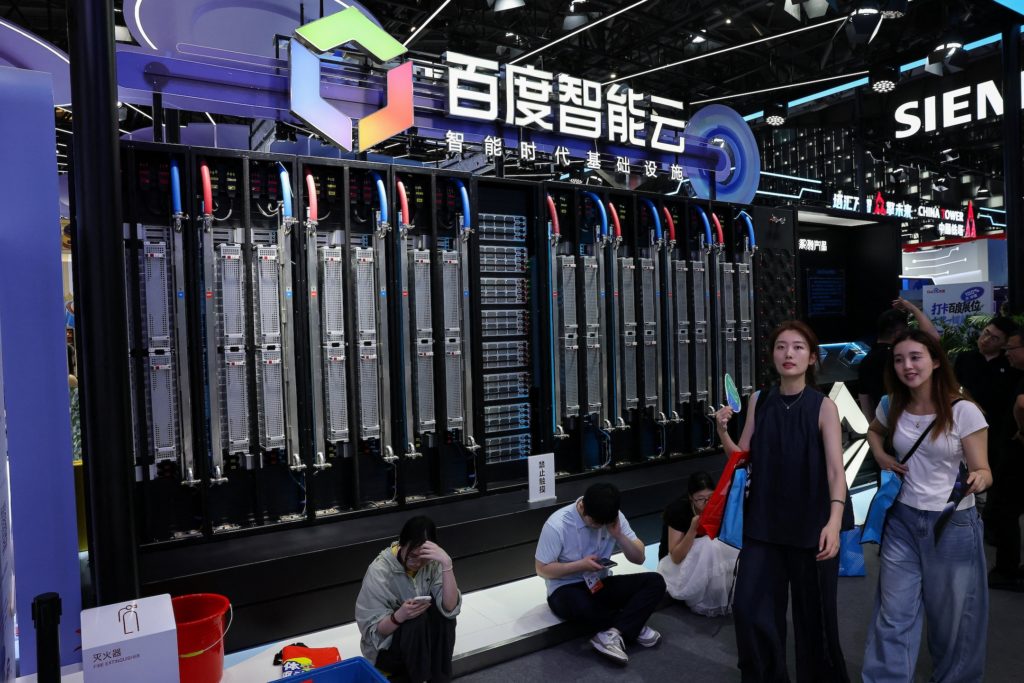
The generative artificial intelligence era requires relentless, heavy-asset spending that Chinese private markets are currently failing to supply
TL;DRAI
U.S. AI capex drove 50% of Q1 2026 GDP growth amid market euphoria; China's contracted under U.S. GPU export controls and macro pressure. U.S. faces dot-com bubble risk; China risks permanent tech obsolescence without state-backed capex acceleration.
514 words~2 min read