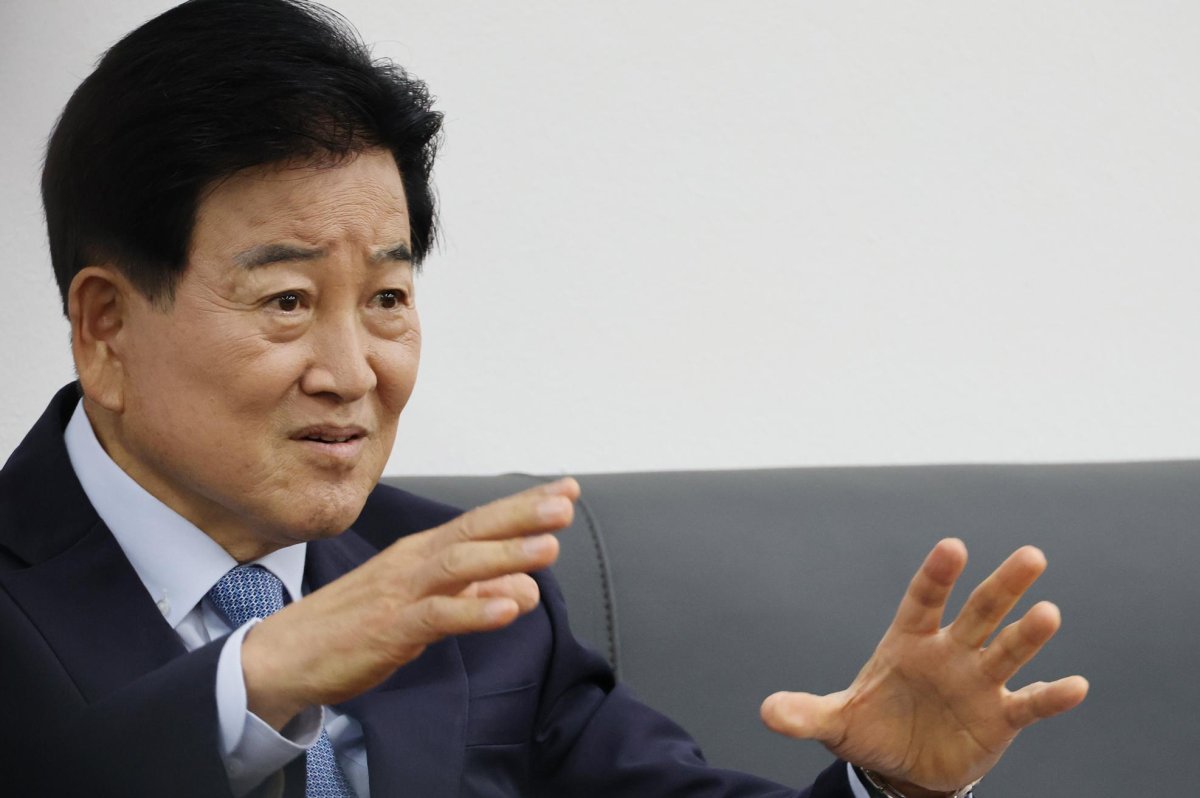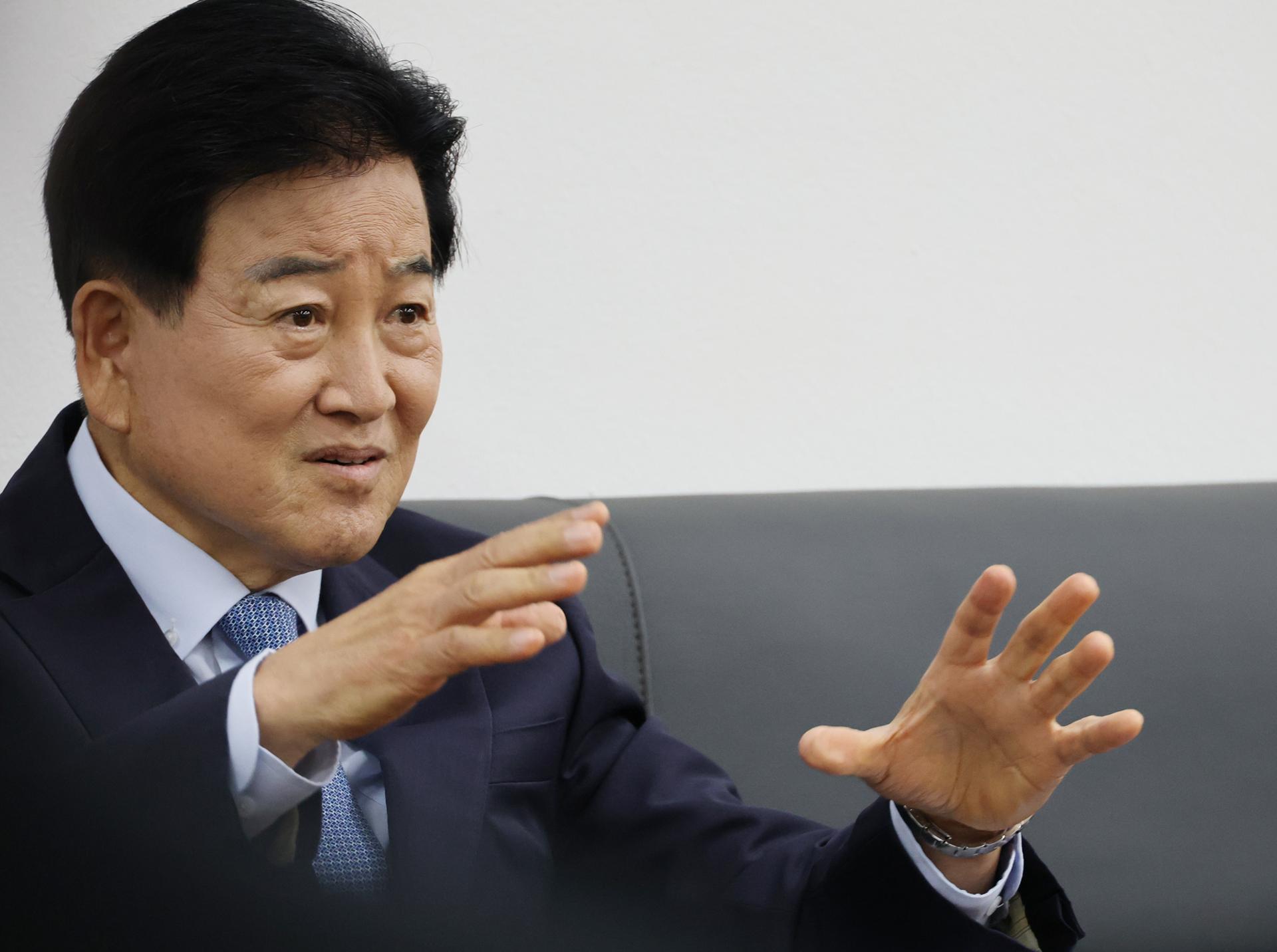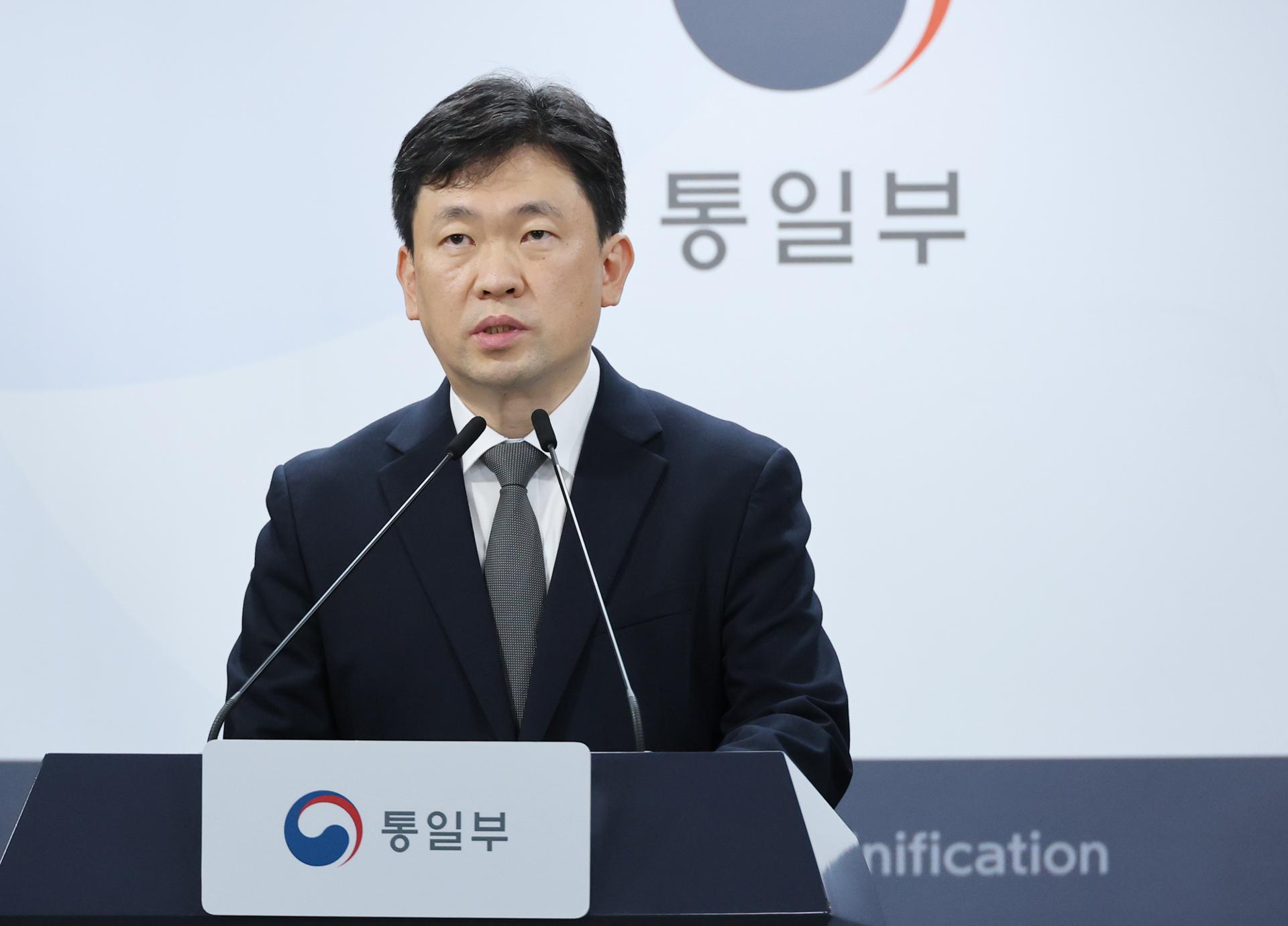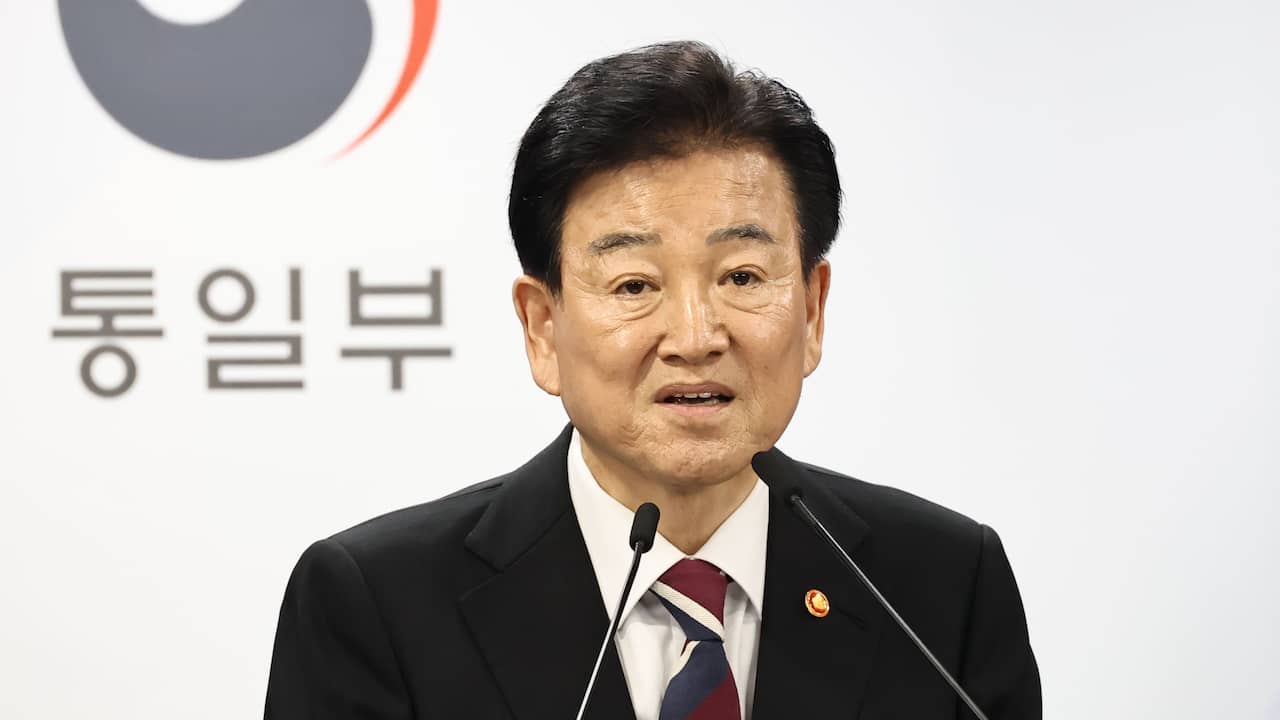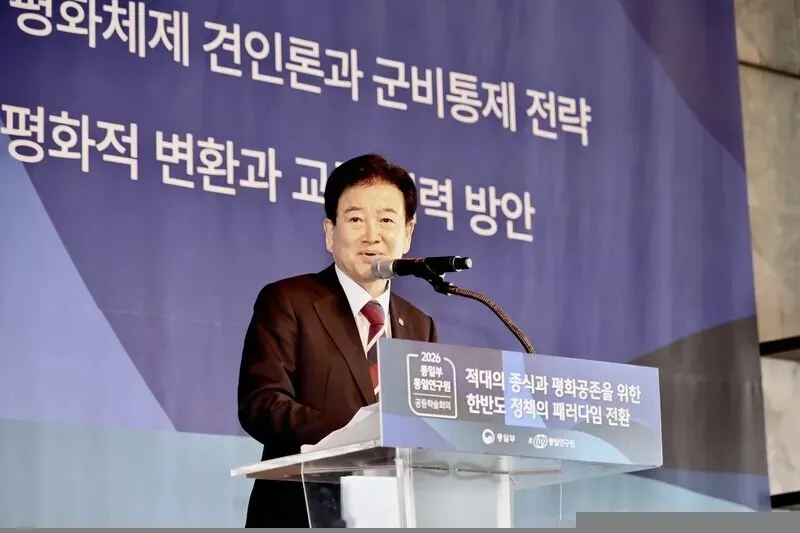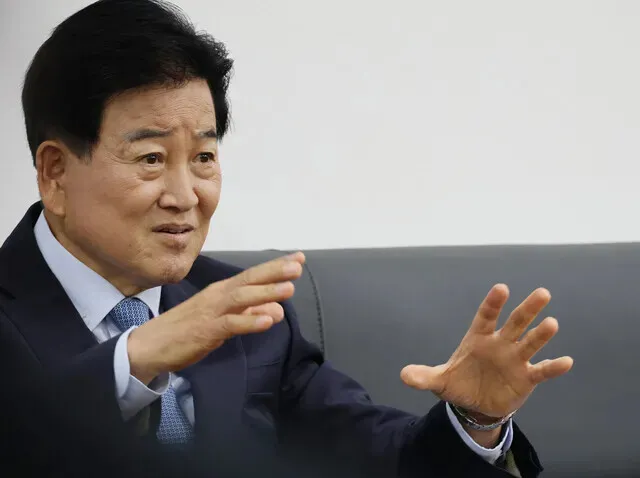
Unification Minister Chung Dong-young speaks to reporters at a press conference to mark his first year in office on July 23, 2026, at the ministry headquarters in Seoul. (Yonhap)
South Korea’s unification minister on Thursday hailed the Lee Jae Myung administration’s decision to effectively abandon Seoul’s decades-long denuclearization-first approach toward North Korea, calling the pivot toward peace-building one of the government’s defining achievements in its first year. It is unclear, however, if this change in policy is the official government position as coordinated through the National Security Council.Unification Minister Chung Dong-young made these comments while speaking with reporters to mark his first year in office, the anniversary of which falls on Saturday. “For the past year, the Lee Jae Myung government has practically abolished the previous government’s stance centered on achieving denuclearization first, or its complete, verifiable and irreversible denuclearization policy, and shifted toward a ‘peace-first’ policy,” Chung said. “We’re working to flesh out a strategy that starts with a halt on North Korea’s nuclear program where peace comes first,” he said, noting that Pyongyang was continuing to advance its nuclear capabilities at that very moment. He added that the ministry and the administration are both concerned over whether the country can afford to keep delaying this matter.“Even superpowers like the US and China have effectively abandoned the denuclearization-first approach, and Victor Cha, considered a North Korea hawk, has called this approach a failure,” the minister said. “Previous administrations insisted on denuclearization first largely for domestic political purposes.”“Restoring severed dialogue with North Korea comes first, and insisting on denuclearization right out of the gate shuts down the possibility of dialogue,” he added. “This critical realization is precisely why we’re dropping the denuclearization-first policy for a peace-first approach.”In materials released to the press that day, Chung said the ministry is exploring a pragmatic solution of corresponding measures for if North Korea takes the first step and suspends its nuclear buildup. He proposed to first initiate talks on a “peace regime on the Korean Peninsula” to create conditions conducive to halting Pyongyang’s nuclear ambitions.In September last year, Lee proposed a “three-step solution” to the North’s nuclear issue in his keynote address at the United Nations General Assembly, saying, “The international community must gather its wisdom in a pragmatic and phased solution beginning with a ‘stop’ in the sophistication of nuclear and missile capabilities, going through a ‘reduction’ process and reaching ‘dismantlement.’”At a news briefing last month, he also explained his stance on phased denuclearization. “Over the short term, simply refraining from producing additional nuclear materials, halting their output, not exporting them and ceasing development of ICBM [intercontinental ballistic missile) technology — in other words, simply stopping such activities — would benefit the international community,” he said at the time. On the prospects for resuming North Korea-US dialogue, Chung said that Chinese President Xi Jinping’s visit to and summit in the US this coming September, followed by US President Donald Trump’s trip to China for talks in November, will “provide momentum to serve as another critical juncture.”“If something is to happen then, we cannot just sit idly by in August and September,” the minister said. Chung said he heard that new US Ambassador to South Korea Michelle Steel will take office late this month and that he believed he would have the opportunity to meet her.As a key achievement of the Lee administration’s first year, Chung cited the proposal of a “peaceful two-state relationship oriented toward unification” as part of the implementation strategy for diplomacy toward the North, dubbed the “policy for peaceful coexistence on the Korean Peninsula.” He also praised this approach for creating a new paradigm for inter-Korean ties to overcome Pyongyang’s stance of a hostile two-state relationship.On North Korean Foreign Minister Choe Son-hui’s recent visit to Russia, Chung said that the “reasonable inference” is that the visit was meant to prepare for a visit to Moscow by North Korean leader Kim Jong-un.“Russian President [Vladimir] Putin appears interested in improving his country’s ties with South Korea, and we’re also interested in this,” he added. “From this perspective, we must participate in the Eastern Economic Forum [in September in Vladivostok, Russia], though we don’t yet know at what level.”The unification minister said the barbed wire fences surrounding the Settlement Support Center for North Korean Refugees, also known as Hanawon, a ministry training facility that prepares North Korean defectors for life in South Korea, were recently removed. Starting next month, he added, all Hanawon graduates entering society will each get the latest model of a mobile phone purchased with a donation from the philanthropist Yang Han-jong.By Park Min-hee, senior staff writerPlease direct questions or comments to [english@hani.co.kr]