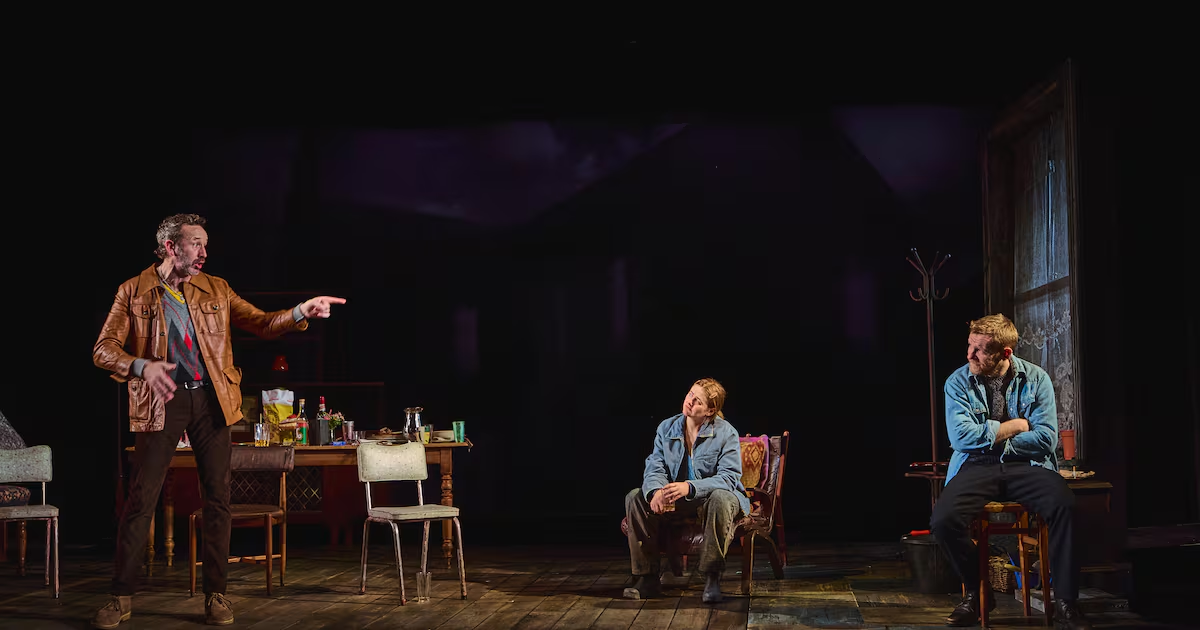
From Conor McPherson’s The Brightening Air at the Gate to Garry Hynes’s revival of The Shaughraun at Galway’s Town Hall Theatre, late-summer invariably brings rich cultural pickings for Irish audiences. Spare a thought, however, for the many promising productions that didn’t bear fruit this season, including a suite of plays by FrielDays, which was forced to pause its five-year celebration of the late Brian Friel’s work after failing to secure funding. Friel himself would surely have sympathised with the project’s predicament. Despite his success, the playwright understood just how fickle the worlds of theatre and arts funding can be.Born in Tyrone in 1929, Friel went to school in Derry and made his home in Donegal. Befitting a life spent on either side of the Border, his work dealt with questions of language, identity and belonging. A progressive nationalist who took part in the civil rights march on Bloody Sunday, Friel was also acutely sensitive to those who didn’t share his beliefs, be it Northern Irish unionists or Catholic conservatives in the Republic. His work, though varied in its subject matter and style, mined these differences rather than constructing a singular vision of Irishness. Friel’s breakthrough, as anyone who took the Leaving Cert in recent decades knows, was Philadelphia, Here I Come! The play’s success was neither sudden nor straightforward, as the scholar Kelly Matthews recounts. Friel endured months of rewrites in an attempt to win backing from literary agents, who remained sceptical about the writer’s dark comic sensibilities and decision to split the story’s protagonist, Gar O’Donnell, into public and private personas. So worried was Broadway producer David Merrick about Philadelphia that he abruptly cancelled a preview in February 1966 rather than allow Stanley Kauffmann, the New York Times critic, to take his seat. Merrick needn’t have worried about the play, which received six Tony nominations. But the impresario sensed critics’ ambivalence towards Friel. The Loves of Cass McGuire, the writer’s next offering, divided opinion and set the pattern for a career that swung between triumph and disappointment.The capriciousness of performance is a central theme of Faith Healer, Friel’s 1979 masterpiece about Frank Hardy, a shamanic showman who travels between village halls purporting to cure the sick. Hardy says he has healed people, but he doubts his powers, which he denies having any control over. On any given night, as he takes to the stage, he cannot be sure what will happen. ‘Was it all chance? – or skill? – or illusion? – or delusion?’, he asks, conveying Friel’s own unease about his craft. Ironically, Faith Healer closed on Broadway after only 20 performances before electrifying audiences in Dublin. Friel’s greatest impact came from his collaboration with the Belfast-born actor Stephen Rea. By the late 1970s, Rea was a rising star of London’s West End, but he craved work that would allow him to express himself more fully as an Irish person, and so approached Friel with a plan to seek funding from the Arts Council of Northern Ireland. The pair established Field Day, a theatre company which sought to bring Northern Ireland’s divided communities together in the fifth province, a mythical cultural realm.An early Irish concept revived by the philosophers Mark Patrick Hederman and Richard Kearney, the fifth province found new meaning in September 1980, when Field Day presented Friel’s Translations at the Guildhall in Derry. Set in the fictional Donegal village of Baile Beag in 1833, the play tells the story of how locals respond to the arrival of British soldiers from the Ordnance Survey who have come to anglicise Irish placenames. Baile Beag, for starters, becomes Ballybeg. A meditation on the politics of place, as well as a plea for understanding, the play received a rapturous response in the Guildhall, as army helicopters hovered overhead. At the final curtain, the Ulster Unionist Party’s Marlene Jefferson joined a standing ovation, as did Martin McGuinness, a convicted member of the IRA.For Friel, Field Day took a “modest little stand”, but the company’s impact turned out to be far greater. At the height of the Troubles, it toured politically-charged plays in small venues across the island of Ireland and revealed the power of art to foster tolerance and understanding. Frustrated by the grind of fundraising, Friel gave Dancing at Lughnasa, his most commercially successful work, to the Abbey Theatre in 1990, and resigned from the Field Day board four years later. However, the project has kept going chiefly thanks to Rea. At a time when ultranationalism is on the rise at home and abroad, Field Day’s commitment to the fifth province and the politics of difference and understanding remains more relevant than ever.A stand-alone endeavour conceived by Arts Over Borders’ Seán Doran and the late Liam Browne, FrielDays plans to perform each of Friel’s 29 plays in found spaces on either side of the Irish Border. Following a successful first year, in which it brought Friel’s work to old farmhouses, stables and military barracks in the playwright’s own Derry, Donegal and Tyrone, FrielDays was due to mount nine productions in 2026 before the Arts Council of Ireland, Derry City and Strabane District Council, and Creative Ireland turned down its funding applications. Ambitious, experimental and sprawling, FrielDays is exactly the sort of artistic work that needs public funding to drive debate on what sort of society we want to live in. Although arts funding in Ireland is now more competitive than ever, the project hopes to resume next year. Not all crops bear fruit annually, and some harvests, as Friel knew well, are all the sweeter for it.Dermot Hodson is a professor of political economy at Loughborough University
Opinion: There’s a bitter irony in the failure of a celebration of Friel’s work to get funding
The playwright understood better than most how fickle the world of arts funding could be
937 words~4 min read