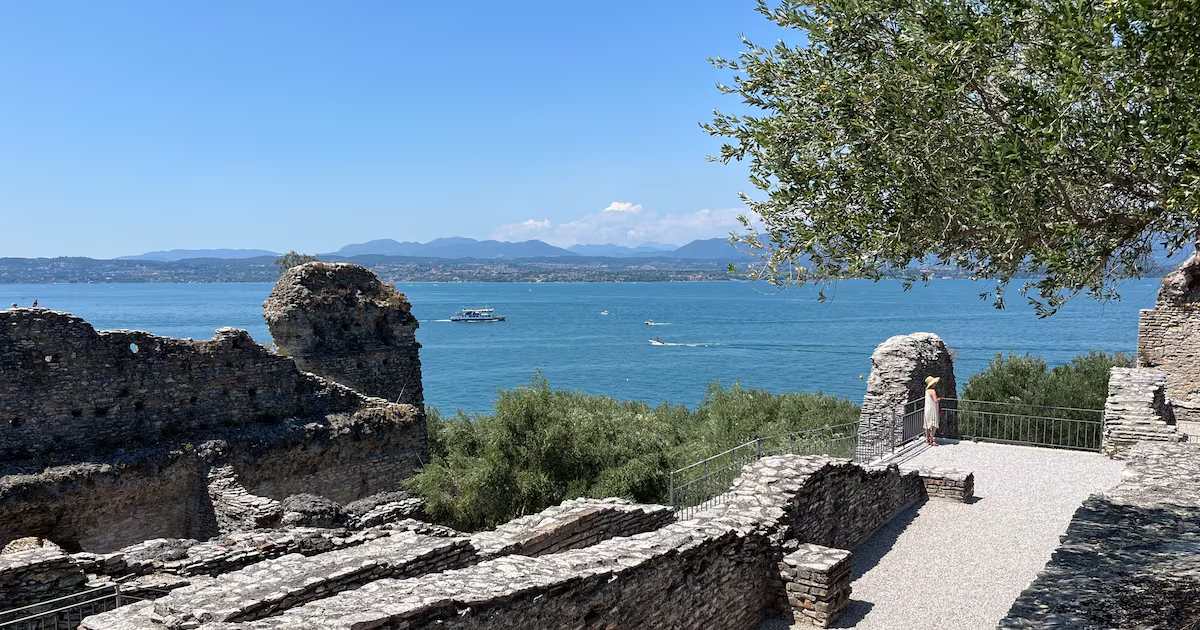
Readers may have noticed a sunny northern hemisphere bent to my recent columns.Throughout July, I’ve been fortunate to merge the roles of arts writer, foreign correspondent and globe-trotting academic (one can only attend so many conferences online). It’s back to South Africa with me next week, but before giving up my glamorous identity as an itinerant wordsmith, I had one more stop.Sirmione lies on the southern shore of Lake Garda, the largest body of fresh water in Italy. More accurately, the town is situated on a narrow peninsula that juts out into the lake — a picture-perfect setting and one that has inspired poets for over two millennia.The primary literary figure associated with Sirmione is Catullus, who lived there for a period in the first century BCE. Catullus came from a wealthy family, and the ruins of a grand Roman villa at the far end of the peninsula are known as Grotte di Catullo, “The Grottoes of Catullus”. The association is somewhat specious, for at least two reasons. First, the foundations of the complex were built a century or two after the poet’s death; and second, while Catullus may have been something of a nepo baby, not even his family had the means to afford such a home.Forget your luxury cliffside home overlooking Clifton or Bantry Bay. This was a waterfront property like no other. Lake Garda is replete with castles, palaces and opulent modern monstrosities, but nothing you can see today matches what the Grottoes of Catullus would have looked like in their prime. The name comes from the 15th century, when the ruins — which had become embedded in the landscape and overgrown with trees — gave the appearance of natural caves.The stone and plaster have since been fully exposed again, and with a little bit of imagination informed by archaeological consensus, it is not too difficult to picture the original structure. Cutting-edge Roman engineering was employed to ensure that the occupants had plenty of hot and cold water throughout the year. The olive groves for which Sirmione is also renowned hint at an abundant and diverse crop to feed the appetites of the ancient elites.A thousand years later, this part of Italy was ruled by the powerful Della Scala family, who put their own architectural stamp on Sirmione, as they did in nearby Verona and throughout the surrounding area. Most impressively, there is the Castello Scaligero, alongside the small bridge connecting Sirmione town proper to the rest of the peninsula. It was here that Dante Alighieri, in exile from his beloved Florence and living under the Della Scalas’ protection, came in the early years of the 14th century.Since then, seeing Catullus and Dante as their literary forebears, innumerable writers have made the pilgrimage to Sirmione. Names like Goethe, Byron and Rilke are among them.The most memorable response to the “all-but-island” of Sirmio surely belongs to Alfred Tennyson, who visited Lake Garda in 1880. His brother Charles had died the previous year, and Tennyson, whose expressions of grief for a lost friend, Arthur Henry Hallam, had shadowed his poetry since the 1850s, was moved to produce a short, lyrical elegy.The Latin title of Tennyson’s poem is taken from the final line of one by Catullus: “Frater Ave Atque Vale” (“Brother, hail and farewell”). Catullus, too, had lost a beloved brother. For Tennyson, overwhelmed by the beauty of Sirmione but unable to suspend his own mourning, recalling the Roman poet’s “hopeless woe” brought some comfort. Accepting the intertwining of joy and sorrow, Tennyson turns to the “Lydian laughter” of the people on the shore below the Grottoes of Catullus.I think Tennyson would be pleased to know that the same sounds still drift across the waters of Garda. He might not approve of the roaring engines of the speedboats cutting across the lake (the atmosphere of his poem depends on the quiet splash of rowing oars). But for the rest, not too much has changed. Unfairly sexy Italians strut their stuff in the shallows or drink Aperol Spritz at beach bars, while above them loom the Roman ruins. Sic transit gloria mundi: thus passes the glory of the world.Business Day
CHRIS THURMAN | Sirmione’s literary legacy still echoes across Lake Garda
Ancient ruins and enduring beauty keep Lake Garda's poetic heritage alive
690 words~3 min read