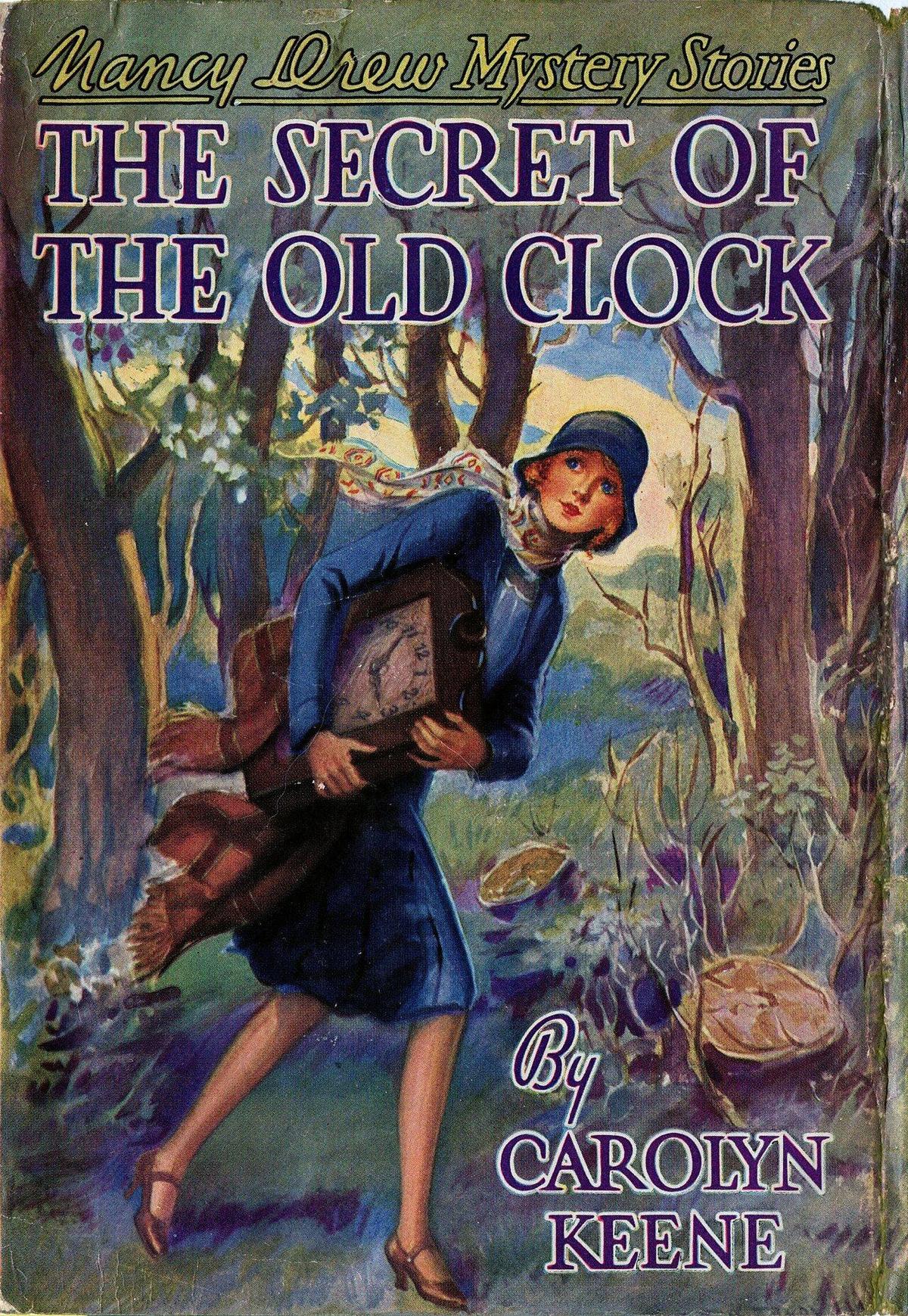
Now that Miss Marple and Nancy Drew’s early novels are entering the public domain, what comes next for them?Did you know LARB is a reader-supported nonprofit?LARB publishes daily without a paywall as part of our mission to make rigorous, incisive, and engaging writing on every aspect of literature, culture, and the arts freely accessible to the public. Help us continue this work with your tax-deductible donation today!IN FIFTH GRADE, I brought a stack of Nancy Drew books on a camping trip. I read one a day, hauling them on hikes and finishing them by flashlight in my tent, to my little brother’s annoyance. At that time, I didn’t have access to earlier film or TV adaptations of the novels, so I encountered Nancy the way Mildred Benson, the first ghostwriter to operate under the pseudonym Carolyn Keene, wrote her on the page: a blonde sleuth who drove her own car and walked straight into danger and was always, always right.Nancy Drew felt electric in a way I couldn’t explain. She showed me a world organized entirely differently from the one I lived in, one in which a young girl could take risks that paid off, one in which following her instincts never steered her wrong.I left Nancy behind eventually, her confidence and sheen less real to me as I grew up and recognized the foundational formulas that undergirded the books’ mysteries. My mother and aunt were Agatha Christie fans, so, somewhere in adolescence, I graduated to Miss Marple and Poirot, to the manor house murders I would come to love most. In country estates, the secret staff moved through the house like its silent machinery, keeping their employers’ secrets and their own, while upstairs, the mysterious houseguest turned up dead. I read Christie on school breaks when I needed books that were engrossing, comforting.And yet there is nothing “cozy” about the different kinds of female intelligence these detectives embody, or the challenges their creators faced in maintaining ownership over their work.This year, the first four Nancy Drew books and the first Miss Marple novel entered the US public domain. The cultural response has been overwhelmingly celebratory: there’s a Christie Netflix adaptation, a Christie British Library exhibition, and a forthcoming novel about grown-up Nancy Drew. The implicit message is that these two women detectives, born around the same time (Miss Marple first appeared in a short story in 1927), are finally free. But the word “free” seems wrong because it hints at someone keeping them either safe or hostage, and it glosses over what crime was committed and whose freedom we’re actually talking about.The first novels starring Miss Marple and Nancy Drew were both published in 1930, in the same interwar moment, when women had recently been enfranchised—their right to vote was 10 years old in the United States, two years old in the United Kingdom. Modernity was making promises it wouldn’t be able to keep, as it is wont to do. Both detectives were created or at least popularized by women; both possessed a typically female kind of intelligence that was easy to miss or dismiss. But the women who made them lived entirely different relationships to ownership and credit, and those relationships come through in the characters themselves.The contrast is legible from the first pages of each book. The Secret of the Old Clock, the first Nancy Drew mystery, opens with Nancy leaning over a library table, interrogating her lawyer father about a missing will before anyone has asked her to investigate anything. By the second chapter, she is alone in what Benson describes as her “shining new blue roadster,” driving 15 miles on a country road with a storm coming in, transporting legal documents, making small talk with herself about the scenery. The book moves at the pace of her certainty, chapter by chapter, obstacle by obstacle, each one cleared until the clouds part and all is revealed.The Murder at the Vicarage introduces Miss Marple as an item on a list. While ticking off the afternoon’s tea guests, the vicar’s wife describes her as “that terrible Miss Marple. […] She’s the worst cat in the village, [who] always knows every single thing that happens—and draws the worst inferences from it.” When Miss Marple finally speaks, she appears to be gossiping about a young secretary and her older employer, apparently just another village woman with too much time and too many opinions. Of course, she is not. The vicar observes, almost as an aside, that “Miss Marple always sees everything. Gardening is as good as a smoke screen, and the habit of observing birds through powerful glasses can always be turned to account.” Christie introduces her detective through revealing how others underestimate her.Nancy Drew’s power is declarative in that, as soon as she arrives—rich, young, and pretty—she acts, and she wins. It is the power of someone who has been given, or has taken, the right to occupy space. Miss Marple’s power is in watching and waiting. One character moves through the world’s temporary obstacles; the other moves through the world with her infinite resource of invisibility. And while Nancy Drew performed a kind of freedom that didn’t quite exist for her, Miss Marple took advantage of the constraints that did.¤Mildred Benson was 24 years old and finishing her graduate degree when Hardy Boys creator Edward Stratemeyer hired her to turn his three-and-a-half-page outline into a book. She was already exceptional. In 1927, she became the first student to earn a journalism master’s degree from the University of Iowa, where, two years earlier, she had finished her undergraduate program in only three years. Stratemeyer paid her between $125 and $250 per book. In exchange, she signed away all rights to the work and agreed never to reveal she had written it.The name on the cover, Carolyn Keene, belonged to the Stratemeyer Syndicate rather than to Benson. She could sign it on fan mail responses, but she could never truly acknowledge her connection or claim it as her own.Benson went on to write 23 of the first 30 Nancy Drew mysteries, and for 50 years, almost nobody knew. It wasn’t until 1980, when a lawsuit against the Stratemeyer Syndicate forced her to testify, that Benson’s authorship became public record—and only then because Harriet Stratemeyer Adams, Stratemeyer’s daughter, had publicly claimed to be the sole author of the series and needed to be contradicted under oath. The woman who gave Nancy Drew her personality, her nerve, her refusal to be managed, and her roadster was summoned to a courtroom to prove she had existed at all.In a bitter footnote, Adams, who took over the series in the 1950s, rewrote the original books by softening Nancy to fit with the decade’s postwar ideals of femininity. The assertive girl Benson had created a few decades earlier became more cautious, demure, and rule-abiding (Nancy’s tomboyish tendencies were displaced onto Nancy’s best friend Georgia “George” Fayne, who was introduced in 1931 with The Secret at Shadow Ranch).The character’s personality was malleable because it belonged to whoever held the contract. The Nancy Drew I had experienced as a feminist icon of my childhood was always, underneath, just corporate property, always subject to cultural and representational reboot.Christie’s relationship to ownership was the opposite of Benson’s in nearly every respect. By 1930, when The Murder at the Vicarage introduced Miss Marple to the wider world, Christie was already a published novelist with a loyal readership and enough professional standing to negotiate her terms and legacy. By the time she died in 1976, aged 85, she had incorporated Agatha Christie Limited, a company designed to manage the literary and media rights to her work on her own terms. Unlike Benson, she had built a legal infrastructure that would long outlast her.It turned out she needed it. Christie went on record repeatedly with her dislike of adaptations, feeling that few did her writing justice. She considered the 1960s MGM films featuring Margaret Rutherford as Miss Marple “very inferior” since Rutherford was essentially playing herself, and the slapstick plots had little to do with the books. According to Christie’s grandson Mathew Prichard, who handled Christie’s estate after her death, she “did not care much for television” either. What she cared about was her characters as she had written them, and she understood how easily a screen adaptation could hollow out a character while maintaining, and profiting from, name recognition.Miss Marple was particularly vulnerable to misreading. In the novels, her power is nearly imperceptible. She is an elderly spinster in a village, unimportant and easily overlooked, and she uses that invisibility as the foundation to her epistemology. She gathers information the way women of her class and era would have—through the strategic deployment of apparent harmlessness. Miss Marple asks questions that seem like either confusion or idle chatter. She makes intuitive connections many trained detectives might miss. She is never hurried, never loud, and, most impressively, never wrong. Her intelligence operates through her marginalization rather than despite it, which is what makes her most subversive and also misunderstood.Render her cozy enough and you’ve turned her weapon into wallpaper.Christie always knew exactly what she had made. In 1946, after watching a stage production, she wrote to the actress Joan Hickson to say she hoped Hickson would one day play her dear Miss Marple. Forty years later, on the BBC, Hickson would do just that. That letter is a remarkable thing, showing a writer, midcareer, already thinking carefully about who should embody her character’s characteristic intelligence, already worrying about what a wrong interpretation might cost.Hickson’s 1984–92 BBC portrayal is still widely considered the most faithful to Christie’s original vision. It is also the most austere and the least cozy or comic, the most willing to let Miss Marple’s watchfulness feel wholly unnerving. (I’m partial to Geraldine McEwan, who played the role like a sweet old lady with a sparkle of naughtiness in her eye. She was also nosy and intelligent, two qualities I strive for.)Christie spent her life building the foundations and structures that might protect that quality. What she could not fully protect against was time itself. Now that both characters are free—or freeish—the question is what we actually do with them.¤The newest Netflix adaptation will give us a fresh look at Christie’s other characters, and the grown-up Nancy Drew novel will give us Benson’s girl reimagined by two novelists who can now legally claim her but are writing under a pseudonym, just as Benson did. These are not nothing.Still, it’s worth being clear about what public domain actually means. Simon & Schuster still own the Nancy Drew character, which includes her image, her name, and her brand. What entered the public domain this year is the text of four specific books. Anyone can reprint them or quote them, or, like the novelists of the forthcoming Nancy books, build on the world Benson first created.Benson developed her and immediately lost her, and the corporation has held her ever since. What looks like liberation for Nancy Drew is actually just a change in who—and who else—gets to profit. The character who felt to me, as a child, like pure autonomous energy was always someone else’s asset. She still is. She belongs to all of us and none of us.Miss Marple’s situation is, in some ways, more poignant, because until now she did belong to her writer. Christie spent decades anticipating and engineering exactly this moment, or least trying to. She built a company, controlled the adaptations she could, and proved remarkably prescient and savvy in her assessment of screen adaptation. The flurry of estate activity around the public domain anniversary looks, from this angle, less like celebration than like a race to reshape the narrative. Every new authorized version of Miss Marple is an argument about what the character essentially is, staked before the field opens up entirely.Female intelligence, on the page, has never been straightforwardly free. Nancy Drew’s brassy competence, the exact quality that felt so electric to me in that tent, by flashlight, was produced under conditions of total ownership, and has remained corporate property ever since. Miss Marple’s quieter, more patient intelligence was fiercely protected by the woman who made her, and that protection was itself a kind of argument: that this way of seeing the world, through the eyes of an easily dismissed aging woman, was worth fighting for and keeping on its own terms.I didn’t know any of this when I was reading. I just knew that Nancy Drew made me feel like young women’s bravery might be valued, and that Miss Marple made me feel, later, that there was power in being underestimated. Both turned out to be true, and both turned out to be complicated. The women who gave me those feelings paid very different prices to do it. Now that their characters are nominally free, the least we can do is understand what it cost.LARB ContributorEllen O’Connell Whittet is the author of What You Become in Flight (Melville House, 2020), and the forthcoming Book of Hours (Dzanc Books, 2026). Her writing has appeared in The Cut, Vogue, The Paris Review, Literary Hub, and elsewhere.ShareLARB Staff RecommendationsHow to Be a Girl DetectiveThe new film “Enola Holmes” illustrates a cultural shift in how girlhood is conceptualized and understood.Imagine More for WomenCaroline Reilly discusses how Scandinavian women writers have become known for a more complex kind of crime fiction.Caroline ReillySep 28, 2024
Who Owns Women Detectives? | Los Angeles Review of Books
Now that Miss Marple and Nancy Drew’s early novels are entering the public domain, what comes next for them?
2,233 words~10 min read