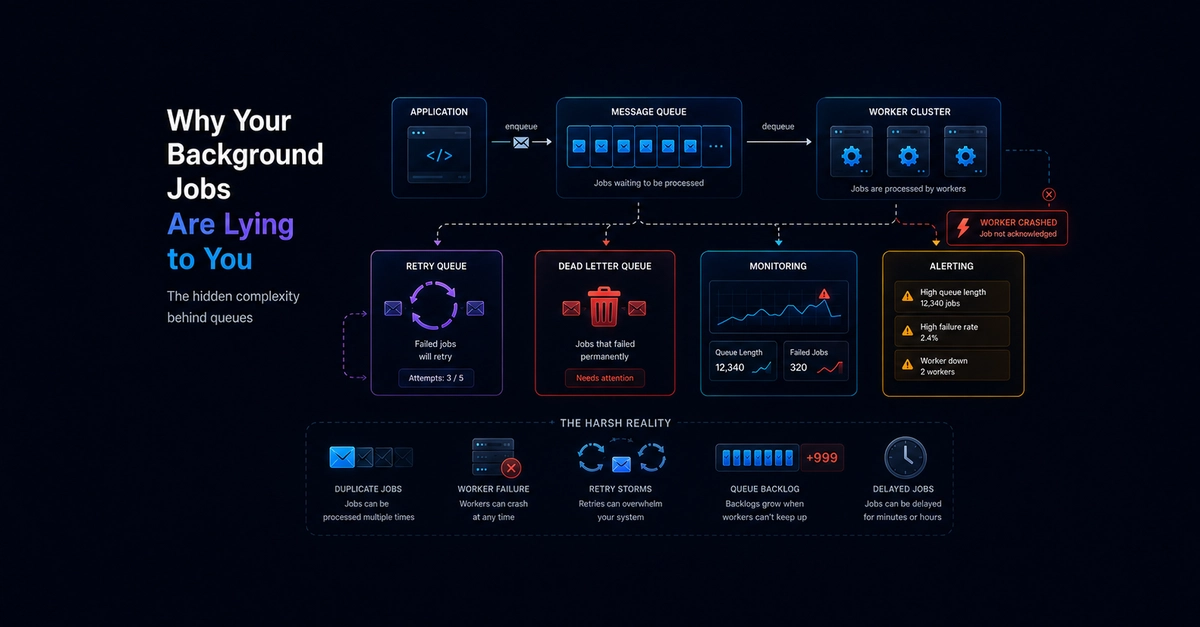
A background worker sits quietly for weeks, chewing through a job queue without incident, and then one Tuesday afternoon it disappears mid-batch, taking forty in-flight jobs down with it. No stack trace pointing at the offending line, no alert until a customer notices their export never finished. Nine times out of ten, the culprit is one of the most under-discussed failure modes in server-side JavaScript: unhandled promise rejections. They are easy to introduce, easy to miss in code review, and in modern Node.js they no longer just print a warning — they can end your process outright. This post walks through what unhandled promise rejections actually are at the engine level, why they are far more dangerous in long-running Node.js services than in typical web requests, how Node's default behavior around them has shifted over the years, and the concrete patterns you can use to stop them from quietly killing your jobs.
What an Unhandled Promise Rejection Actually Is
At the JavaScript engine level, a promise is a state machine with three possible states: pending, fulfilled, or rejected. When an async operation fails — a network call times out, a database query throws, a JSON parse blows up — the promise representing that operation transitions to the rejected state and carries a reason, usually an Error object. That's all a rejection is: a value flowing down the promise's error channel instead of its success channel.