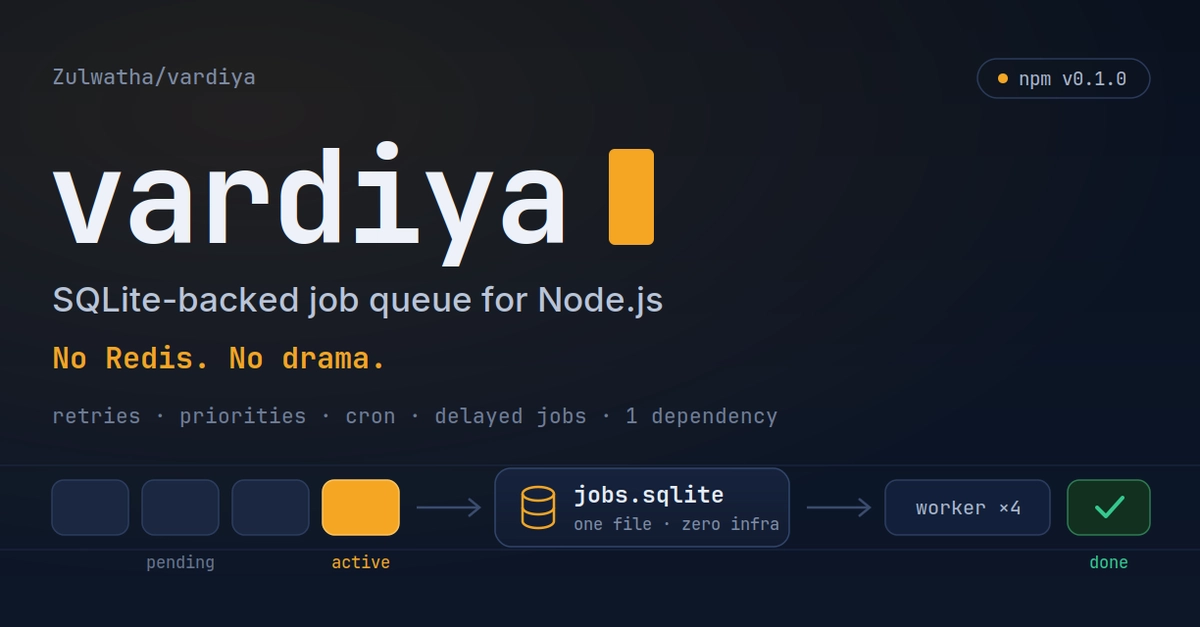
Stop Installing Redis Just to Run Background Jobs
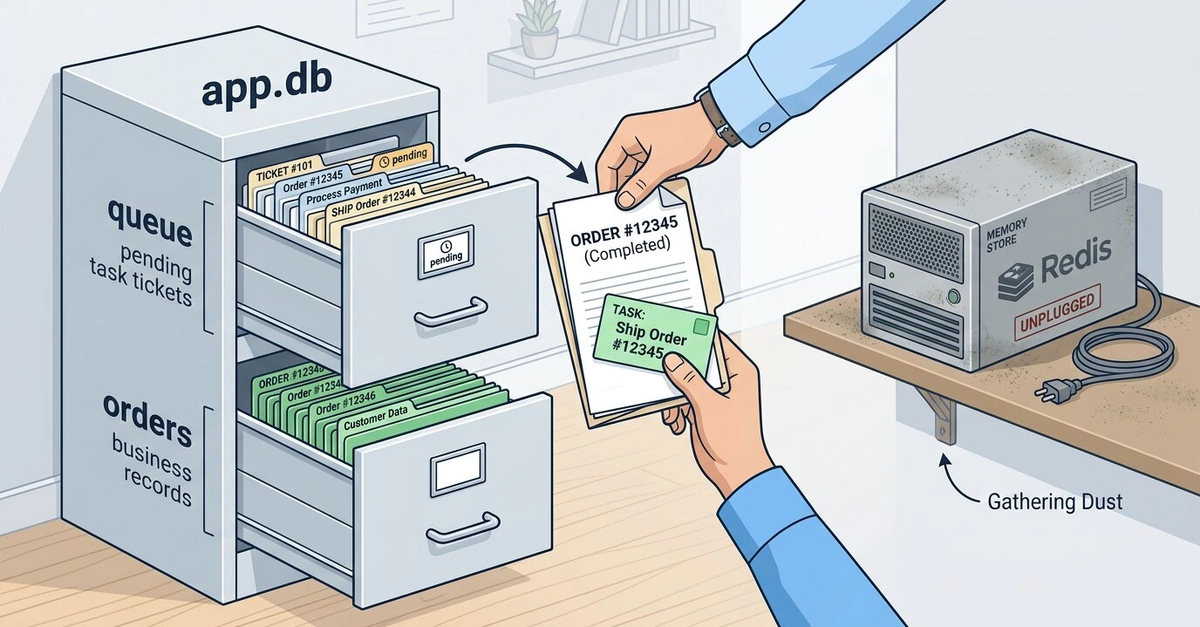
Most Node.js apps reach for Redis the moment they need background jobs. But before you add that dependency, it's worth understanding what's actually happening under the hood — because it's more than most people realise.
Every enqueue is a network call. Your app serializes the job payload, opens a TCP connection (or borrows one from the pool), performs a TLS handshake if the connection is remote, sends the command, and waits for an acknowledgement. On a local network that's a few milliseconds. On a managed Redis instance, it's more. It adds up.
Durability is not free. By default, Redis is an in-memory store. To make jobs survive a restart you need to configure AOF (Append Only File) or RDB snapshots — which means tuning fsync behaviour, understanding the tradeoffs between always, everysec, and no, and accepting that in some failure modes you still lose the last second of writes. Getting this right for a job queue is non-trivial.
A single instance is a single point of failure. If Redis goes down — the process crashes, the container restarts, the managed service has an outage — your queue stops. To harden that you need Redis Sentinel or Cluster, which introduces leader election, replication lag, and split-brain scenarios. For a single-server app, you now have more infrastructure complexity than the application itself.