in Philosophy, Religion, Science | July 23rd, 2026 Leave a Comment
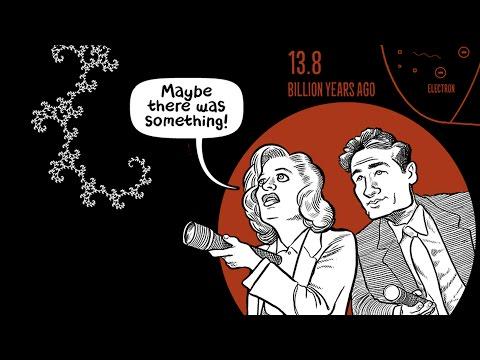
We previously brought you the BBC series of short animated videos, A History of Ideas. Produced in collaboration with the UK’s Open University and narrated by Harry Shearer, these fun introductions to such philosophers as Simone de Beauvoir and Edmund Burke, and such weighty philosophical topics as free will and the problem of evil, make challenging, abstract concepts accessible to non-philosophers. Now the series is back with a new chapter, How Did Everything Begin?, a survey of several theories of the origins of the universe, from Thomas Aquinas’ philosophical speculations, to Hindu cosmology; and from theologian William Paley’s design argument (below), to the theory of the Big Bang (above).
The two videos here present an interesting counterpoint between the origin theories of astrophysics and theology. Though current-day intelligent design proponents deny it, there is still much of William Paley’s argument, at least in style, in their explanations of creation. First propounded in his 1802 work Natural Theology, the theologian’s famous watchmaker analogy—which he extended to the design of the eye, and everything else—gave Charles Darwin much to puzzle over, though David Hume had supposedly refuted Paley’s arguments 50 years earlier. The Big Bang theory—a term created by its foremost critic Fred Hoyle—offers an entirely naturalistic account of the universe’s origins, one that presupposes no inherent purpose or design.