Back to Articles
Large diffusion transformers can create stunning images (or even videos, audio snippets, and now text), but loading a modern text-to-image model in BF16 precision often requires 20-30 GB of VRAM, which puts these models out of reach of most consumer GPUs. Quantization is a powerful solution to this problem, and Diffusers already integrates several quantization backends such as bitsandbytes, GGUF, torchao, and Quanto, which we covered in Exploring Quantization Backends in Diffusers.
Most of these backends are weight-only. This means that they store the weights in low precision and dequantize them back to high precision at compute time. This reduces memory usage significantly, but it usually does not make inference faster, and can even add a small latency overhead.
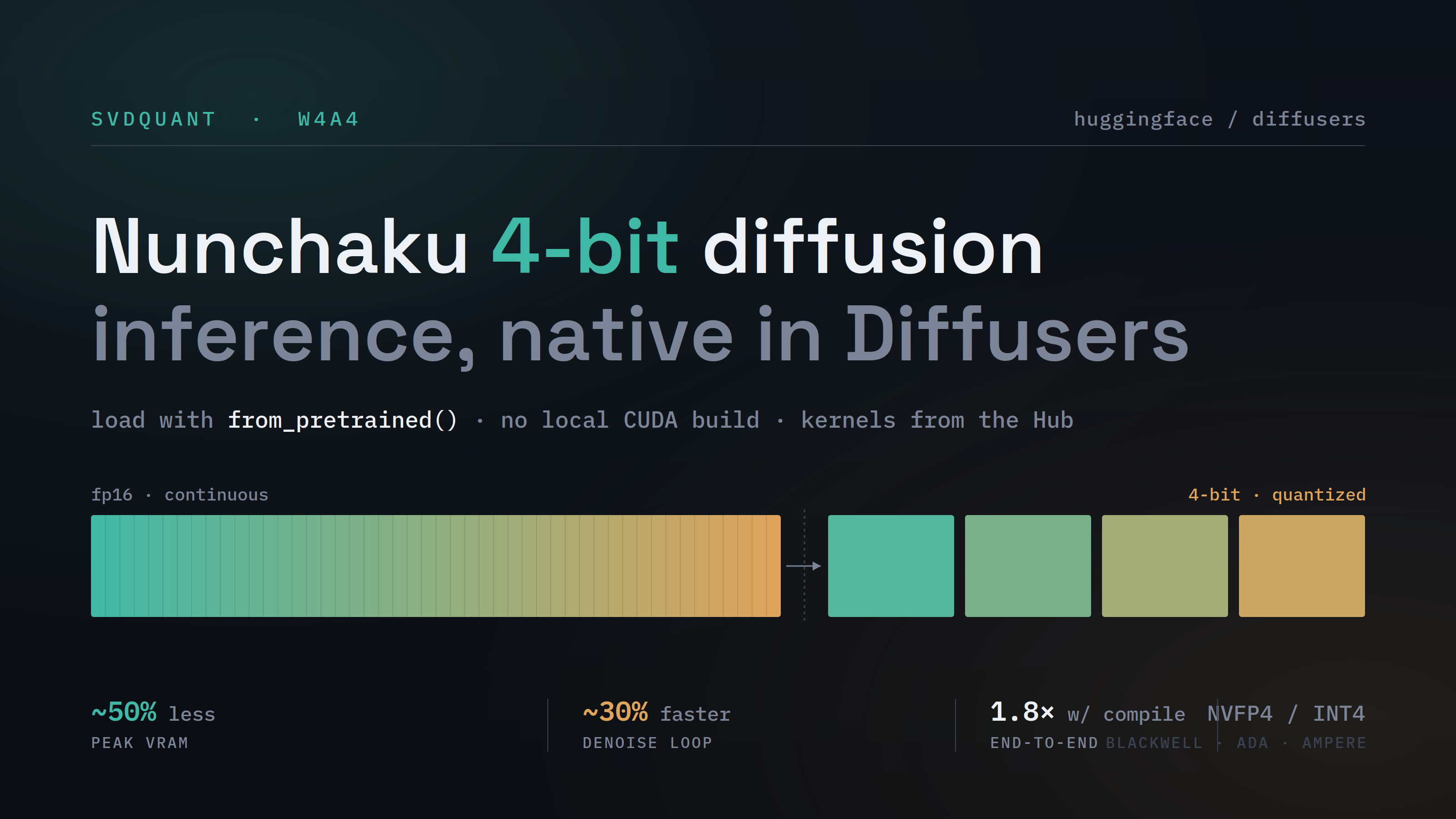
SVDQuant, the quantization method behind the popular Nunchaku inference engine, takes a different approach. It runs the main transformer layers with 4-bit weights and activations (W4A4), reducing memory while also speeding up the denoising loop. The details are covered below, but until now, using these checkpoints required a separate inference library.
With current Diffusers, loading a Nunchaku checkpoint is as simple as calling from_pretrained(), with no local CUDA compilation required thanks to the kernels package. In addition, the companion diffuse-compressor toolkit lets you quantize new architectures yourself and publish them as regular Diffusers repositories.