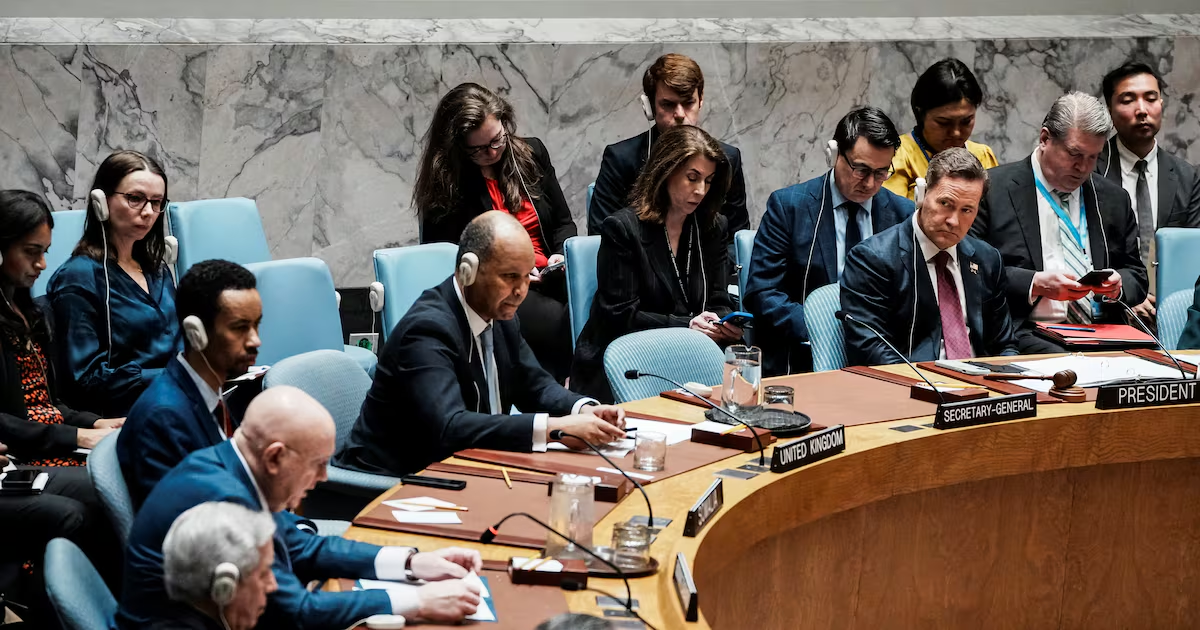
For South Africa, the UN negotiations on a Convention on International Tax Co-operation, which resume in New York next month, matter far beyond technical fiscal concerns. The country faces a confluence of great-power rivalry, war and fragmentation, carrying an old wound: 50 years of capital flight have left African treasuries starved of revenue.The US war against Iran has kept the Strait of Hormuz — artery for much of the world’s gas, oil and fertiliser — closed since February, with conflicts also grinding on in Ukraine, Gaza and Sudan. The UN Conference on Trade & Development reports the collapse in Hormuz transits will cut global trade growth from 4.7% to 1.5% this year — a drag South Africa, an oil importer exposed to global risk sentiment, cannot easily absorb.Capital flight feeds on exactly what these wars generate: uncertainty, soaring debt costs, tax evasion and avoidance, and distracted enforcement.(Karen Moolman) The disorder runs deeper than wars. The UN faces sustained attack from its largest funder — what its secretary-general has called the risk of imminent collapse. Defunding the UN does not make the world safer; it makes it more lawless, as African countries need a rules-based forum where every state has a vote. South Africa has had its own preview: having chaired the G20 last year, it was barred outright from this year’s summit — the first such exclusion in the group’s history. Clubs of the powerful can revoke a seat on a whim; a UN convention, ratified by all, cannot be undone by one government’s displeasure.This is the backdrop to an inequality without precedent. The World Inequality Report 2026 finds that 56,000 people — a crowd that would fit inside a football stadium — own three times more wealth than the poorest half of humanity, while effective tax rates fall sharply for the very richest. South Africa carries this contradiction sharply at home: it remains among Earth’s most unequal societies. Stats SA’s latest labour force survey put the official unemployment rate at 32.7% in the first quarter of 2026, up from 31.4% the previous quarter, with a broader measure that also counts discouraged and underemployed workers reaching 46.3% — even as some of its largest companies and wealthiest individuals shelter income offshore. Moreover, each year about 1% of global GDP flows from poorer to richer countries through the “exorbitant privilege” of reserve-currency economies.In our research with James K Boyce we estimated that 30 African countries lost $2.7-trillion to capital flight between 1970 and 2022 — about their combined GDP — and that the continent loses about $97bn annually through unrecorded outflows. South Africa occupies the unenviable position of the second-highest victim of capital flight on the continent after Nigeria, with a total loss of $422bn over the past five decades. With the continent’s most developed financial sector, South Africa is at the centre of these flows: a sophisticated banking system is not sufficiently appealing to prevent capital from moving quietly across borders. How we design our tax systems is a policy choice, not fate. The International Centre for Tax & Development found that two decades of standards designed by the Organisation for Economic Co-operation & Development (OECD) delivered benefits that were uneven, slow and expensive — a good reason to seek solutions at the UN, where every country has a voice and a vote.What should African negotiators, South Africa among them, defend at the UN in August?An ambitious tax convention. Today’s OECD-based rules limit Africa’s rights to tax multinational profits, through bilateral treaties and transfer pricing rules that allocate little profit to activities on the continent — including mining and resource extraction at the heart of South Africa’s economy. The UN Convention can change this by granting taxing rights to any jurisdiction that materially contributes to profit — where data is generated, infrastructure sustains the market, or consumption occurs.A strong protocol on cross-border services should let countries where services are delivered and used tax them.Truly universal automatic information exchange, public country-by-country reporting requiring multinationals to disclose how much tax they pay in each of the countries where they operate, the possibility of using exchanged information for a wider set of purposes — not only for tax — and interconnected registries of assets and beneficial owners, which for Africa involves security policy as much as tax policy. The African Convention on Mercenarism already criminalises those who finance and recruit armed groups, but African prosecutors cannot follow the money without the evidence trail that beneficial-ownership registries would provide. This is not abstract for South Africa: a recent investigation by Al Jazeera found that Mexican cartels have near-shored methamphetamine production to South African farms, using precursor chemicals sourced from Asia, exactly the kind of opaque land and corporate ownership that beneficial-ownership registries are designed to expose.The latest Tax Transparency in Africa report shows the importance of binding transparency mechanisms: 11 African countries identified nearly €400m in additional revenue in 2024 alone through exchange of tax information — more than €4.2bn since 2009. Where there is political will, transparency converts directly into revenue, which South Africa could invest in hiring more doctors, nurses and teachers or in funding a universal basic income.These gains are a fraction of what is lost. The International Tax Observatory finds that 37% of Sub-Saharan Africa’s offshore wealth is invisible to countries outside the Common Reporting Standard, while Africans hold 56% of that wealth in Europe and 28% in Switzerland. The information exists; it should reach African tax authorities.Not all the news is grim: The Economist expects African GDP growth to outpace Asia’s in 2026. What the continent lacks is not dynamism but fiscal space to close a 40:1 gap in education spending and build states strong enough to face criminal networks fed by war.Africa must speak with one united voice. It was the Africa Group that brought this process to the UN General Assembly in 2022 and carried it forward, against formidable OECD resistance. Wealthy countries will keep working to dilute real change to a status quo that limits African taxing rights. Protecting that unity is the asset that created this process — and can complete it.In a world being remade by force, next month’s negotiations offer a chance to reshape one corner of it according to the rule of law. Africa should seize this opportunity, treating potential new tax revenues not as the prize itself but as the first instalment on a more durable political and legal settlement. South Africa’s role is critical in mobilising Africa’s voice towards this goal.• Ndikumana is a commissioner of the Independent Commission for the Reform of International Corporate Taxation, distinguished professor of economics at the University of Massachusetts Amherst, and former director of research at the African Development Bank.
LÉONCE NDIKUMANA | In a world remade by force, SA should bet on UN tax rules
New tax transparency measures could unlock billions for African development
1,116 words~5 min read