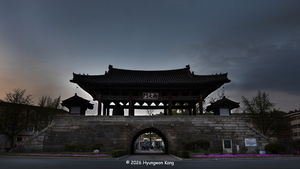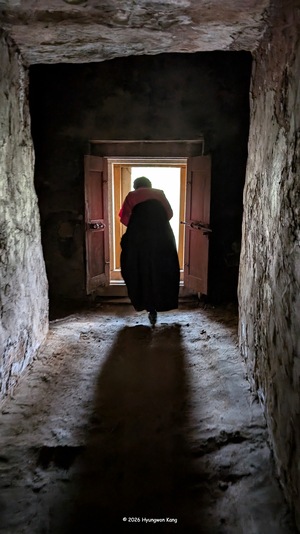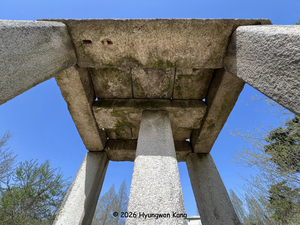
Taedongmun gate, designated as National Treasure No. 4, was built in the sixth century as the eastern entrance to Pyongyang Fortress. (Hyungwon Kang) For centuries, historians have debated a deceptively simple question: Where was the capital of Goguryeo?The question puzzled scholars even during the reign of King Sejong the Great. In 1427, Minister of Rites Shin Sang reported that while the capitals of Silla and Baekje could be identified, "the capital of Goguryeo is unknown." Perhaps the question itself is too narrow.Rather than revolving around a single permanent capital, Goguryeo -- or Koguryo, as it is known in the North -- evolved through at least three major centers of political, military and cultural importance. Taedongmun gate, the eastern entrance to Pyongyang Fortress, in Pyongyang. (Hyungwon Kang) The first was the Beijing–Yanshan region. In his PhD dissertation, Dr. Ki-hoon Yi argues that Hwando fortress, identified with Goguryeo's second capital of Gungnae, was located near present-day Beijing — not at Ji'an on the Yalu River.Dr. Yi's academic theory presents a fundamental challenge to the conventional interpretation of Goguryeo's early capitals. In my assessment, a comparison of his research with the conventional view suggests that the prevailing interpretation reflects historical narratives shaped during the 20th century under Japanese colonial scholarship and subsequently retained by much of today's academic establishment.Dr. Yi's theory demonstrates that Goguryeo's historical geography remains an active subject of scholarly debate. Pyongyang residents walk through Chilsongmun gate, designated as National Treasure No. 17, the northern gate of Pyongyang Fortress, in Pyongyang. (Hyungwon Kang) The second great center was the Ji'an region in today's Jilin Province, China, one of the world's richest archaeological landscapes of Goguryeo civilization.More than 12,000 Goguryeo tombs are distributed throughout Ji'an. Among them are monumental pyramid-like stone cairn tombs, or "jeokseokchong," including the Tomb of King Gwanggaeto, the Tomb of King Jangsu and more than 10 additional royal tombs. These stepped stone monuments — often described as the Goguryeo pyramids — reflect the engineering sophistication and political power of one of East Asia's great ancient kingdoms. Exquisite rounded corner masonry of the stone fortification beneath Ulmil Pavilion, a sixth-century structure designated as National Treasure No. 19, at the northern end of the 16-kilometer-long Pyongyang Fortress enclosing central Pyongyang between two rivers. (Hyungwon Kang) Goguryeo's commitment to honoring its ancestors is recorded on the Gwanggaeto Stele, which was built in 414. The monument states that 330 households were assigned to protect the royal tombs — 30 households serving as direct guardians and 300 households providing labor, supplies and financial support. Assuming five people per household, more than 1,500 people were dedicated to maintaining the royal cemeteries. Recording this administrative system on the stele demonstrates how central ancestor veneration and royal-tomb protection were to Goguryeo statecraft.Why did Goguryeo devote such extraordinary resources to its royal tombs?One possible explanation lies in a devastating episode in Goguryeo history. In 342, Former Yan forces captured the capital, desecrated the tomb of King Micheon, carried away his remains and took members of the royal family hostage. This was not merely a military defeat but a dynastic catastrophe.According to Dr. Yi's interpretation, this trauma helps explain why Goguryeo later concentrated its royal cemeteries in the Ji'an region, separating its kings' burial grounds from political centers farther west. The Juche Tower is seen across the Taedong River in the early morning in Pyongyang. Central Pyongyang lies on an island between two rivers. (Hyungwon Kang) The third great center was Pyongyang.Long before becoming Goguryeo's final capital, Pyongyang had emerged as the kingdom's principal southern military base. The Samguk sagi, or History of the Three Kingdoms, says that King Micheon relocated thousands of captives there after his campaigns. Later kings expanded Pyongyang Fortress and made the city a foundation for southern expansion. Following the invasion of 342, Goguryeo strengthened the city's fortifications and constructed a network of defensive mountain fortresses around it. North Korean postage stamps on display in Pyongyang depict Goguryeo soldiers wearing different styles of armor spanning more than a thousand years of Goguryeo history, from the 3rd century BC to the 7th century AD. (Hyungwon Kang) The Pyongyang region also contains tens of thousands of Goguryeo tombs extending across Daesongsan and surrounding districts. Together with its stone fortifications and mountain fortresses, they demonstrate that Pyongyang was not merely a frontier outpost but one of late Goguryeo's largest political, military and cultural centers.During my visit to Pyongyang in April 2026, I photographed fortress walls displaying the distinctive stone masonry of Goguryeo engineering. Standing atop those walls, it became clear that Pyongyang does not need to claim the status of Goguryeo's only or earliest capital to establish its historical significance. Taedongmun gate in Pyongyang (Hyungwon Kang) Goguryeo's story was never confined to a single city. Its civilization extended across political centers, royal burial landscapes and military strongholds. The Beijing–Yanshan region, the Ji'an royal necropolis and Pyongyang each preserve a different chapter of that history.Among them, Pyongyang remains one of the greatest surviving landscapes of Goguryeo civilization. Its ancient fortresses and vast concentrations of tombs testify that Goguryeo was not the story of one capital, but of a civilization whose legacy stretched across multiple centers over many centuries. Schoolgirls climb the stone fortress walls beneath Ulmil Pavilion, a sixth-century structure designated as National Treasure No. 19, at the northern end of the 16-kilometer-long Pyongyang Fortress, which encloses central Pyongyang between two rivers. (Hyungwon Kang) Hyungwon Kang By Hyungwon KangHyungwon Kang is a Korean American photojournalist, columnist, author and two-time Pulitzer Prize winner. He reported on North Korea in 1995, 1997 and 2026. Kang is the author of "Visual History of Korea" and "Seonbi Country Korea, Seeking Sagehood," and his ongoing Visual History of Korea project documents Korean history and culture across all of Korea for global audiences.The views expressed in this article are the writer’s own. — Ed.
Pyongyang: One of the great centers of Goguryeo civilization
For centuries, historians have debated a deceptively simple question: Where was the capital of Goguryeo? The question puzzled scholars even during the reign of
971 words~4 min read