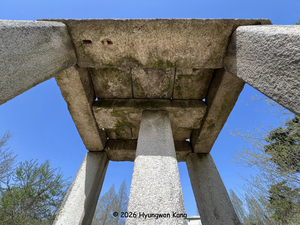
The Goryeo Kingdom's Cheomseongdae in Kaesong, now part of the UNESCO-listed Historic Monuments and Sites of Kaesong in North Korea, stands 247 centimeters tall. Four square granite pillars, together with a central pillar support, uphold eight granite lintels — five supporting lintels with three spanning across them — to form a broad, flat platform. Grooves carved into the summit once anchored a wooden observation structure, allowing it to serve as both an astronomical and meteorological observatory for the Goryeo court. (Hyungwon Kang) In April, I stood before the Goryeo Kingdom's Cheomseongdae in Kaesong, once known as Hwangdo, the imperial capital of Goryeo, and now one of the UNESCO World Heritage Historic Monuments and Sites in Kaesong, North Korea.Unlike the towering 9.17-meter stone Cheomseongdae observatory built during the Silla Kingdom in Gyeongju, Kaesong's Cheomseongdae appears almost understated, standing only 2.47 meters tall.Yet appearances are deceiving. Four square granite pillars, together with a central support pillar, uphold eight granite lintels — five supporting lintels with three spanning across them — to form a broad, flat platform. Grooves carved into the summit once anchored a wooden superstructure, allowing the observatory to serve both astronomical and meteorological functions for the Goryeo court.It stands as a testament to one of the world's oldest continuous traditions of astronomical observation. The Goryeo Kingdom's Cheomseongdae observatory in Kaesong, now part of the UNESCO World Heritage Site Historic Monuments and Sites in Kaesong, North Korea (Hyungwon Kang) Heaven's guiding signsFor ancient Koreans, the night sky was the language of heaven. The movements of the sun, moon, planets and stars were believed to shape earthly events. Comets foretold political upheaval; meteors signaled the passing of a great figure or the birth of one destined for greatness. According to tradition, a great star fell on the night the Goryeo Seonbi Kang Kamchan (948-1031) was born, giving Nakseongdae ("Place Where the Star Fell") its name. Kang later led Goryeo to victory over the Khitans in 1019, ending the Third Goryeo-Khitan War — a clash of empires. Eclipses demanded careful interpretation, while the annual movement of constellations guided the agricultural calendar.Astronomy and meteorology became essential instruments of government.Generations of court astronomers observed both the heavens and the weather, producing increasingly accurate calendars that guided planting and harvesting. Their work enabled Korean farmers to align agricultural activities with the seasonal cycle, contributing to more reliable harvests and the prosperity of one of East Asia's oldest civilizations. The Goryeo Kingdom's Cheomseongdae observatory in Kaesong
Kaesong Cheomseongdae: Astronomical tradition behind Korea's greatest star map
In April, I stood before the Goryeo Kingdom's Cheomseongdae in Kaesong, once known as Hwangdo, the imperial capital of Goryeo, and now one of the UNESCO World H
974 words~4 min read