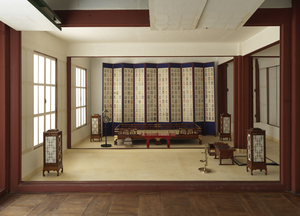
Jeukjodang (Korea Heritage Service) Jeukjodang, a palace hall next to Seokjojeon at Deoksugung, is known as the site where Joseon kings Gwanghaegun (r. 1608-23) and Injo (r. 1623-49) ascended the throne. The term "jeukjo" means "the king's enthronement."During the early Korean Empire, the building served as the main throne hall before later being used as the emperor's office.The previously empty hall, which visitors could only view from outside, will open to the public from Tuesday through June 21 as part of the "Re-creation of Interior Crafts in Palace Buildings" project.Visitors can remove their shoes and step inside to explore its recreated interior, where 14 pieces representing 11 types of furnishings — including a wooden platform, a reading table with silver-inlaid candlesticks, a folding screen, an inkstone box and a lamp — offer a glimpse into life at the royal court.The recreation project is a joint initiative by the Korea Heritage Service's Deoksugung Management Office and the nonprofit Arumjigi Foundation, supported by Hermes, to recreate the interiors of historic palace buildings.The project began in 2015 at Hamnyeongjeon in Deoksugung, expanded to Jeukjodang from 2018 to 2021, moved to Sajeongjeon in Gyeongbokgung from 2022 to 2024, and has focused on Geunjeongjeon since last year.The furnishings were produced by nationally recognized traditional artisans based on research and expert consultation, drawing on artifacts preserved by the National Palace Museum of Korea, the National Museum of Korea and the National Folk Museum of Korea."Although the exhibition is modest in scale, it offers one of the most meaningful opportunities to see how palace spaces remain living environments and how the skills and spirit of traditional artisans are carried into the future," an official from the Arumjigi Foundation said Monday during a press preview.The exhibition is open to all visiting Deoksugung. Guided entry is available every hour on the hour from 10 a.m. to 4 p.m. under the supervision of a docent.
Recreated furnishings bring Joseon king's space at Deoksugung to life
Jeukjodang, a palace hall next to Seokjojeon at Deoksugung, is known as the site where Joseon kings Gwanghaegun (r. 1608-23) and Injo (r. 1623-49) ascended the
316 words~1 min read