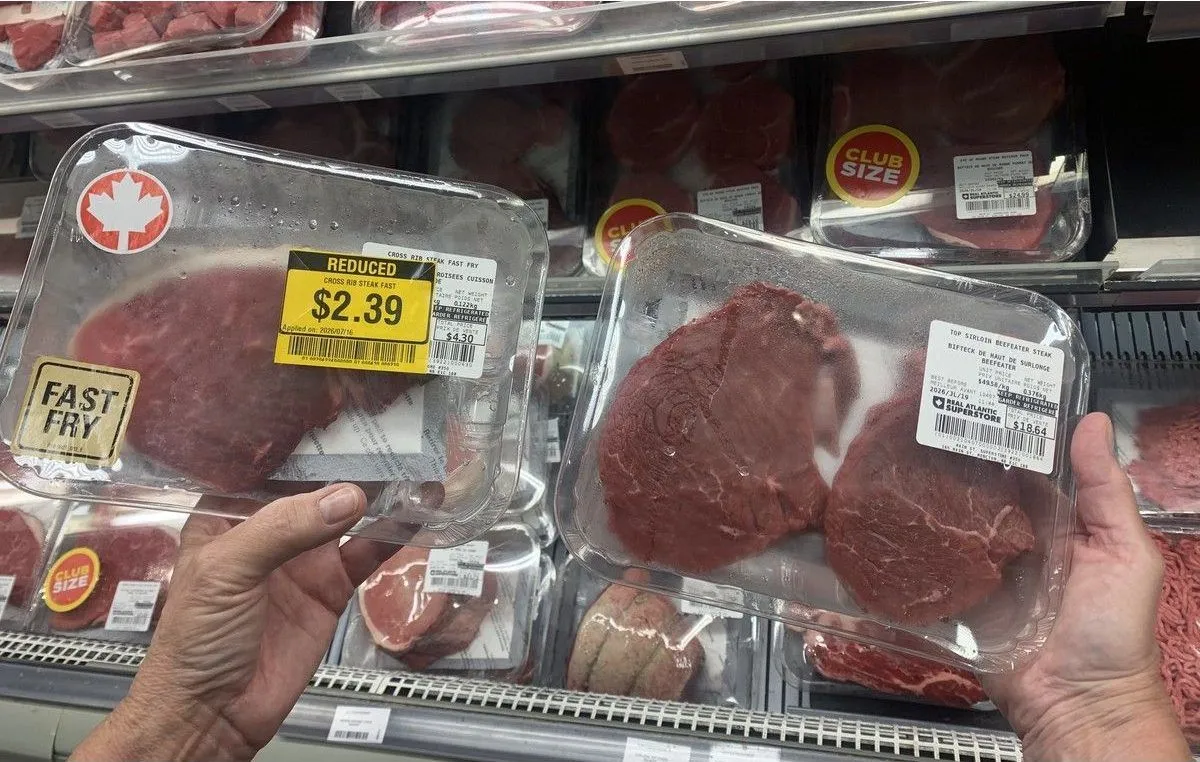
Skip to Content News Archives Economy Energy Oil & Gas Renewables Electric Vehicles Mining Commodities Agriculture Real Estate Mortgages Mortgage Rates Finance Banking Insurance Fintech Cryptocurrency Work Wealth Smart Money Wealth Management Investor Personal Finance Family Finance Retirement Taxes High Net Worth FP Comment Executive Women Puzzmo Newsletters Financial Times Business Essentials More Innovation Information Technology FP500 Podcasts Small Business Lives Told Tails Told Shopping Financial Post Store Obituaries Place a Notice Advertising Advertising With Us Advertising Solutions Postmedia Ad Manager Sponsorship Requests Classifieds Place a Classifieds ad Working Profile Settings My Subscriptions Saved Articles My Offers Newsletters Customer Service FAQ News Economy Energy Mining Real Estate Finance Work Wealth Investor FP Comment Executive Women Puzzmo Newsletters Financial Times Business Essentials HomeNewsEconomyWhy Atlantic Canadians are the country's most stressed grocery shoppers80% of those surveyed in the Maritimes say their grocery bill keeps climbing no matter what they cutLast updated 23 hours ago You can save this article by registering for free here. Or sign-in if you have an account.Interac Corp's State of the Cart spending survey found Atlantic Canadians are the most stressed grocery shoppers in the country and more likely to say they've been forced into food trade-offs they're unhappy with. Photo by PAYGE WOODARD/BRUNSWICK NEWSPeople in Atlantic Canada are the most stressed grocery shoppers in the country, according to Interac Corp’s State of the Cart spending survey.Subscribe now to read the latest news in your city and across Canada.Exclusive articles from Barbara Shecter, Joe O'Connor, Gabriel Friedman, and others.Daily content from Financial Times, the world's leading global business publication.Unlimited online access to read articles from Financial Post, National Post and 15 news sites across Canada with one account.National Post ePaper, an electronic replica of the print edition to view on any device, share and comment on.Daily puzzles, including the New York Times Crossword.Subscribe now to read the latest news in your city and across Canada.Exclusive articles from Barbara Shecter, Joe O'Connor, Gabriel Friedman and others.Daily content from Financial Times, the world's leading global business publication.Unlimited online access to read articles from Financial Post, National Post and 15 news sites across Canada with one account.National Post ePaper, an electronic replica of the print edition to view on any device, share and comment on.Daily puzzles, including the New York Times Crossword.Create an account or sign in to continue with your reading experience.Access articles from across Canada with one account.Share your thoughts and join the conversation in the comments.Enjoy additional articles per month.Get email updates from your favourite authors.Create an account or sign in to continue with your reading experience.Access articles from across Canada with one accountShare your thoughts and join the conversation in the commentsEnjoy additional articles per monthGet email updates from your favourite authorsSign In or Create an AccountorReleased last month, the payment company surveyed 1,500 Canadians between May 8 and 12, 2026.According to the results, 80 per cent of those surveyed in Atlantic Canada say grocery bill keeps climbing no matter what they cut.Atlantic Canadians reported higher levels of stress than the national average, with 73 per cent saying grocery shopping feels more stressful than it used to. Nationally, that number was 60 per cent.SUBSCRIBER EXCLUSIVE: FP West: Energy Insider brings you behind the oilpatch’s closed doors with exclusive insights from insiders every Wednesday morning.By signing up you consent to receive the above newsletter from Postmedia Network Inc.A welcome email is on its way. If you don't see it, please check your junk folder.The next issue of FP West: Energy Insider will soon be in your inbox.We encountered an issue signing you up. Please try againEast Coast grocery shoppers were also more likely to say they’ve been forced into food trade-offs, with 66 per cent saying they have had to make swaps compared to 54 per cent nationally.While shoppers who live alone said they face disproportionately higher per-person costs than Canadians who split grocery expenses, the survey found food shopping is no picnic for couples. Twenty-eight per cent said grocery spending has been a source of strain in their relationship in the past six months.“There’s a secondary layer that is so important to us, because when you are making those trade-offs but you still want to have fun and you still want to protect your relationship, what are ways you can go about doing that?” said Lauren Mostowyk, Interac’s head of corporate affairs and partnerships.“There are a number of ways that people are doing this, including cutting back on premium cuts of meat, switching to discount or store brand versus an expensive brand.”Mostowyk explained Interac is the payment product in everybody’s pocket, so the company is interested in learning how Canadians use their products.One thing Interac’s survey found is that Canadians are drawing the line at small indulgences, with 50 per cent saying they still buy snacks like chips and chocolate and 23 per cent still reaching for artisanal bread or pastries.“The small joys are still top of mind for everybody who’s shopping,” Mostowyk said. “Despite the fact you’re managing your grocery list, you’re thinking about how to stretch your dollar, people are still saying I need something that brings me joy that I’m pulling out of the kitchen cupboard … People aren’t ready to trade it all off.”Mostowyk said Interac does spending pulse checks a couple of times a year to get a sense of various trends, and said they will likely conduct another State of the Cart survey later this year.“My team is constantly looking for new ways to tell the spending story of Canada,” she said.The survey results weren’t surprising to Sylvain Charlebois, director of the Agri-Food Analytics Lab at Dalhousie University.On average, he said, the typical Canadian spends about 22 per cent of their after-tax budget on food.“That’s the disposable income portion, and that percentage is actually quite significant,” he said.On the East Coast, that near quarter of the budget will also likely result in fewer bags of groceries coming home.“The food inflation rate has historically always been higher in the Atlantic. It’s a harder market to service given the distances and everything else, so we’re vulnerable to energy costs,” he said. “I’m not surprised that Atlantic Canadians are under tremendous stress. You only need to travel a little bit to realize there is a huge difference between prices we see here in our region versus the prices we would see in major urban centres like Toronto and Montreal.”Charlebois agreed with the findings about trade-offs, saying consumers are mostly trading down when it comes to which brands they choose and what kinds of food they’re eating.Any hope that prices could come down is slim, with Charlebois saying the entire supply chain adjusts to higher prices and costs, and if those costs go down, it doesn’t necessarily mean the prices will.He said whether it’s a new tax or energy costs driving up prices, the higher price tends to become the new normal for companies.“It’s like the tide,” Charlebois said. “The tide will actually make its mark on a beach or on a dock, and that line remains. That becomes a mental line that the industry tends to use.”On the East Coast, shoppers have fewer options than elsewhere in the country, Charlebois noted.“We need more competition up the food chain with manufacturing so retailers have more options to offer and more variety, and that’s what’s missing right now,” he said.In June, Ottawa announced the launch of the National Food Security Strategy. It aims to create more choice. According to a government release, the strategy is backed by more than $3 billion in investments over 10 years.“This strategy will break open the market for independent retailers, boost domestic food production, and build a stronger, more independent, and more affordable food system for all Canadians,” it reads.Of the $3 billion investment, the release says $1 billion of that will be invested in food infrastructure to build new and expanded food terminals and hubs to help independent grocers buy and move competitively priced products without relying on large retail chains.The plan’s other pillars are to boost domestic food production across Canada, grow fruits and vegetables year-round and cut red tape across the agricultural supply chain.“Is it going to help? Only time will tell,” Charlebois said of the plan. “But I think there is this recognition that we need to do something, so at least there’s that.”Charlebois said grocers can exercise a lot of power over their suppliers.“That’s the point I’ve been trying to make for years,” he said. “I do think there is an unhealthy relationship between grocers and suppliers right now, and it’s often penalizing consumers in the end.”As an example, Charlebois said a grocer like Loblaws Company Ltd. may buy a three-month supply of a product and tell the supplier the store will promote it at 10 per cent off for a week, but the grocer will actually ask the manufacturer to sell the entire three-month inventory at 10 per cent off.After the sale, he said the grocer will increase prices and increase its profit.He said that leads the manufacturer to then increase its prices.“That yo-yo game up the food chain is basically pushing prices higher, so margins may not be increasing all that much at retail, but it is actually making inflation a worse problem,” he said.When asked about affordability, Financial Post received an emailed response from Loblaws’ public relations team saying the company knows affordability remains a key concern for many customers.“That’s why we remain focused on delivering value through weekly promotions, PC Optimum offers, price matching where available, and a strong assortment of control brand products, including No Name. We also continue to invest in our discount banners to provide more options for customers in Atlantic Canada,” it reads.On the relationship between grocers and suppliers, the email said they work closely with suppliers to provide customers with the best possible value while continuing to offer the quality, selection and availability they expect.“Food prices are influenced by a range of factors across the supply chain, including commodity costs, labour, transportation, currency and other input costs,” it reads.When it comes to affordability, Charlebois said grocers have the most control within the supply chain.“They set prices,” he said. “It’s up to us to decide whether it’s too expensive or not, but at some point you have to eat.” Join the Conversation This website uses cookies to personalize your content (including ads), and allows us to analyze our traffic. Read more about cookies here. By continuing to use our site, you agree to our Terms of Use and Privacy Policy.
Why Atlantic Canadians are the country's most stressed grocery shoppers
Interac Corp's State of the Cart spending survey found Atlantic Canadians are the most stressed grocery shoppers in Canada.
1,752 words~8 min read