Data availabilityscRNA-seq, scTCR-seq and bulk RNA-seq data are available through the dbGaP portal: from cohort 1, scRNA-seq and scTCR-seq data are available under accession phs002252.v1.p1; bulk RNA-seq data are available under accession phs002252.v2.p1. From cohort 2, all raw data for P101–P110 are available under accession phs003710.v1.p1, and data from P111–P112 are under phs003710.v2.p1. Spatial RNA-seq and TCR-seq data are available at the Broad Single Cell Portal (https://singlecell.broadinstitute.org/single_cell/study/SCP3155), as are both bead-level data relating to Extended Data Fig. 9c,d, Supplementary Figs. 8, 9, 12, 13 and 18 and the RSEM output for CA9-selected bulk RNA-seq. ProjecTILs atlas for CD4+ and CD8+T cells available at Figshare (https://doi.org/10.6084/m9.figshare.21981536 and https://doi.org/10.6084/m9.figshare.23608308)99,100. All data are available from the corresponding authors on reasonable request. Source data are provided with this paper.Code availabilityThe code for all packages used, including Seurat (v.4.1.0, v.4.3.0, v.4.4.0, v.5.0.1, v.5.2.1), NetMHCPan4.1 (for binding prediction), ABSOLUTE (v.1.5), RANN (v.2.6.2), Harmony (v.1.2.3), LIANA (v.0.1.13), scanpy (v.1.9.3), SeuratWrappers (v.0.3.5) and SCTransform (v.0.4.1), is available publicly. The code used to perform TCR clonotype grouping is available at GitHub (https://github.com/kstromhaug/oliveira-stromhaug-melanoma-tcrs-phenotypes). All other code used for single-cell, bulk RNA and spatial analyses is available at GitHub (https://github.com/chloetutu/AfeyanNaglerTu_RCC/tree/main).References Hugaboom, M. B. et al. Presence of tertiary lymphoid structures and exhausted tissue-resident T cells determines clinical response to PD-1 blockade in renal cell carcinoma. Cancer Discov. https://doi.org/10.1158/2159-8290.CD-24-0991 (2025).Article
Tertiary lymphoid structures harbour stem-like tumour-specific T cells - Nature
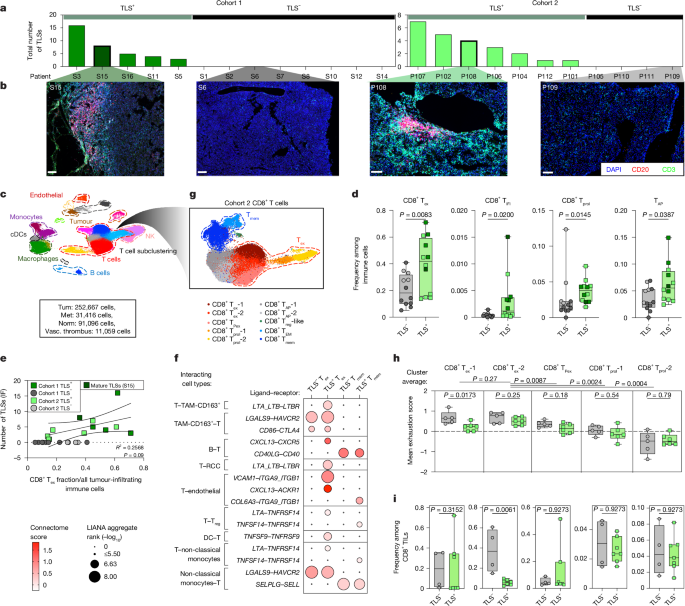
Renal cell carcinoma tumours containing tertiary lymphoid structures (TLSs) are enriched for exhausted CD8+ T cells, including tumour-specific clonotypes with stem-like progenitor features and reduced terminal exhaustion.
7,204 words~33 min read