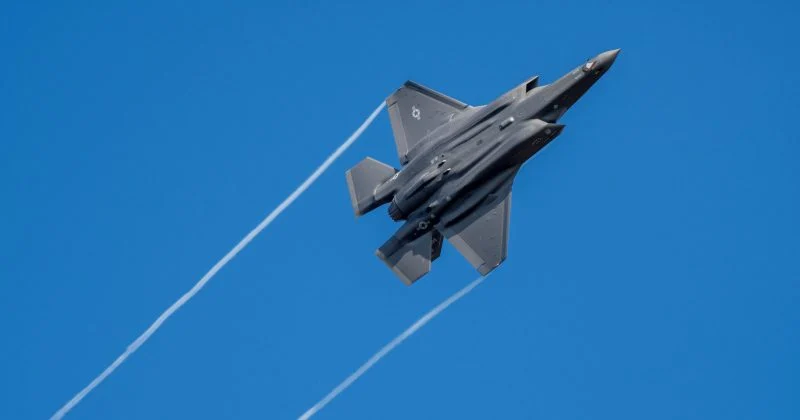
The House of Representatives will vote today on final passage of the $1.15 trillion National Defense Authorization Act for Fiscal Year 2027 (H.R. 8800) - and with it, Section 219, the United States-Israel Defense Technology Cooperation Initiative, a provision directing the Pentagon to expand and accelerate the integration of US and Israeli military technology, supply chains, and defense industrial capacity.On paper, it is one section among hundreds in a sprawling must-pass bill. In practice, it has become the single most watched line item in the entire package - partly because of what it does, and partly because House leadership just made sure nobody gets to vote on it by itself.What Section 219 Actually DoesSection 219 - numbered Section 224 in earlier drafts - directs the Secretary of Defense to designate an "executive agent" inside the Department of Defense whose mandate is to expand and accelerate joint research, development, co-production, and industrial integration with Israel across next-gen warfare domains: missile and air defense, counter-drone systems, cyber and electronic warfare, artificial intelligence and autonomous systems, quantum technologies, directed energy, biotechnology, and defense manufacturing - with explicit pathways for moving Israeli-origin and jointly developed technology into US programs of record.House Armed Services Chairman Mike Rogers (R-AL), who introduced the bill on May 13, has pushed back on the "merger" framing, saying the section simply designates a single senior official to coordinate cooperation that already exists, but critics say that's exactly the point. Executive agents are permanent bureaucratic machinery - they outlive administrations, and a statutory mandate to "expand and accelerate" only runs in one direction. The Quincy Institute, in a June analysis titled Cooperation without Oversight, argued the executive-agent authority makes the provision "significantly different" from America's existing defense technology arrangements with any other allied nation. Once two industrial bases are physically intertwined - shared components, co-production lines, joint classified programs - no future Congress unwinds that with a floor amendment.What "Executive Agent" MeansA June policy note by the Quincy Institute's Steven Simon starts from an inconvenient fact for both sides of this fight: the United States does not need Section 219 to buy, co-develop, or field Israeli defense technology. Iron Dome, the Trophy active-protection system, and Barak missiles were all acquired under existing law - cooperative R&D authority under 22 U.S.C. § 2767(j)(1), plus standard Foreign Military Sales and Direct Commercial Sales channels under the Arms Export Control Act. Whatever the initiative is for, it is not access. Its real impact is structural.The structure is the executive agent. Under DoD Directive 5101.01, an executive agent's authority takes precedence over other Defense Department component heads within its assigned scope - meaning the Israel-cooperation agent could overrule determinations by offices like the Defense Technology Security Administration, the Pentagon body that manages the risks of transferring defense technology and critical information abroad. Pair that precedence with a statutory mandate to "expand and accelerate," and the note's conclusion follows: wherever an internal office pushes back on a transfer or an integration step, the agent exists to push it through. State Department export-control channels would still operate independently, and programs must comply with existing law - but inside the Pentagon, the tie would go to integration.No other US ally has anything like this. Defense cooperation with the United Kingdom, Japan, Australia, and NATO runs through the standard architecture - the under secretary of defense for policy and the Defense Security Cooperation Agency - with no dedicated agent holding precedence authority to promote one country's participation in sensitive US programs. Proponents read the same structure as streamlining: one accountable senior official instead of a dozen scattered offices. Quincy reads it as handing Israeli defense firms "their own promoter in the Pentagon" - and recommends Congress strip the provision outright.The note also supplies the missing context for why this is happening now. Section 219 is one piece of a broader, publicly acknowledged shift from aid to integration. The FY2026 NDAA already ordered a working group to study folding Israel into the National Technology and Industrial Base. A draft Senate intelligence authorization provision would mandate expanded intelligence sharing with Israel while limiting the president's power to curtail it. And the endgame is not hidden: the Washington Post reported in June that Netanyahu himself backs the GOP effort to wind down the $3.3 billion in annual direct military aid in favor of integration and purchases, and House Resolution 1339 frames the transition, in its own title, as "Prime Minister Benjamin Netanyahu's Initiative." The concern Quincy raises is the one every aid critic should sit with: a $3.3 billion check is at least a number - published, debated, and voted on every year. Integrated supply chains carry no price tag and come up for no annual vote.The entrenchment aspect is serious:the F-35 program already ran this experiment, and it is worth being precise about who paid for it. When Turkey was expelled from the program in 2019 over its purchase of a Russian air-defense system, Turkish industry was building roughly 1,000 parts in the global supply chain - and the costs of cutting it loose landed on both sides. Turkey lost its planned jets and its production share. But the United States - the party doing the expelling - did not walk away clean: late parts deliveries spiked, finished-jet deliveries went delinquent, and the already-delayed program slid further behind schedule, all documented by the Government Accountability Office. Fuse two defense industrial bases deeply enough, and the option of changing course quietly disappears - whatever the next decade brings.Speedrunning it... On June 15, Rep. Thomas Massie (R-KY) and Rep. Ro Khanna (D-CA) filed a bipartisan amendment to strike Section 219 outright. The Rules Committee refused to make it in order - no debate, no vote. Then the process blew up on its own: on June 30, the rule governing the NDAA failed on the House floor, 198-224, after thirteen Republicans revolted - not over Israel, but over Speaker Mike Johnson's decision to staple a contested voter-ID bill to the defense package. Johnson canceled the rest of the week and sent members home.Opponents of Section 219 hoped the do-over would finally produce a clean vote. Instead, the Rules Committee reported a reworked rule, H. Res. 1438, on a party-line 8-4 vote Monday night - once again leaving the Massie-Khanna amendment off the approved list. The full House adopted the rule Tuesday, 214-211, a three-vote margin. The resolution sweeps six separate measures to the floor at once, puts the NDAA under a structured rule limiting amendments to a leadership-approved list, and closes off the other five bills entirely, according to a Capitol Wire analysis of the rule.Massie posted minutes after the floor vote, saying "No debate or vote was allowed on section 219, integration of US military technology and supply chains with Israel's." Unfortunately the Rule passed just now and no debate or vote was allowed on section 219, integration of US military technology and supply chains with Israel's.
Today: Congress Votes To Integrate US Military Tech & Supply Chains With Israel
On paper, it is one section among hundreds in a sprawling must-pass bill. In practice, it has become the single most watched line item in the entire package...
1,925 words~9 min read