Young women are falling behind young men in the entry-level job market — but it’s not primarily artificial intelligence that’s to blame, according to the researchers behind one of the country’s most closely watched labor-market trackers. The finding comes from new data shared exclusively with Fortune ahead of its public release tomorrow.
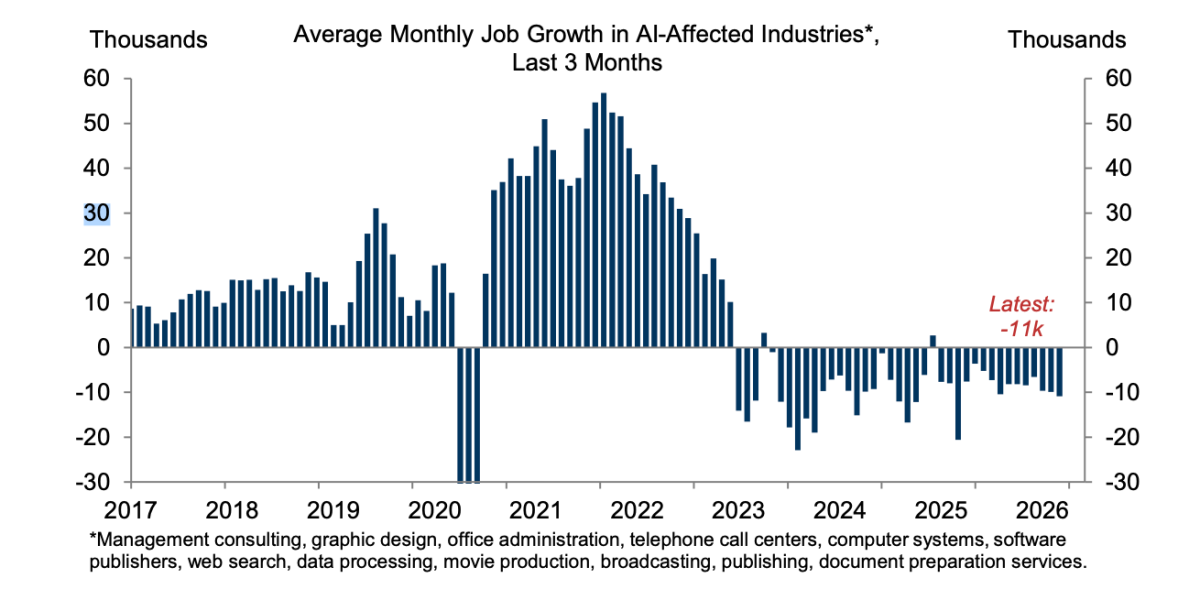
The data comes from an update to the “Canaries Dashboard,” a joint project of the Stanford Digital Economy Lab and ADP Research, led by Erik Brynjolfsson and Nela Richardson that documents how generative AI is reshaping entry-level hiring. Since its debut, the dashboard has established a clear and unsettling pattern: workers age 22 to 25 in the most AI-exposed occupations, like software development and customer service, have seen employment decline sharply since ChatGPT’s late-2022 debut, even as overall U.S. employment growth has stayed healthy. That divergence hasn’t reversed — it’s deepened steadily, growing by roughly half a percentage point per month since the researchers’ original paper last year.
The latest update breaks the numbers down by gender for the first time, and young women in the Canaries sample do show weaker employment growth than young men in the same 22-to-25 age bracket. The researchers found two forces working at once: women are more likely to work in AI-exposed occupations to begin with, and, separately, they see somewhat slower employment growth than men at every level of AI exposure.