The debugger spat out a stack trace at 2:47 a.m. on a Tuesday. Three nested loops. A retry handler that retried the retry handler. And a state object that had mutated into something unrecognizable — half user context, half API response, half hope. I stared at the terminal and realized: I hadn't built an agent. I'd built a Rube Goldberg machine made of while True statements.
That night was the last time I trusted loops to carry architecture.
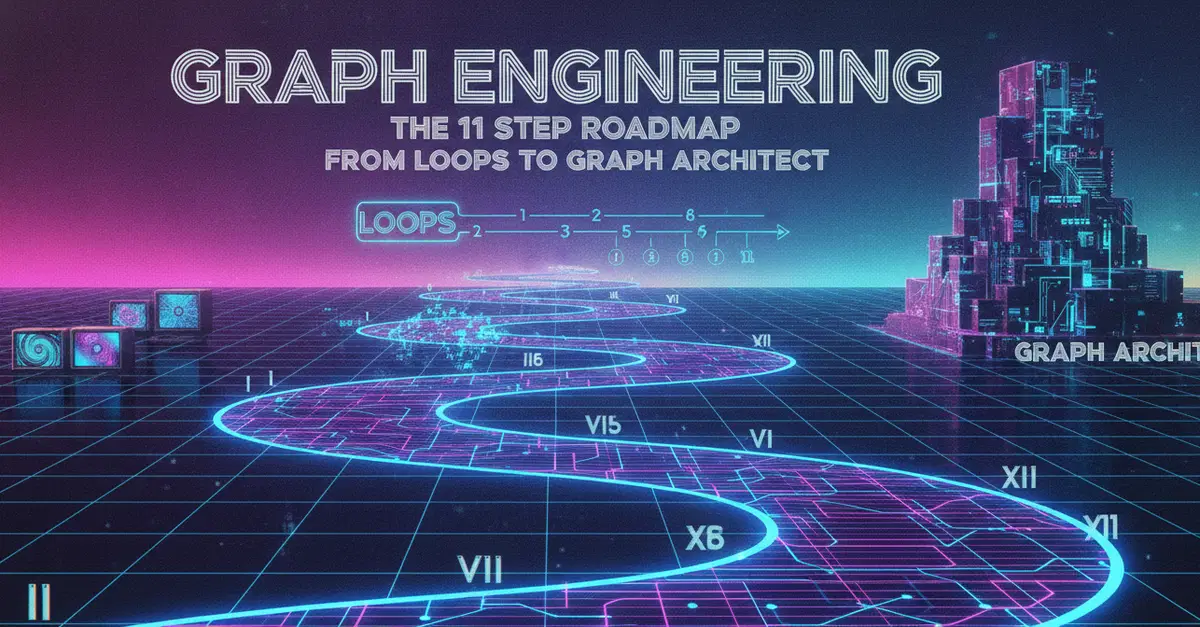
Graph engineering is the discipline of modeling agentic workflows as directed acyclic graphs (DAGs) with explicit state transitions, typed edges, and deterministic failure domains — replacing ad-hoc control flow with a topology you can inspect, version, and debug.
Not a flowchart you draw in Notion. A runtime structure the executor traverses.
The boundary is sharp: loops embed logic in sequence. Graphs declare logic in topology. A loop asks "what happens next?" A graph answers "what depends on what?" That distinction is the product.