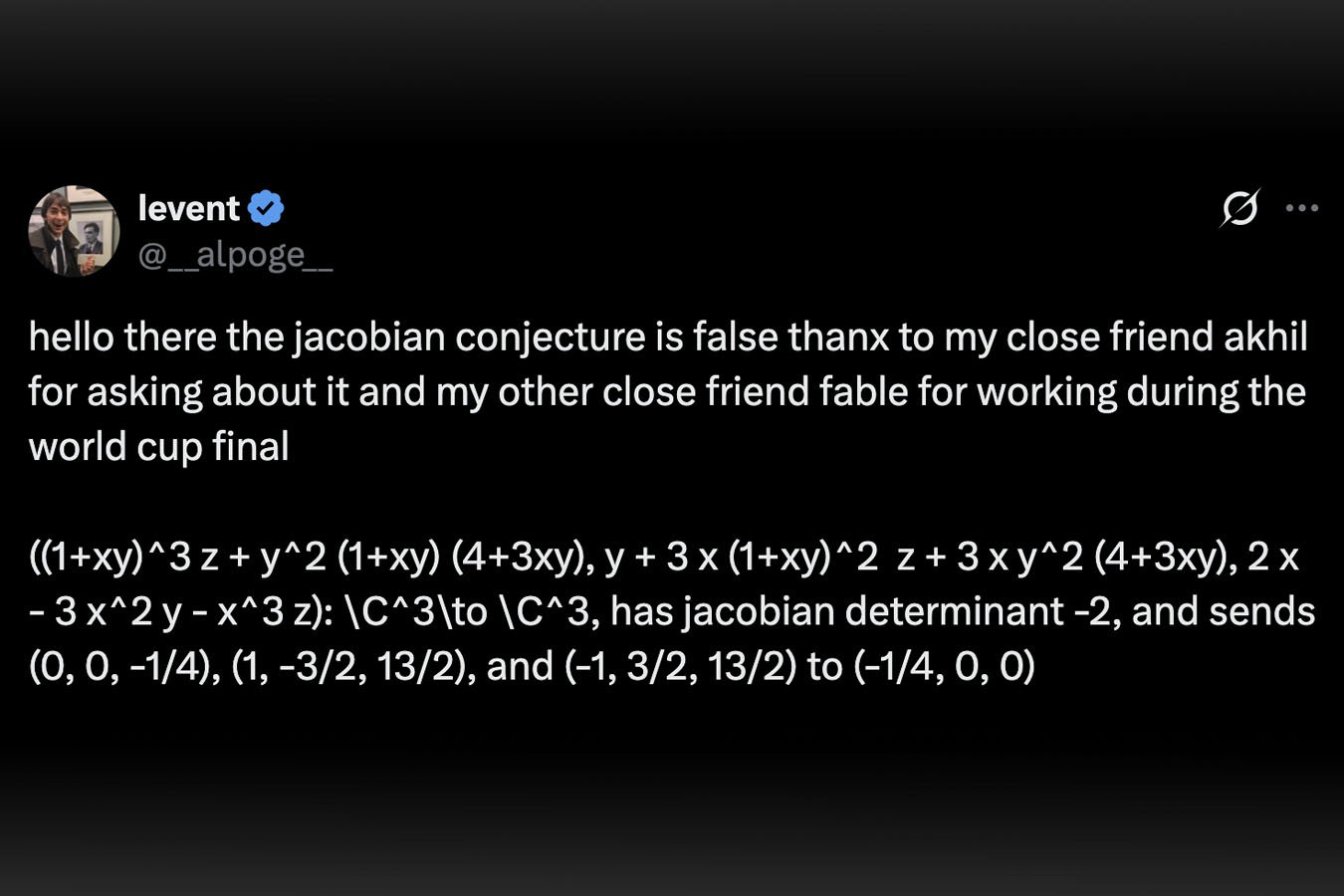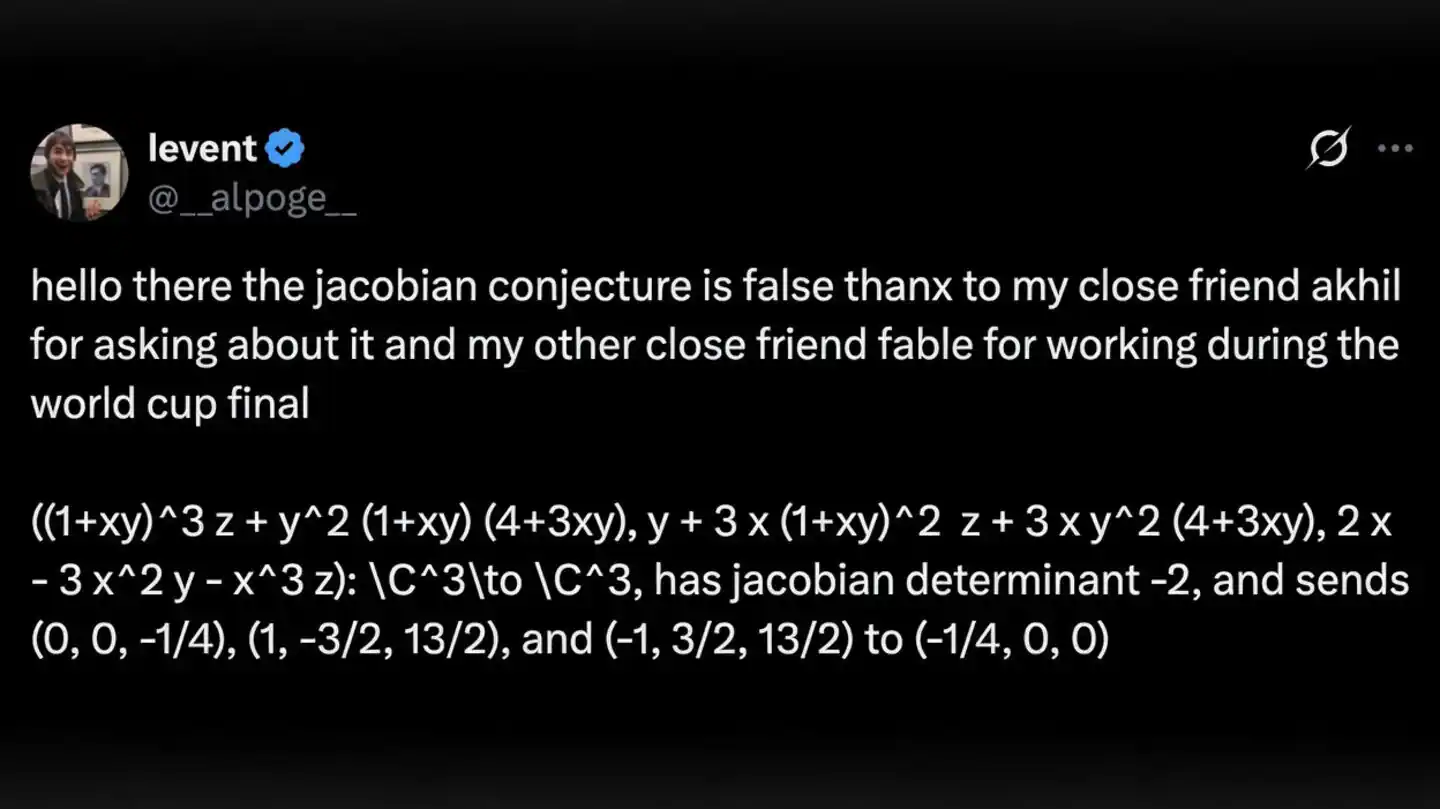
On Sunday afternoon, while the rest of the world’s eyes were glued to the World Cup final, an AI model resolved a problem that had tortured mathematicians since 1939.
By the time Kevin Buzzard woke up in London the next morning, the result had been verified. By lunch, it was all his peers at the Imperial College London’s pure mathematics department could talk about; at the time of writing, Anthropic employee Levant Alpöge’s post announcing the result has drawn more than 20 million views on X.
“It is a big day,” Buzzard told Fortune. “I think it’s a great time to be alive, personally.”
It was the latest in a series of AI-driven mathematical breakthroughs. AI’s progress (or assault) on unsolved mathematics has compounded rapidly since mid-2025, when models first solved five of six problems at the International Mathematical Olympiad. From there, the list of fallen problems grew fast: OpenAI’s model disproved an 80-year-old Erdős conjecture on combinatorial geometry in May, and in June, 16 researchers from 15 universities published the Leiden Declaration on Artificial Intelligence and Mathematics, urging the profession to set guardrails around transparency, attribution, and peer review before AI reshapes what mathematical knowledge even means.