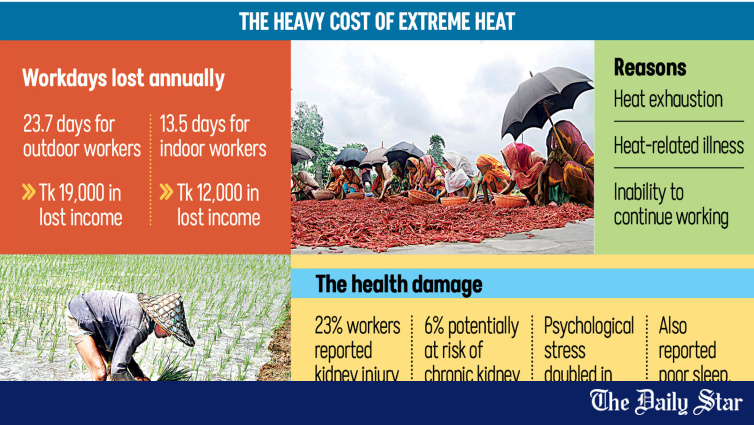
Nearly 75% of migrants in Dhaka, the capital of Bangladesh, reported being negatively affected by rising temperatures, while 100% reported being affected by extreme weather events.Bangladesh’s maximum temperature has increased by 1.1°C since 1980, while the country’s “feels-like” temperature has risen by 4.5°C.In 2024 alone, heat-related illnesses and productivity losses contributed to the loss of 250 million workdays, costing Bangladesh an estimated $1.78 billion, equivalent to 0.4% of GDP.Bangladesh’s informal economy employs approximately 85% of the national workforce, nearly 60 million people making heat stress not only a public health issue but also a major economic concern.
DHAKA — On June 28, as the afternoon sun beat down on Bangladesh capital Dhaka’s sprawling Tejgaon neighborhood, Samiha Begum gathered her two school-aged children and headed for the shade of Hatirjheel Lake. Their narrow one-room home in a nearby slum had become unbearable.
She said, “The room starts heating up as soon as the sun rises. Even if it rains in the morning, the heat becomes like a boiler once the sun comes out. My children cannot stay inside after returning from school. Thus, I come to the lakeside and take the trees’ shade. Here, the air is cooler than in my house.”