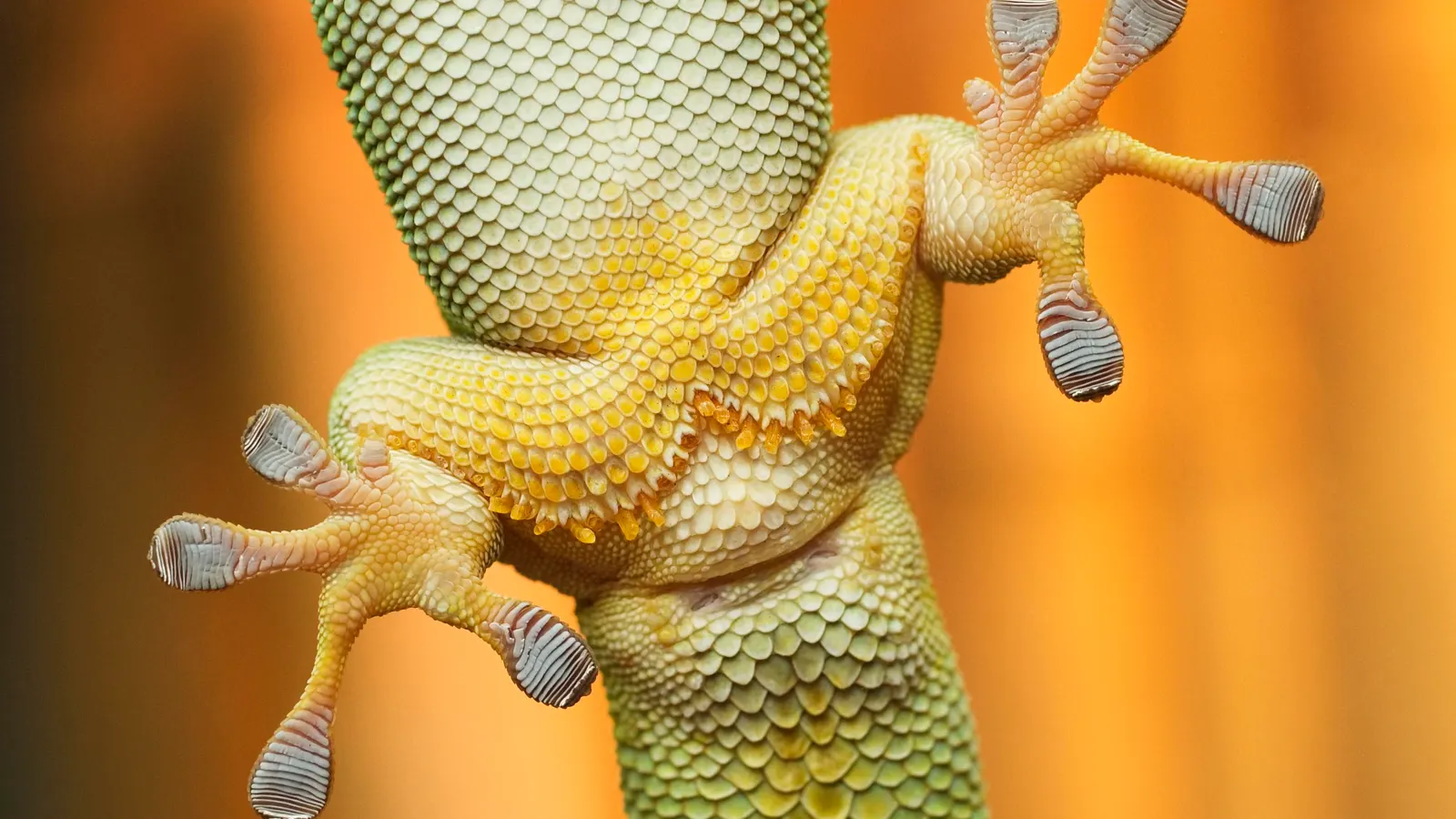
A real soldier scaling a glass wall with nothing but two handheld paddles sounds like science fiction, but it's the direct result of one of biology's stranger unsolved mysteries: how gecko feet stick to anything without any glue at all.gettyIn 2014, the Defense Advanced Research Projects Agency, better known as DARPA, demonstrated a program called Z-Man in which a climber weighing over 200 pounds, carrying a pack, ascended roughly 25 feet of sheer glass using only a pair of adhesive paddles — no rope, no harness doing the work, no suction, according to DARPA’s own program page. Thanks to the common gecko.The paddles worked because they copied, as closely as engineers could manage, the underside of a gecko’s toe. It’s the closest thing science has produced to a real Spider-Man suit, and the biology behind it is arguably stranger than the comic book version.The Trick Isn’t Stickiness, It’s Gecko-Inspired GeometryFor decades, the assumption was that geckos must secrete some kind of adhesive, the way a tree frog’s feet stay moist and tacky. That turned out to be wrong. A gecko’s toe pad is completely dry. Under a microscope, it's covered in hundreds of thousands of microscopic hair-like structures called setae, and each of those hairs splits at the tip into hundreds of even finer branches called spatulae — structures so small they interact with a surface at the molecular level.That interaction is called a van der Waals force — a weak, temporary attraction between molecules that exists whenever two surfaces get close enough, as a 2002 study on the Tokay gecko (Gekko gecko) published in the Proceedings of the National Academy of Sciences confirmed — whether or not either one is “sticky” in any everyday sense. A single spatula’s pull is close to nothing. Multiply it across roughly a half-million setae per foot, each branching into hundreds of contact points, and the combined force is enough to let a gecko hang from a single toe or sprint upside down across a ceiling.Why An Elephant Can’t Do What A Gecko DoesThis is where it gets counterintuitive. You might expect that a bigger animal, with bigger feet, could stick even better. Biologists have found close to the opposite: adhesive force scales with the area of contact, not body size and larger animals can’t grow proportionally larger, denser fields of setae without the structures becoming too stiff to conform to a surface. It’s a real constraint: a 2016 study published in the Proceedings of the National Academy of Sciences calculated that a human-sized climber would need roughly 40% of their body surface covered in sticky footpads to pull off the trick, a big part of why nothing bigger than a gecko climbs this way in nature, and why replicating it at human scale took engineers years to crack.The other underappreciated detail is reversibility. A gecko can plant a foot and rip it free in a fraction of a second, over and over, fast enough to run at speeds equivalent to many body-lengths per second. That combination — strong holding force, instant release, no residue — is exactly what a synthetic adhesive would need to be useful, and exactly what ordinary tape or glue can't do.Turning A Gecko’s Toe Hairs Into Military HardwareDARPA’s Z-Man program set out to build a synthetic version of that system for soldiers who need to scale urban walls without ropes or ladders. The winning approach, developed with Draper Laboratory and mechanical engineers at Stanford, wasn’t a sheet of tiny plastic hairs — it was a set of stiff paddles engineered to spread a climber’s full weight evenly across the adhesive surface, mimicking what the gecko’s foot does structurally rather than copying its hairs one-for-one. A related material called Geckskin, developed separately at the University of Massachusetts Amherst and first described in a 2012 study published in Advanced Materials, took a similar structural approach — an index-card-sized patch holding roughly 700 pounds against a vertical pane of glass.None of this is fictional radioactive-spider physics. It’s convergent engineering: humans arriving, through trial and constraint, at a solution evolution had already spent millions of years refining in a three-inch lizard.The gecko story is a useful correction to how people imagine biological “superpowers.” It isn’t a substance, and it isn’t magic — it’s a geometry problem solved at a scale too small to see. That distinction is exactly why it was engineerable. You can’t bottle “stickiness,” but you can, with enough patience, replicate a shape.Soldiers climbing walls with gecko paddles remain a research demonstration rather than standard equipment, and much of the follow-on work in this space is still developing. But the underlying science is settled enough that it’s now a standard example, in biomimicry circles, of nature’s engineering outperforming anything designed from scratch — no radioactive spider bite required.Think gecko feet are impressive? Test how much you really know about the reptiles and amphibians pulling off nature’s wildest tricks with this science-backed quiz: Reptile & Amphibian IQ Test
The U.S. Military Studied Gecko Feet To Build Real Spider-Man Suits — A Biologist Explains
Gecko toe hairs use van der Waals forces so strong DARPA copied them into real wall-climbing suits — the science behind nature's own Spider-Man trick.
826 words~4 min read