Consolidated revenue surged 65 per cent following the inclusion of KTM-related businesses, while the company also generated over ₹2,300 crore in free cash flow and maintained a surplus cash position of more than ₹21,000 crore.
| Photo Credit:
bl-online Administrator
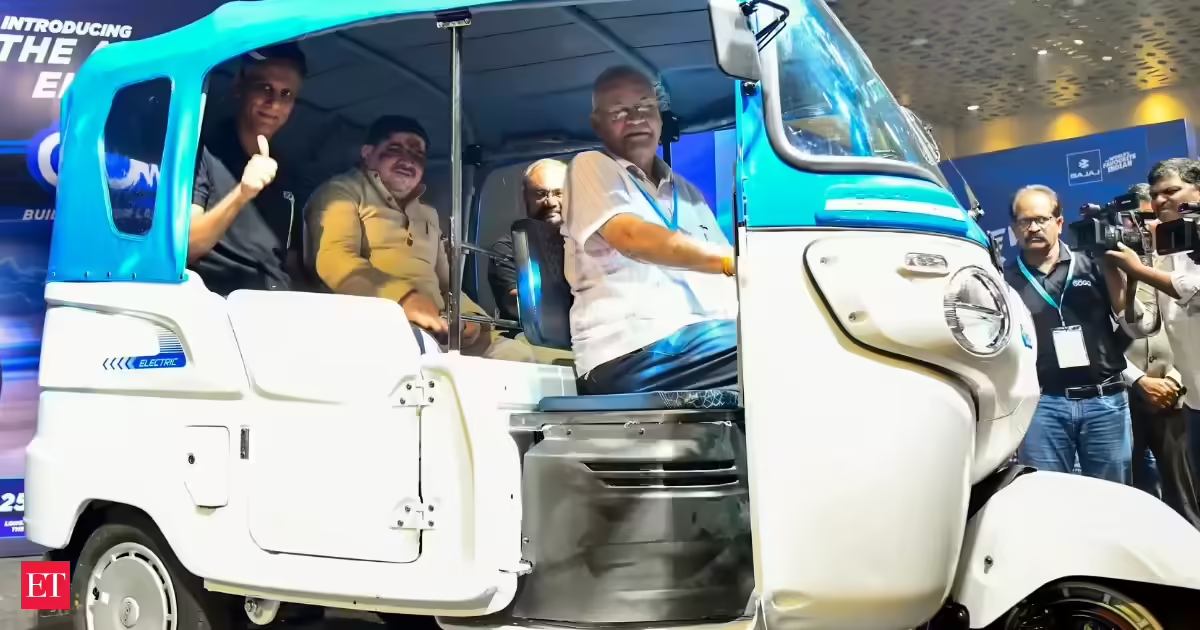
Bajaj Auto’s record standalone profit after tax rose 42 per cent to ₹2,982.84 crore in Q1 FY27 from ₹2,095.98 crore in Q1 FY26, while standalone revenue from operations increased 37 per cent to ₹17,243.72 crore from ₹12,584.45 crore, as record exports, electric-vehicle growth and strong demand for sports motorcycles drove its highest-ever quarterly performance.The company’s consolidated profit attributable to owners increased 46 per cent to ₹3,225.63 crore in Q1 FY27 from ₹2,210.44 crore in Q1 FY26, while consolidated revenue from operations rose 65 per cent to ₹21,688.83 crore from ₹13,133.35 crore. The performance was led by exports, EVs and premium motorcycles, although higher input costs and capacity constraints limited the full potential of the EV business.Record standalone performanceThe company has described the quarter as a “strong start to FY27” and said it had delivered a “record performance” in volume, revenue and profit. Standalone EBITDA increased 45 per cent to ₹3,596 crore in Q1 FY27 from ₹2,482 crore in Q1 FY26, while the EBITDA margin expanded to 20.9 per cent from 19.7 per cent.The company attributed the margin improvement to favourable dollar-rupee realisation, better product mix, operating leverage, pricing and cost savings, which offset sharply higher input costs.Consolidated profit risesConsolidated profit after tax rose 44 per cent to ₹3,188.75 crore in Q1 FY27 from ₹2,210.44 crore in Q1 FY26. The difference between consolidated profit after tax and profit attributable to owners reflects a ₹36.88-crore loss attributable to non-controlling interests during the quarter.The consolidated results include Bajaj Auto’s newly acquired KTM-related businesses. The company said the current-quarter figures were not comparable with the year-earlier period because its acquisition of control over Bajaj Auto International Holdings AG in November 2025 brought Bajaj Mobility AG and KTM AG into the consolidated accounts.Domestic business gains momentumDomestic business revenue increased 26 per cent year-on-year, with double-digit growth across two-wheelers, commercial vehicles, internal-combustion-engine models and electric vehicles.Total volumes rose 29 per cent to 14.38 lakh units in Q1 FY27 from 11.11 lakh units in Q1 FY26. Domestic volumes increased 11 per cent to 7.06 lakh units from 6.35 lakh units, while exports rose 54 per cent to 7.32 lakh units from 4.76 lakh units.Motorcycles gain shareThe domestic motorcycle business posted double-digit revenue growth, led by sports motorcycles. Retail sales in the segment grew around 1.5 times faster than the rest of the industry.Pulsar, Avenger and Dominar each recorded double-digit year-on-year growth, while the sports motorcycle segment expanded by around 50 per cent. Product interventions across the Pulsar portfolio helped Bajaj Auto gain market share. Upcoming upgrades across the 125cc-160cc range are expected to strengthen its competitive positioning.EV revenue nearly doublesElectric-vehicle revenue was nearly twice the year-earlier level and contributed nearly 30 per cent of domestic revenue. Chetak reached record levels in volumes, revenue and profitability, although demand continued to exceed production capacity. Investments are underway to expand production, improve availability and support international expansion.Exports and electric three-wheelersExport volumes crossed 700,000 units for the first time in a quarter. Latin America delivered another benchmark performance, while African volumes more than doubled, led by a three-fold increase in Nigeria. Commercial-vehicle exports rose around 70 per cent despite logistical and geopolitical challenges in the MENA region.Commercial-vehicle revenue increased 25 per cent, led by electric three-wheelers, whose revenue rose around 80 per cent. The electric three-wheeler business is now nearly two-thirds the size of the ICE three-wheeler franchise. Bajaj Auto’s Riki electric rickshaw business is present in 150 cities.Domestic KTM and Triumph revenue rose 60 per cent, supported by the 350cc range and a network spanning more than 90 towns.Bajaj Auto generated more than ₹2,300 crore in free cash flow, equivalent to about 80 per cent of standalone PAT. Its surplus funds exceeded ₹21,000 crore at the end of June.Published on July 21, 2026