If you’ve ever felt that the stock market is too much of a roller coaster, fixed-income investing is the calmer option. It’s basically like lending your money to the government or a company and getting regular interest payments plus your original money back on a fixed date.
Fixed vs Variable income
Unlike stocks, where your returns can jump up or down wildly depending on how well a company is doing or what’s happening in the market, fixed income gives you more predictable cash flow. In other words, you know roughly what you’ll earn and when you’ll get your capital back, as long as the person or institution you lent to doesn’t default.
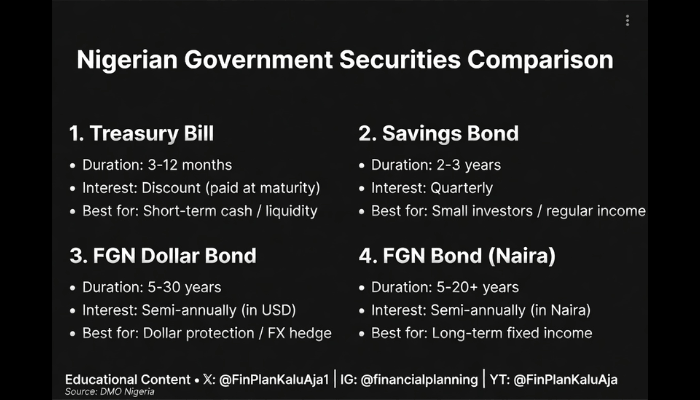
The most useful number for most investors is the yield to maturity — it tells you the total return you’ll get if you hold to maturity. Here’s something important: yield and interest rates move in opposite directions. When the Central Bank raises rates or inflation is high, new fixed-income products offer higher yields. As a result, older issues with lower coupons become less attractive, so their prices fall, and their yields rise to catch up. In Nigeria, many people use the 91-day Treasury bill rate as a rough measure of the risk-free rate because the government is the safest borrower. If a corporate bond is only offering 2% more than the current T-bill rate, you have to ask yourself if that extra little bit is worth the extra risk of the company possibly having problems.