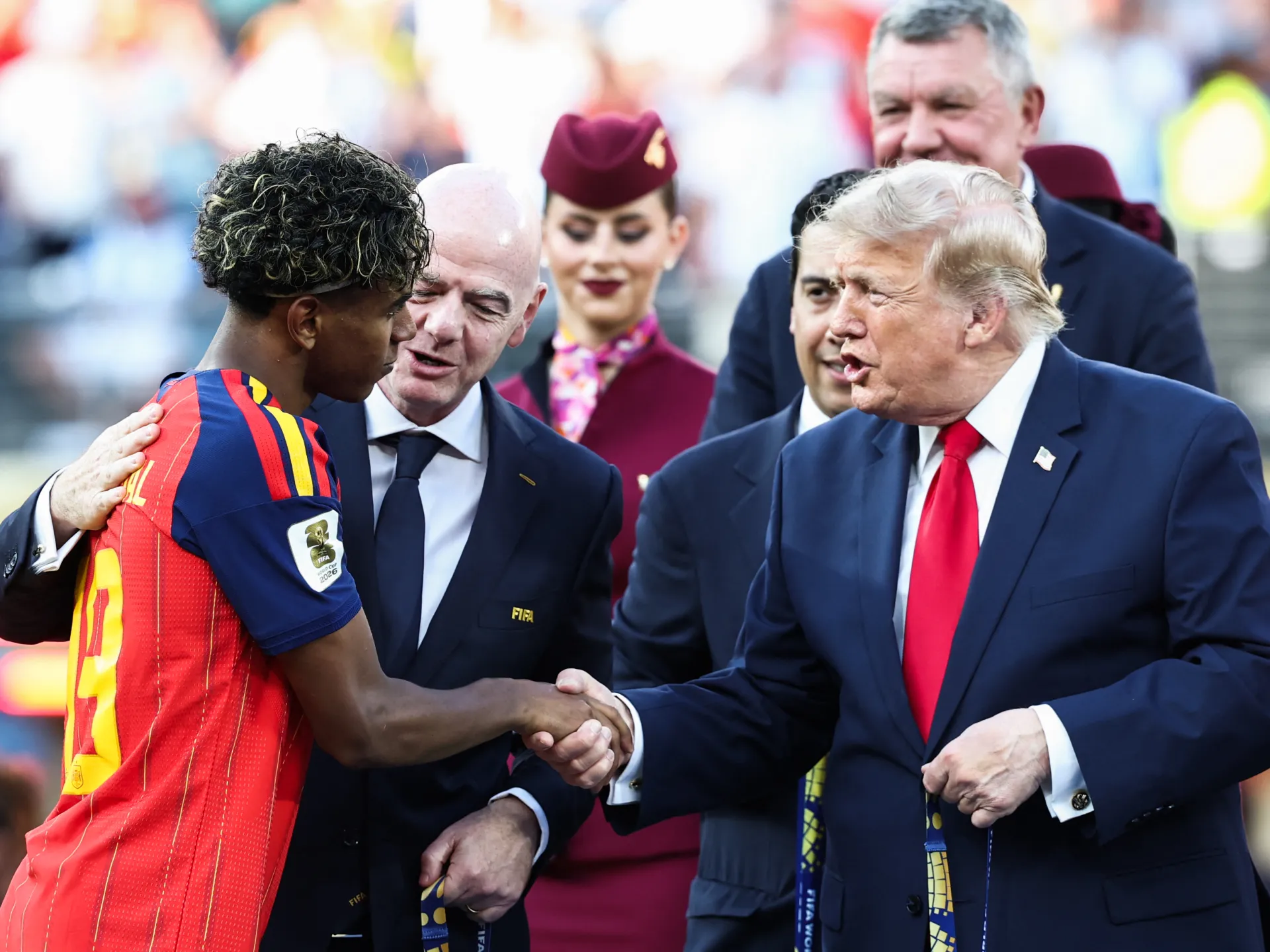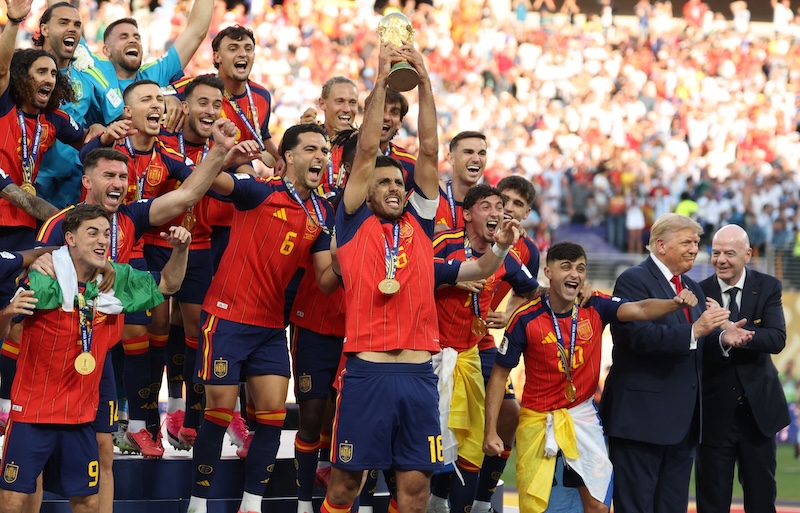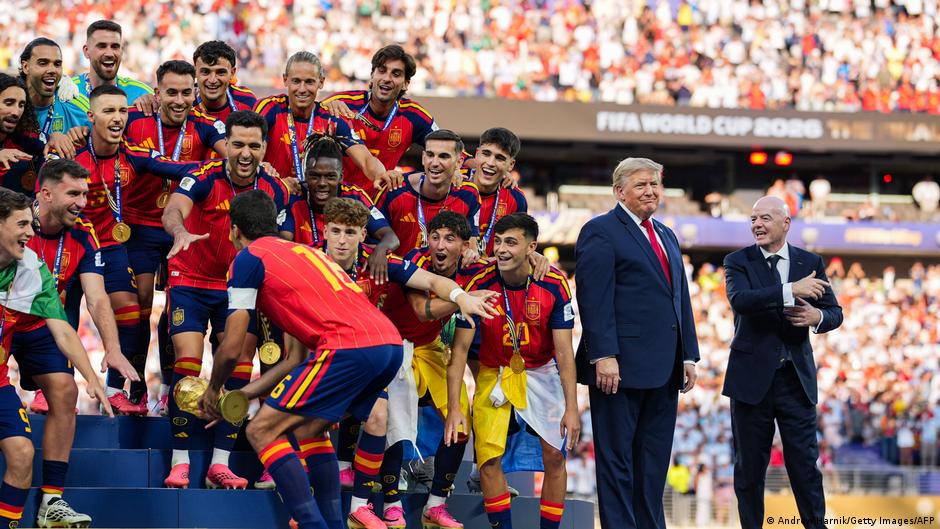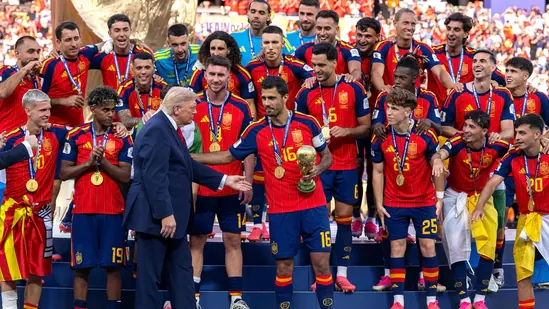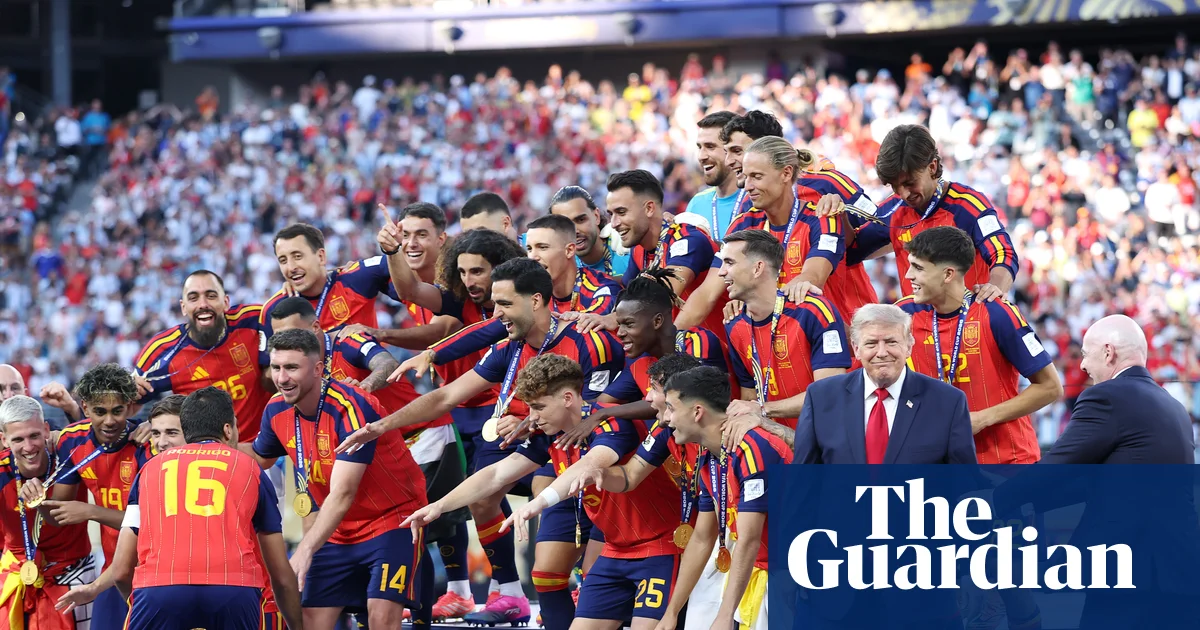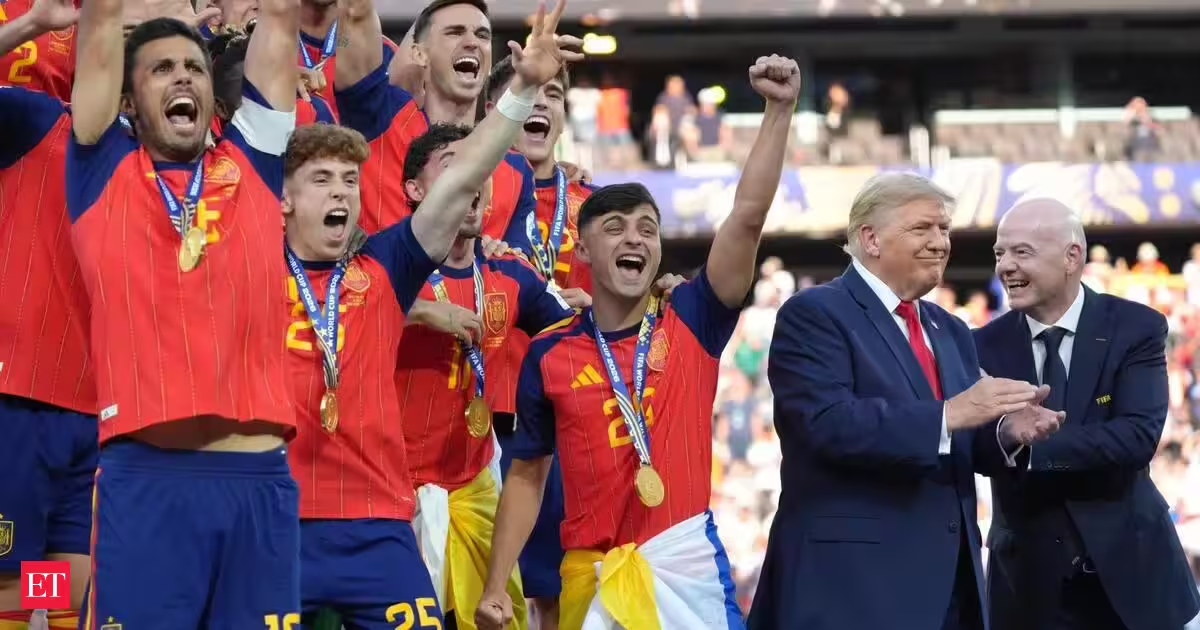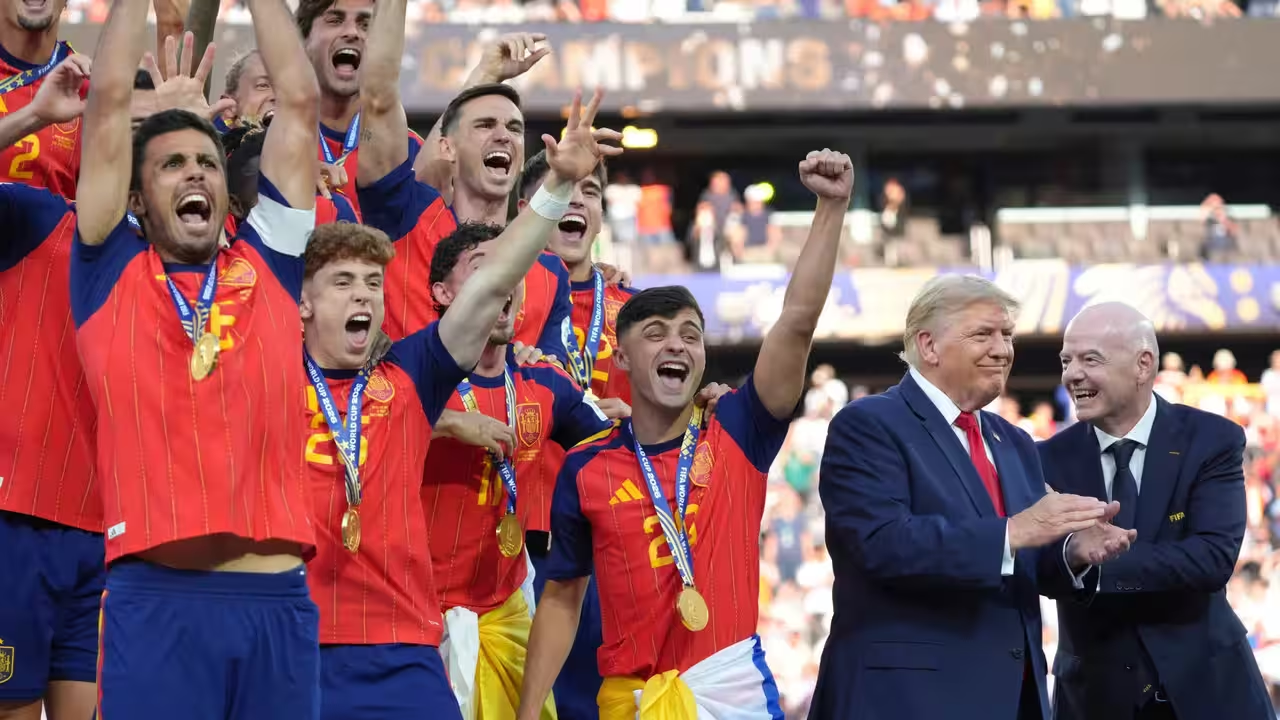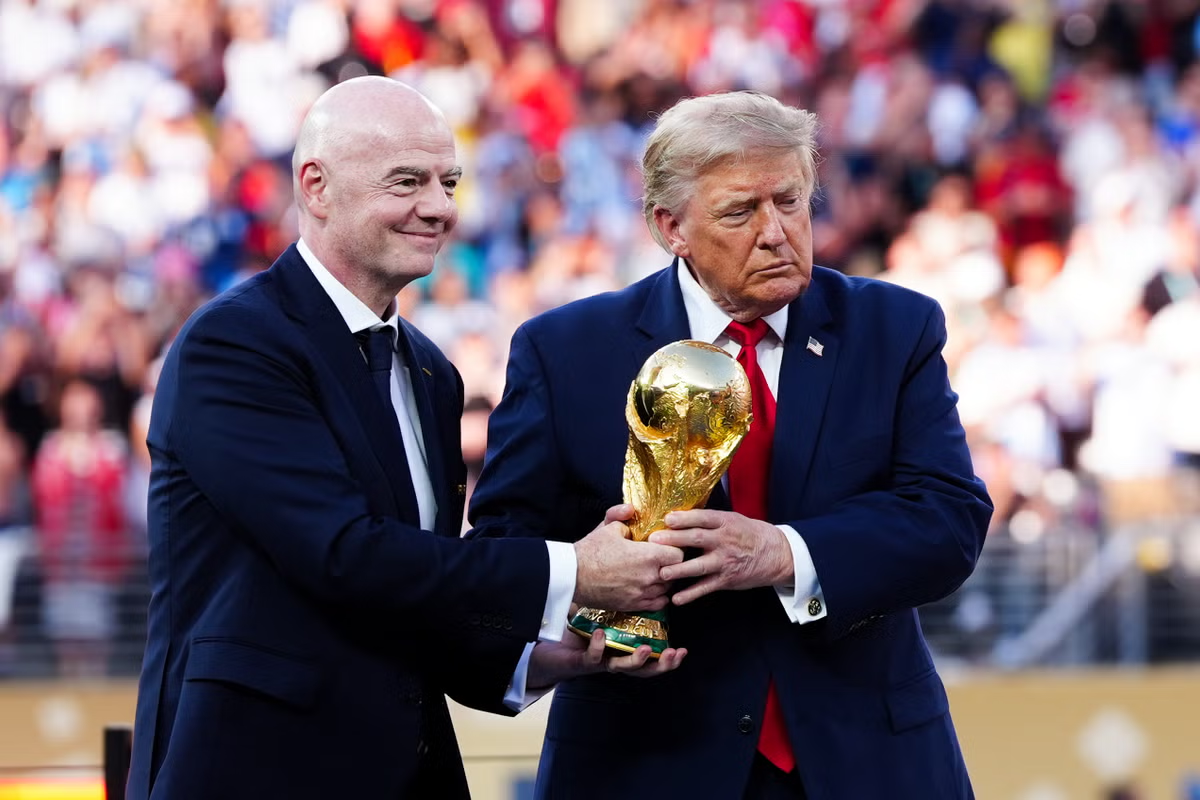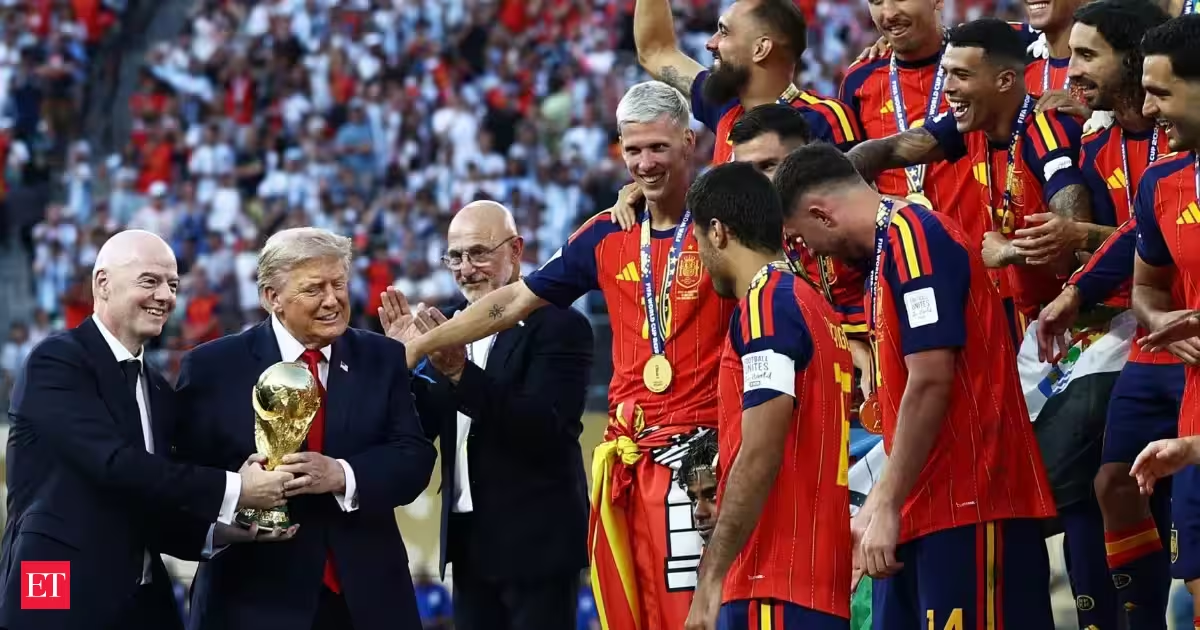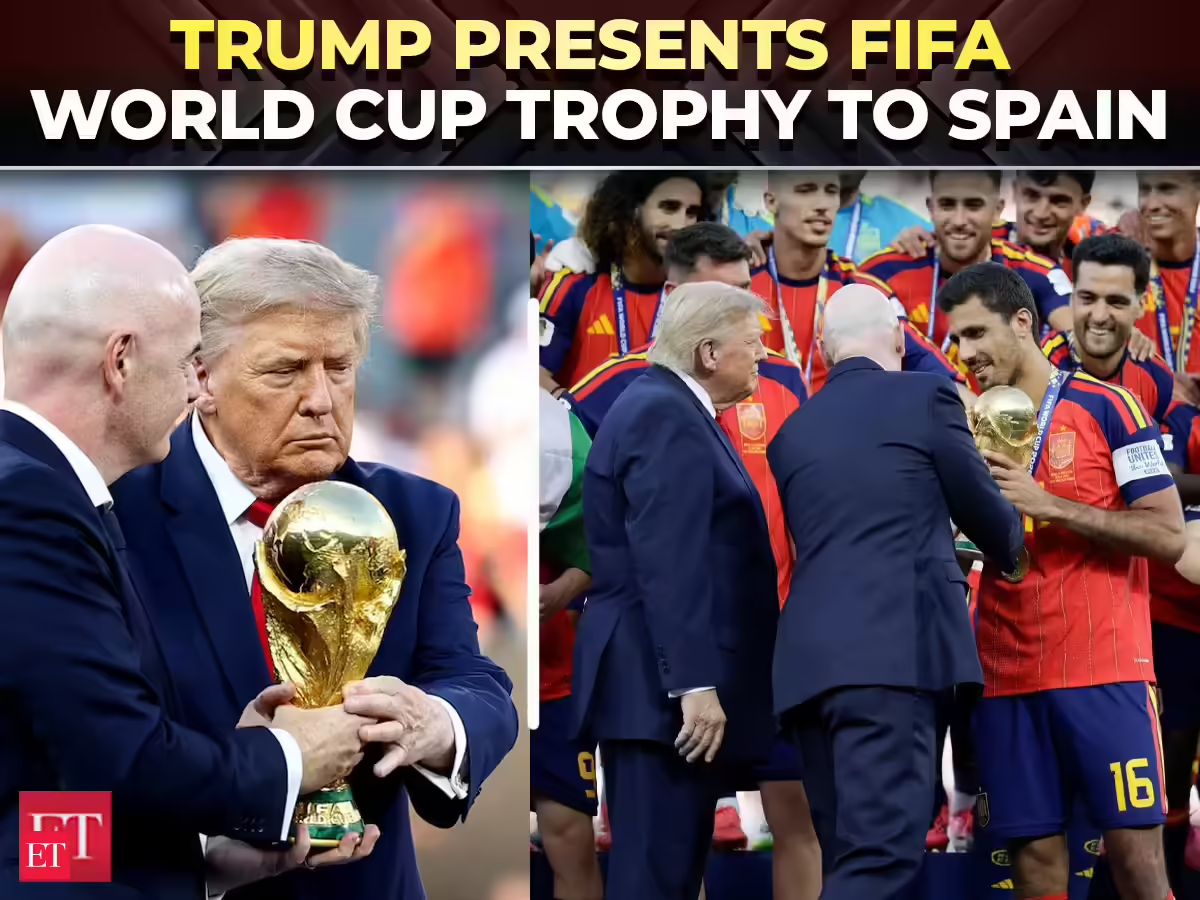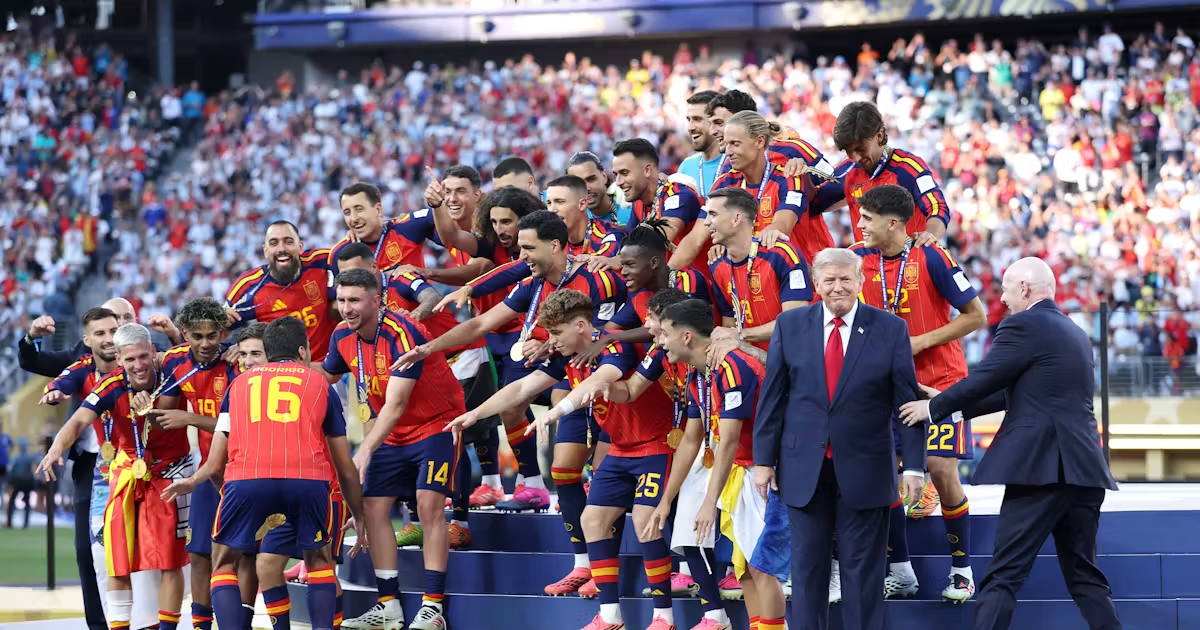
The official team photo of Spain’s celebration at Sunday’s World Cup final looks the same as it always does, more or less. Rodri—the team’s jubilant captain and the tournament’s best player—lifts the golden trophy high overhead as his teammates surround him, fists raised, jumping in the air. It’s one of the purest moments in sports. Only 23 teams from eight nations have won the honor. This Spanish squad, only the second in the country’s history to win the cup, made history with a stingy defense that allowed just one goal in eight games. If you look more closely at the photo FIFA shared, though, you’ll notice something odd in the bottom-right corner: a glimpse of a slightly crumpled blue suit. It is a visual metaphor for the 2026 World Cup. President Donald Trump largely stayed out of the way—but he was always there, just out of sight, exerting malign influence. In the case of Spain’s celebration, Trump did exactly what you would expect him to do. After presenting the World Cup trophy with his pal, FIFA president Gianni Infantino, he should have hightailed it out of there so the team could have its moment. But Trump does not let anyone have celebratory moments in his presence without his participation. A year ago, in the very same MetLife Stadium in New Jersey, he inserted himself into Chelsea’s title celebration at the Club World Cup. And so, once again, he awkwardly lingered onstage, even as Infantino tried to pull him off. When Rodri lifted the trophy, Trump was still there. In other photos, you’ll see Infantino patiently explaining to him that he wasn’t supposed to be there. Not like he cares. For Trump, this was his moment and he wasn’t going to let it go to waste—even though he had just been loudly booed by tens of thousands of fans. Trump was largely out of sight at the final, just as he was throughout the tournament. The direst predictions—of his immigration goons running amok, of foreign fans being detained, of political violence—never quite materialized. But it was nevertheless rare to go very long without the president and his noxious regime barging into view. There was Trump blocking a Somali referee from entering the country, on spurious grounds. There was the Uruguayan team being invasively searched by drug dogs. There was Trump getting on the phone to Infantino to demand that he let a suspended U.S. player play.It was a good tournament, in the end. It was very close to a great one. But it will always have Trump’s greasy fingerprints on it. This, coupled with the U.S. Men’s National Team’s embarrassing loss to Belgium in the Round of 16, ensures that the 2026 World Cup will not be fondly remembered by most soccer fans here in the U.S.—even as the tournament created many more of them.It is strange to still hear Trump boast about being “forced” to intervene to get FIFA to let USMNT striker Folarin Balogun play against Belgium after he had received a red card in the previous match. But that’s exactly what he did on Saturday evening, at a press conference where he had been well briefed to sound like he knew the sport—praising Djed Spence, critiquing England manager Thomas Tuchel’s admittedly bizarre tactics. But mostly, he was there to pat himself on the back for his role in the overturning of Balogun’s red card: This has been a tournament like no other, filled with fierce competition, unforgettable moments. Probably the most unforgettable is when they gave that gentleman—is it a red card? And I was forced to call Gianni and just make a recommendation. I said “Gianni, I’d like to make a recommendation. Let the guy in the game!”No, I didn’t say that. I said, “I’d like to wage a complaint.” I had no idea what was going to happen. But, you know, so much better the way it worked out because there’s no controversy. They won the game and our team had all of its players. [Infantino] made another great decision if you think about it. You’ll never get credit for that.It’s a bizarre point to dwell on because, even though Balogun played well, his team got demolished by Belgium, 4-1. Not only that, it was clear that Trump’s intervention had backfired badly. The Belgians were fired up out of the gate, while the U.S. played like sheepish kids who knew the president of the United States had just cheated on their behalf. And pretty much the whole world, outraged over the president’s meddling, was rooting for Belgium. It was the low point of the tournament—for everyone but Trump. No one wanted to see Trump onstage with the Spanish team, either. He was just there because he could be and because he knew that no one could really take it away from him (though they could edit him out of official photographs and videos, as FIFA and Spain’s Soccer Federation did). For Trump, the ability to cheat on the home team’s behalf is just another perk of the office. And for Infantino, who was instrumental in the Balogun Affair, it’s just another piece of client service. Catering to the whims of despots is part of the job of running FIFA. This is nothing new. At the 2022 World Cup trophy lift, the emir of Qatar placed a ceremonial robe over Lionel Messi—meaning his Argentina uniform was obscured in every photo. But this World Cup may have been a new low, thanks to the Trump administration’s treatment of Somali referees, the Iranian national team, and fans. The exorbitant cost of tickets was yet another black mark, though that is already being treated as proof of the tournament’s success. As predicted, this was the most profitable World Cup ever—and for Infantino, that’s all that really counts. It’s tempting to look at the outcome—a Spanish team that privileges selflessness, solidarity, and patience triumphing over an Argentine one that thought it could foul its way to a repeat title—as yet another example of this World Cup’s greatness. After all, a great deal of this tournament did not belong to Trump and Infantino—or, for that matter, to Lionel Messi and the defending champions. This was also the World Cup of Cabo Verde, of “Rock Chalk Algeria,” of Scots taking over Fenway, of Mexico vs. England at the Estadio Azteca, of the U.S. finally becoming a soccer nation. It was a good tournament that ended with the best team winning, which is more or less what the World Cup should be. But the victory over cynicism was far from complete. It’s not clear to me that it’s even a victory. Yes, Spain won and Argentina lost. Yes, Trump is being cropped out of official photographs as if he had done something to upset Stalin. Yes, the worst predictions about MAGA mayhem never materialized. But FIFA and Trump still largely got what they wanted out of it—more money, power, and glory—and that’s a huge loss for the rest of us.
The 2026 World Cup Was a Cynical Triumph
It was a great tournament. But the malign influence of Donald Trump and Gianni Infantino was inescapable.
1,166 words~5 min read