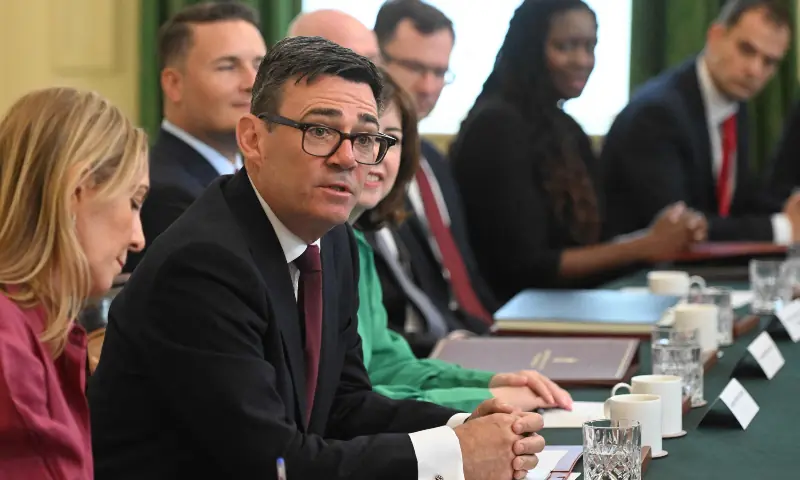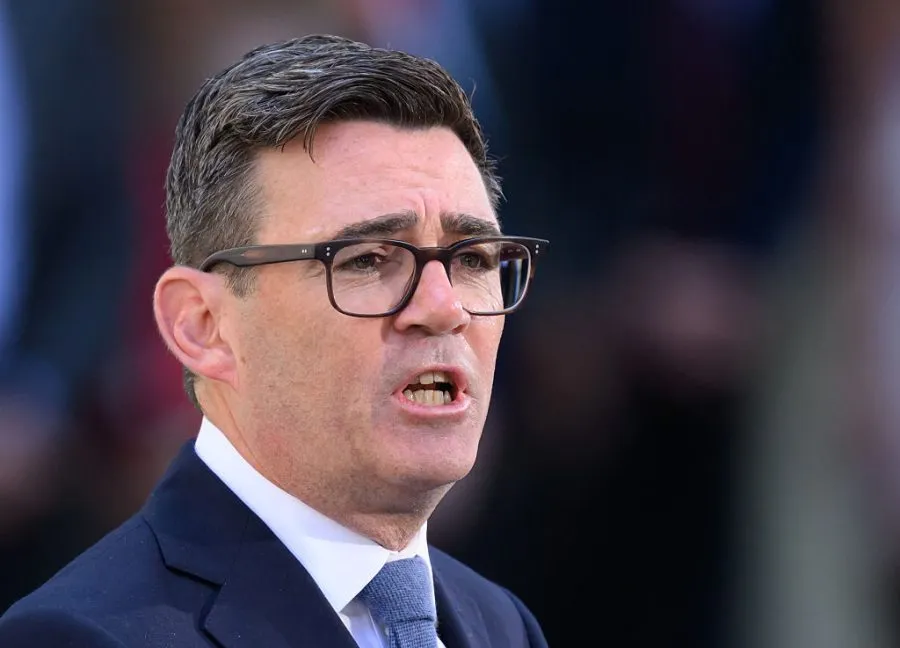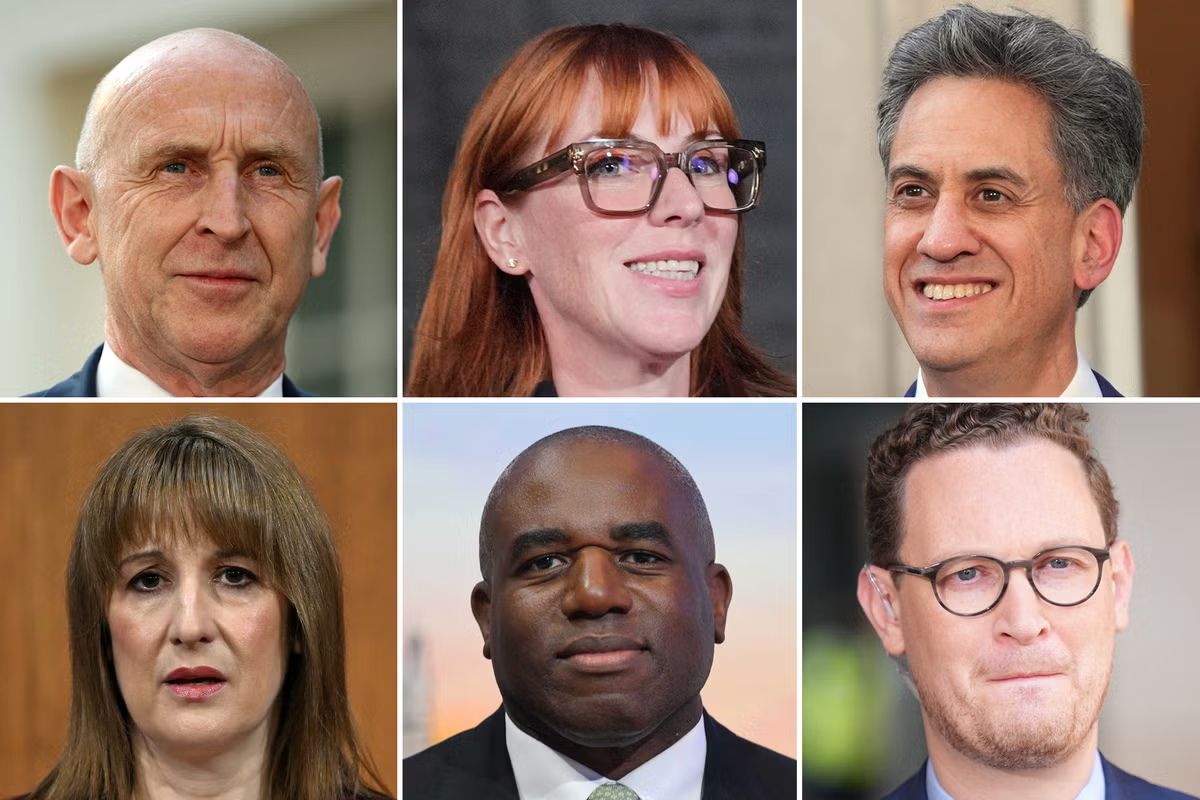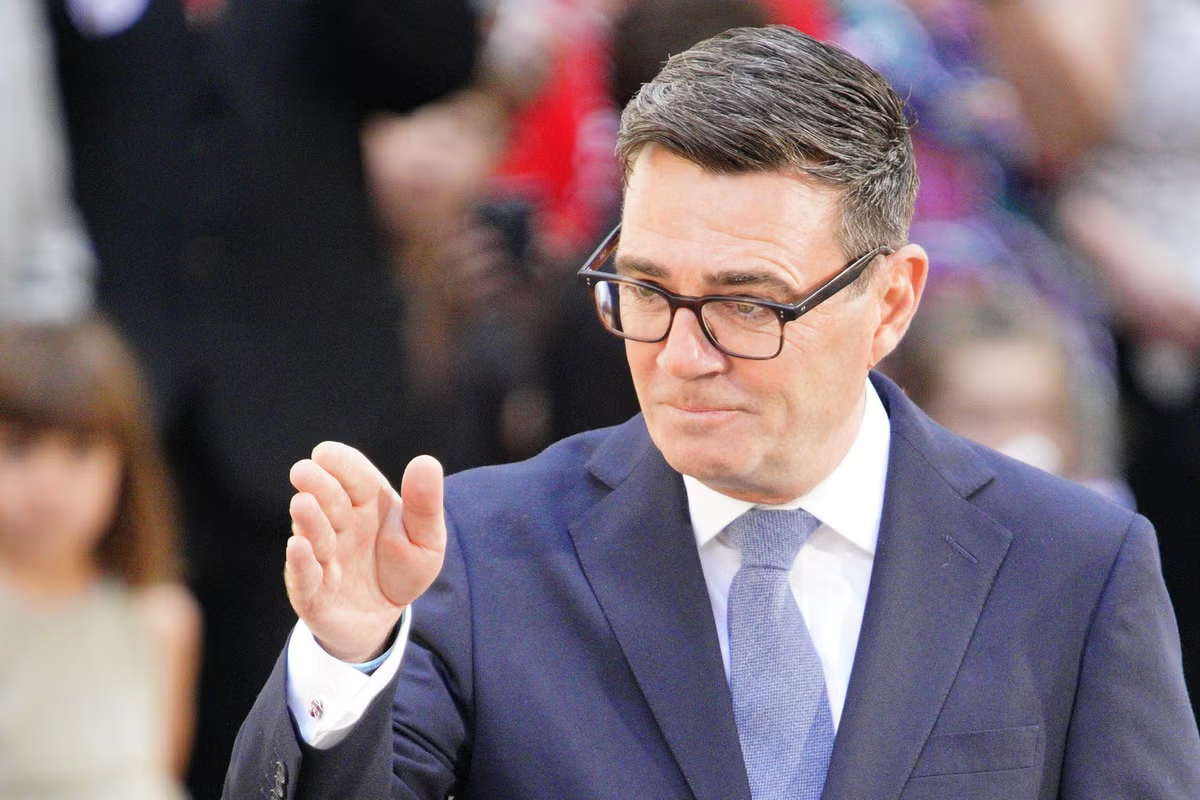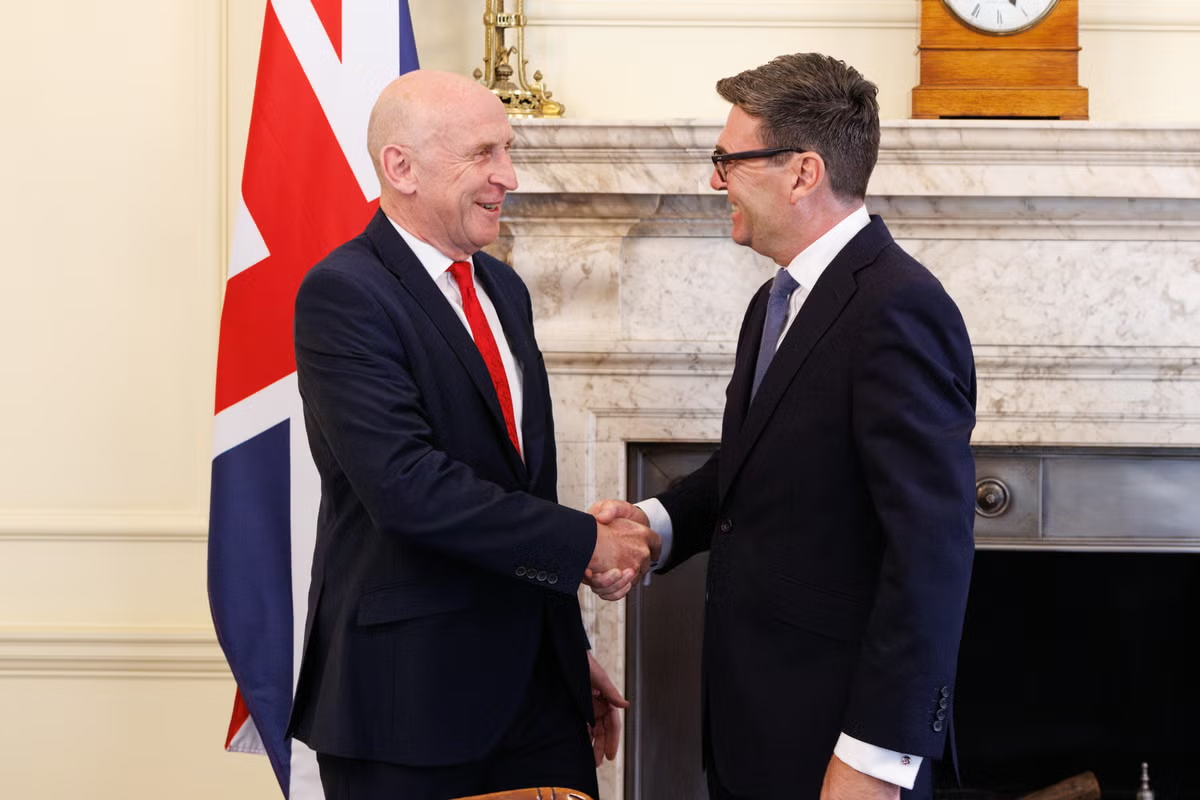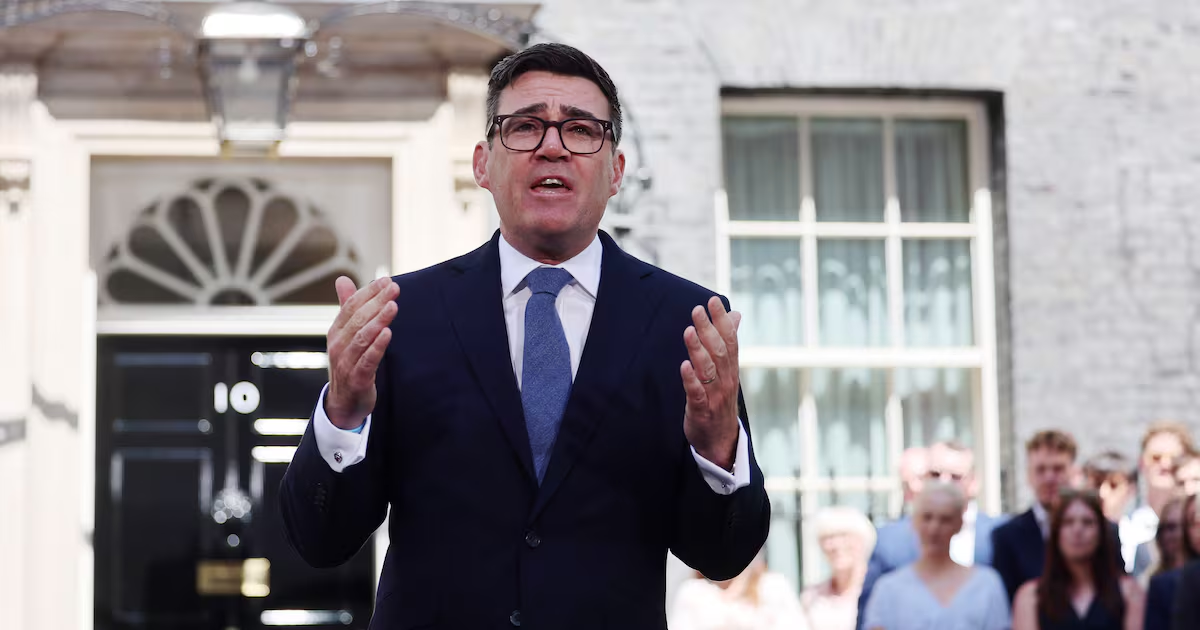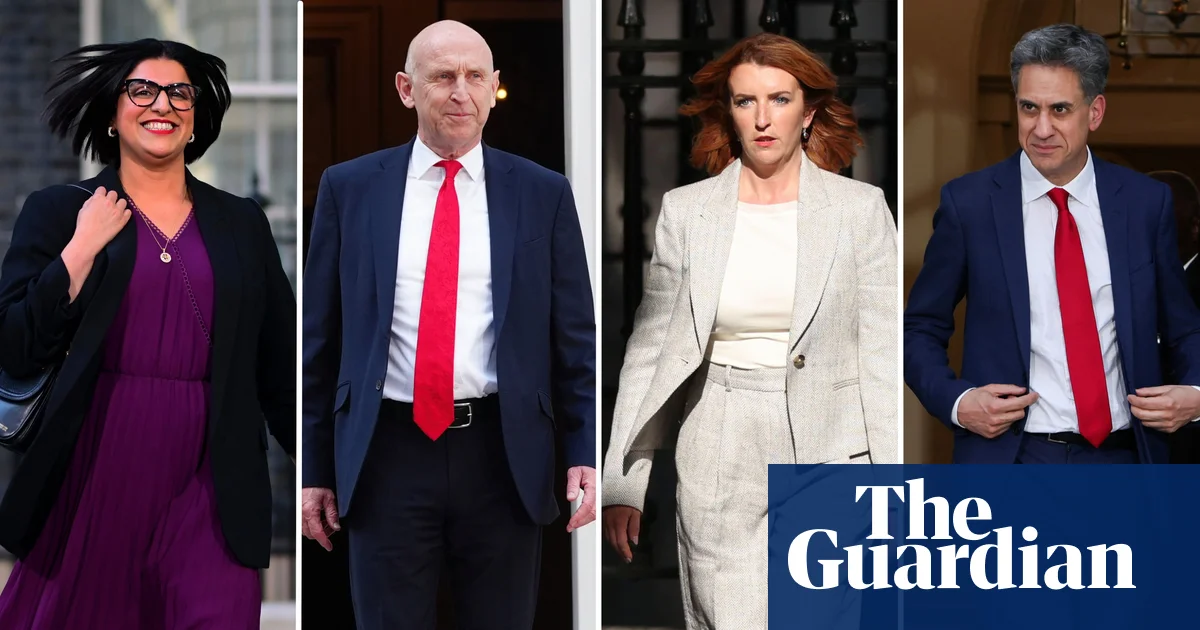
Andy Burnham has appointed his first cabinet, with the new prime minister rewarding those who have been loyal to his takeover efforts. He had promised to pick his top team from all wings of the party in an effort to show he is trying to run a more inclusive administration.But at the same time, his decision to have a brutal clearout of Starmer allies resulted in many considered to be on the right of the party or close to the former prime minister losing their jobs. These are the key announcements so far:Who is in?John HealeyChancellorJohn Healey. Photograph: UK Parliament/PAThe former defence secretary who quit the government over a lack of funding for the defence investment plan is the surprise appointment to the Treasury.Healey, 66, is a steady and experienced force, having been an MP since 1997, and serving as a Treasury minister under Tony Blair.The job had been first expected to go to Ed Miliband and then it was mooted for Shabana Mahmood. But one advantage of Healey is his longstanding history on Labour frontbenches for every faction of the party. He was a minister in the Blair-Brown years and a loyal member of the shadow cabinets of Miliband, Jeremy Corbyn and Starmer.Healey grew up in Wakefield, studied political science at the University of Cambridge, and was a journalist, campaigns director at the Trades Union Congress and a disability rights campaigner before entering parliament.Unshowy and not part of the usual Westminster dramas or scandals, it was a shock when he resigned his role under Starmer, in what would be one of the fatal blows for his premiership. In the job, he will be expected to push for a fuller funding settlement for the Ministry of Defence, which was denied to him under the Treasury of Rachel Reeves. His other major shared interest with Burnham is reindustrialisation.His X bio describes him as “Husband and Dad. Proud Yorkshireman. Labour MP for Rawmarsh and Conisbrough and former secretary of state for defence”. He can now add chancellor to that list.Shabana MahmoodThe home secretaryShabana Mahmood. Photograph: ITV/ShutterstockMahmood will keep her role in Burnham’s cabinet after being appointed home secretary by Keir Starmer last year and charged with driving through controversial immigration policies.She is considered to be on the Blue Labour right of the party, which is socially conservative and tough on crime. She grew up in Small Heath in inner-city Birmingham in the 1980s and 90s, where her father kept a cricket bat behind the till of the family shop to fend off would-be robbers. After going to the University of Oxford to study law, she worked as a barrister.The 45-year-old is an MP in Birmingham and ran Labour’s election campaign in 2024, before a stint as justice secretary overseeing an early release programme to ease overcrowding. She is viewed as steely and decisive.A cabinet colleague told the Guardian earlier this year that she “never wastes a word” in meetings, and last year warned that the government was still caught up in an opposition mindset and preoccupied with taking on the left instead of speaking to the concerns of the country more widely. She has also been a leading advocate for the UK to take a more pro-Palestinian stance, including on statehood.Ed MilibandForeign secretaryEd Miliband. Photograph: Getty ImagesMiliband is a great survivor in the Labour party – almost as much so as Andy Burnham. A former cabinet minister under Gordon Brown, he led Labour to an election defeat in 2015 before serving in the shadow cabinet of Keir Starmer.He was a leading contender to be chancellor but there were fears his positioning on the soft left and as a firm defender of Britain’s net zero commitments would spook the financial markets. Having once made a speech pitching some companies as producers and others as predators, he is not a favourite politician of big business.Born in north London in a political family, his father was a Marxist academic. He studied PPE at Oxford and worked mostly in politics and research before joining his older brother, David, in the House of Commons as a Labour MP. They became the first brothers to both serve around the cabinet table since before the second world war, and their sibling relationship was put to the test when Ed beat David in the leadership contest to succeed Brown with the support of the trade union vote.As Labour leader, he led in the polls for many months against David Cameron and identified ahead of his time the public mood on the cost of living but was pilloried by some of the rightwing media as gaffe-prone and somewhat awkward. In Starmer’s cabinet he was viewed as one of the most successful cabinet ministers at driving through his priorities, including Great British Energy, and blocking more drilling in the North Sea – a policy expected to be partially overturned by Burnham.As foreign secretary, he will be expected to take international matters off Burnham’s hands as much as possible, take a more pro-Gaza stance and potentially set a path to restoring Britain’s aid commitments to 0.7% of national income. He replaces Yvette Cooper.Yvette CooperHealth secretaryYvette Cooper. Photograph: David Woolfall/UK Parliament/PAAmong the Starmer-era big beasts who had been tipped for survival, Cooper is shifted from the Foreign Office to the vital domestic post of secretary of state for health and social care, the suffix especially important given Burnham’s stated mission to finally unlock the clogged adult care system.Cooper does, of course, have recent experience of a tricky UK-focused post, starting out in Starmer’s government as home secretary, and she held several posts under Tony Blair and Gordon Brown.While still in her 50s, Cooper is approaching Labour “grandee” status, having been an MP since 1997 and getting her first taste of ministerial life at the tail end of the 20th century. When Labour’s 2015 leadership campaign began she was initially viewed as a favourite, but finished third behind Corbyn and a certain Andy Burnham.The daughter of a trade union leader, Cooper is a near-political lifer, having begun her career with then-shadow chancellor John Smith, although she did spend a period as a journalist before entering parliament.For a decade of her time in parliament, Cooper was part of a political double act with her husband, Ed Balls, who lost his seat in 2015 and later became a broadcaster.Pat McFaddenWork and pensions secretaryPat McFadden. Photograph: Carl Court/Getty ImagesSome continuity had been expected with the new ministerial slate and it makes sense for this to happen with a department that could be central to Burnham’s political fortunes.McFadden, one of the more experienced operators in government, will be tasked with continuing to pilot through some sort of reform to social security, with the intention of limiting the costs without cuts or conditions of the sort that prompted a major backbench rebellion for Starmer.An MP since 2005, McFadden was soon propelled into the Blair and Brown frontbenches, and spent the buildup to the 2024 election as Starmer’s national campaigns coordinator, going on to take the Cabinet Office post at the centre of policymaking.A trusted voice on even the trickiest morning broadcast round, the child of two Irish speakers from County Donegal transplanted to Paisley, McFadden trod the traditional political path of researcher and policy adviser before winning his Wolverhampton South East seat.Louise HaighChancellor of the duchy of Lancaster, first secretary of state and Cabinet Office ministerLouise Haigh. Photograph: Getty ImagesHaigh became a linchpin of Burnham’s byelection operation, so it is no surprise she is now his chief organiser in government and effectively his deputy as first secretary of state. As the most senior Cabinet Office minister, she will coordinate work across the government and oversee any changes to Whitehall.It marks a return to cabinet for the 38-year-old Haigh, who was sacked by Keir Starmer as transport secretary for not having told him fully about a fraud conviction over a missing mobile phone when she was in her 20s.She grew up in Sheffield and studied politics and government at LSE, then Nottingham University, before working in parliament, for Unite and later at the insurer Aviva. It was during her time at that company where she got in hot water over the phone, having reported it stolen but failed to update the police when it was found. She pleaded guilty to fraud, but it did not stop her political career.Elected in 2015, she was one of 36 Labour MPs to nominate Jeremy Corbyn for the Labour leadership that year and was given a frontbench role when he made her a shadow Cabinet Office minister at age 28.The MP for Sheffield Heeley rose through the junior ministerial ranks and was one of a handful of Corbyn’s frontbench to be appointed to Keir Starmer’s first cabinet when he took over. She became the shadow Northern Ireland secretary.Known for an engaging communication style, she retained her frontbench role even as Starmer moved his party to the right. As transport secretary, she oversaw the nationalisation of railways legislation until she was returned to the backbenches. She replaces Darren Jones.Who’s out?Rachel ReevesFormer chancellorReeves had always wanted the job of chancellor and was proud to be the UK’s first female holder of the office. She had worked hard to instil ironclad fiscal discipline on Labour, sticking broadly to her self-imposed fiscal rules and enforcing spending curbs across departments.However, some in Labour blamed early missteps from her Treasury for Starmer’s downfall, starting with the cut to the winter fuel payment, but also the rise in national insurance for employers that her critics in business claim stymied the jobs market and growth.Reeves can, however, claim a record of having started to turn the economy around. She made a valiant effort to stay in her job but ultimately was judged too close to the Starmer project to stay in the Treasury. She is believed to have turned down another senior position.A former child chess champion and Oxford economics graduate, Reeves had also faced criticisms from some newspapers for having exaggerated her credentials as an economist on her LinkedIn page, having allowed some plagiarism to creep into a book she wrote on female economists and having inadvertently failed to pay for a landlord’s licence.In her departing statement, she said: “It has been the privilege of my life to serve as the chancellor of the exchequer. The economy today is stronger, fairer and more resilient because of the choices we have taken as a Labour government over the past two years. Stability restored, investment delivered and reform to our economy under way … I’m proud to say that they have. And to every young woman and girl let my time in office show there should be no ceilings on your ambitions, your hopes or your dreams.”David LammyFormer foreign secretaryLammy has been a longstanding frontbencher after serving as a minister in the last New Labour governments.A former lawyer, he served as foreign secretary for Keir Starmer and then won a promotion to deputy prime minister and justice secretary when Angela Rayner stood down. He has been at the former prime minister’s side for many of his toughest moments.Such is his experience and standing that there was some speculation he might stay on in a different ministerial role. In a post on X announcing his departure, Lammy made it plain he had been happy to stay on but was not wanted.He wrote: “I would have been proud to continue serving in cabinet. But a new prime minister is entitled to build his own team, and I wish Andy Burnham and the new cabinet every success.”Darren JonesFormer chief secretary to the prime ministerFrom the centre of No 10 operations to nothing. As Jones put it in a bluntly worded social media post: “Andy Burnham has called to tell me I won’t be a part of his new cabinet. I wish him and his team every success.”An MP since 2017, Jones’s fairly rapid rise to the top table began with well-reviewed performances as chair of the business and trade committee. It began with the tricky if powerful role of Reeves’s number two as chief secretary to the Treasury.There he was so central to spending negotiations, that when Starmer undertook one of his several organisational revamps, as part of the September 2025 reshuffle, Jones took on the new and somewhat artificial role of chief secretary to the prime minister, tasked with leading change from No 10.Vague hints that Jones might contest for the Labour leadership came to nothing, and while – as his tweet indicated – he would have been happy to do another role, this was also not on the cards.Steve ReedFormer housing secretaryReed was one of most loyal cabinet ministers to the Starmer administration, although he had made a play to keep his job in recent weeks by highlighting his achievements.An old ally of Morgan McSweeney, Starmer’s former chief of staff, Reed was a veteran of south London local government before entering parliament in 2012. He served as environment secretary before his current job and will now return to the backbenches.His letter to Burnham after his departure from government was somewhat spiky, warning him not to disadvantage London and also sending his hopes that those who were not loyal to Starmer will be loyal to the new prime minister.Peter KyleFormer business secretaryKyle took on the job of business secretary last year in the emergency reshuffle prompted by the departure of Angela Rayner over her council tax affairs. It meant he found himself on flights to the US and China at a moment’s notice at a critical time for negotiations over trade and tech companies. He previously served as science secretary – a role that is now likely to be folded into the business department.Kyle entered parliament in 2015 and has been open about his struggles to get there. He had difficulties at school owing to dyslexia and left, in his own words, “without any usable” qualifications. He made it to university in his 20s after several failed attempts.An ally of Wes Streeting and Starmer, Kyle appears to be departing from cabinet largely to make way for closer supporters of Burnham although he has also been criticised for a perception that he has been too open towards tech companies.Richard HermerFormer attorney generalHermer was probably Starmer’s closest friend in politics. A fellow human rights lawyer, he was made a peer so that he could join the prime minister’s first cabinet.However, he quickly became a bogeyman for the rightwing press, which disliked his role in signing over the Chagos Islands to Mauritius and generally espousing views on the liberal left. His past legal work, including his representation of Gerry Adams and advice to Caribbean countries seeking reparations, has been raked over by Tories who have demanded that he publicly recuse himself from some areas.The criticism was not confined to the right. Maurice Glasman, the Blue Labour founder and associate of the US vice-president, JD Vance, called Hermer “an arrogant, progressive fool who thinks that law is a replacement for politics”.Starmer steadfastly stuck by him though, and Hermer has been an invaluable source of counsel and friendship through his final months as premier. He was also a bastion of progressive thought in a cabinet that many in the Labour party felt had veered too far away from core party values.Liz KendallFormer science and technology secretaryAlso to be filed under: no surprise here. Kendall has always been on the right of Labour and ideologically much closer to Starmer than to the new PM.An ever-present figure on Starmer’s frontbench, the Leicester West MP started as work and pensions secretary, the job she had shadowed in opposition, before moving to the science brief in the wholesale cabinet reshuffle of September last year.An MP from 2010, Kendall supported David Miliband in the Labour leadership election of that year. Five years later, she stood herself, coming last of the four candidates when Jeremy Corbyn became leader.In a tweeted letter, Kendall thanked Starmer and other cabinet colleagues, saying she was ready to support Burnham “in any way I can”.Jo StevensFormer Wales secretaryAlso not expected to stay on, the Cardiff East MP has been a fixture in the Wales office, filling the brief in opposition and then government since 2021, having previously been Starmer’s shadow culture secretary.A backer of Starmer when he stood to be Labour leader, Stevens had served as shadow Wales secretary under Corbyn, but resigned in opposition to Corbyn’s decision to back formal moves for the UK to leave the EU.Hilary BennFormer Northern Ireland secretarySome had speculated that Benn could be among ministers to stay in their job and provide continuity, given that he is not overtly partisan and was largely seen as doing a quietly good job in a sensitive brief.But Benn tweeted that he has gone. It is a return to the backbenches for a Labour grandee, in parliament for more than 25 years, who held a series of ministerial jobs under Blair and Brown.
Andy Burnham’s first Labour cabinet: who’s in and who’s out?
From the Treasury to the Home Office, we look at who will head up key departments in new PM’s government
2,813 words~13 min read