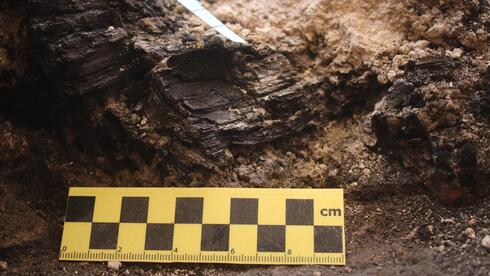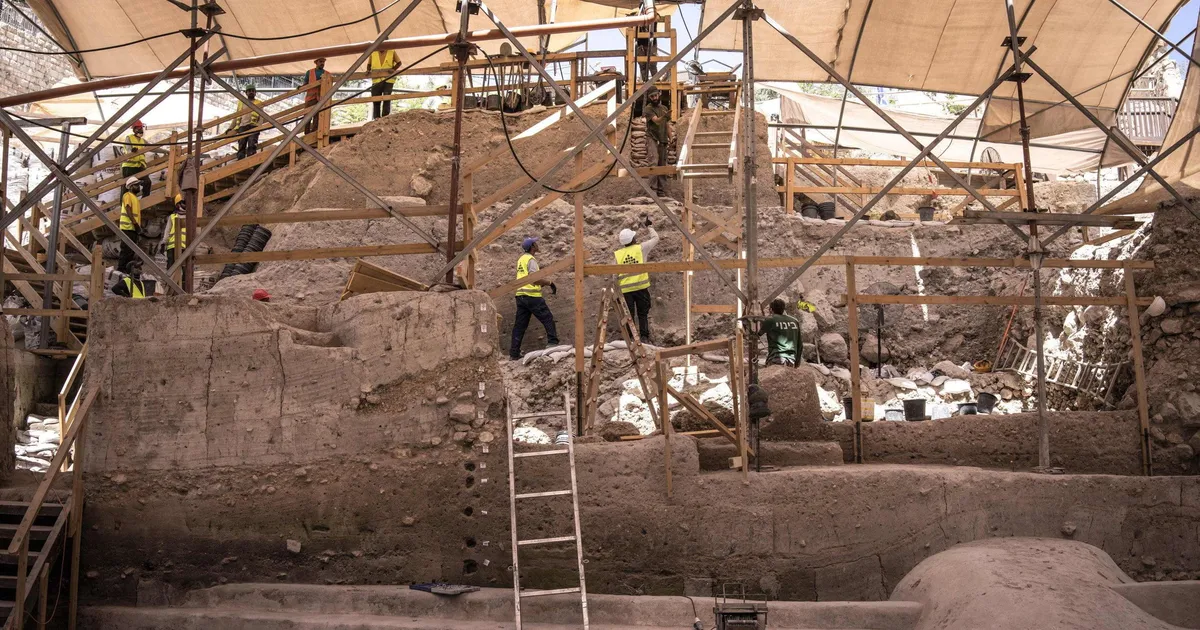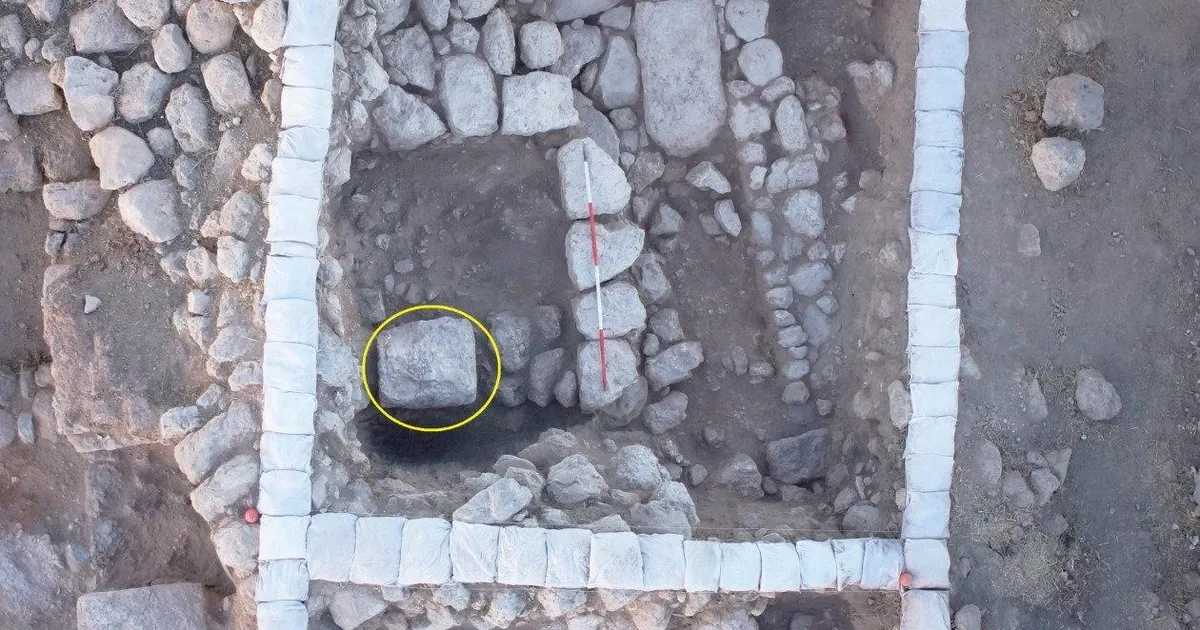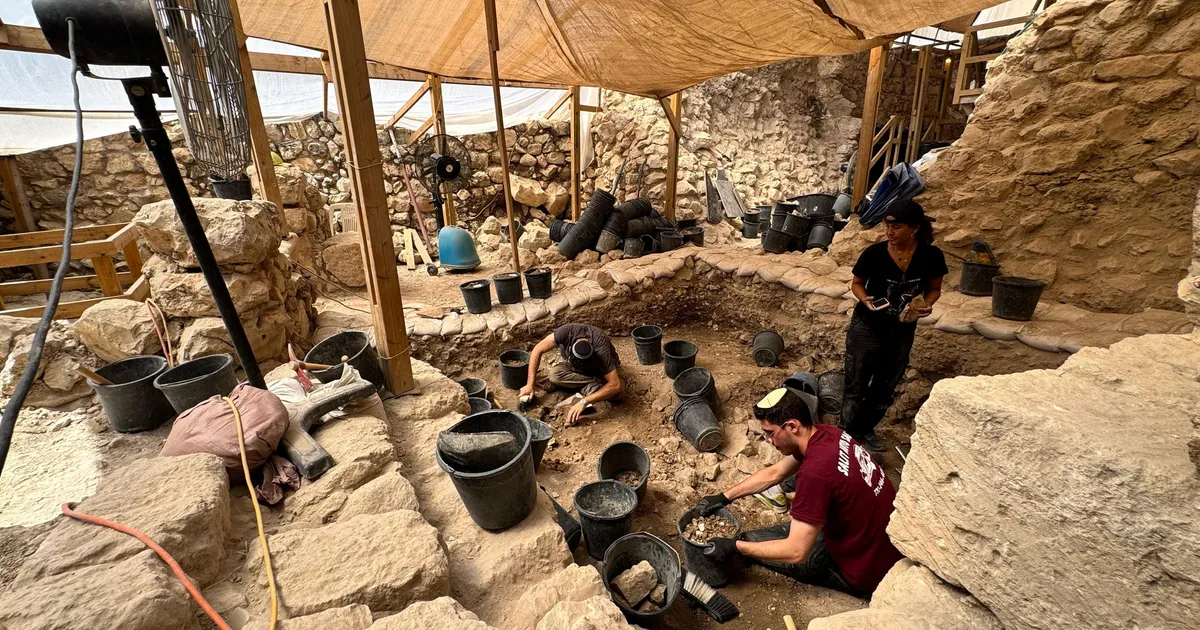
This is the second set of wooden roofing found in a mysterious building that burned down in 586 B.C.E., but when was it erected?Charred wooden beams from the time of the Babylonians' howling attack on Jerusalem in 587 or 586 B.C.E. have been unearthed in the City of David excavation, again. This second discovery of massive wooden beams in a large and highly mysterious building that the Babylonians burned down was unveiled by the Israel Antiquities Authority on Monday.It is true that wood in archaeological contexts is rare in general and certainly in the debris from the violent destruction of ancient Jerusalem. Yet this is the second time that roof beams from this specific building have been found in the archaeological site formerly known as the Givati Parking Lot.The first time was in the building's southern part. That wood was deduced to be sycamore, wood of the local fig tree. Now researchers from the IAA and Tel Aviv University are digging on its other side and found more beams, some of which are sycamore and some of which were something else, apparently conifers, explain Efrat Bocher, the excavation director on behalf of the IAA and Joanna Regev of the IAA and Weizmann Institute of Science in Rehovot.The beams may have been spared decay by becoming coated in plaster from the building that melted in the blistering conflagration, the archaeologists say.The charred beams unearthed Credit: Reut Vilf/City of DavidThe charred beams unearthed Credit: Reut Vilf/City of DavidThe fond hope of the archaeologists is that the latest discoveries will shed more light on the enigma that is this building, which the Babylonians burned down together with the city in the First Temple period. That much they are sure of, based on a host of evidence. Another question is when it was first built.Quite possibly, the origins of this building go back into the biblical era, around the ninth or possibly even the 10th century B.C.E., explains Regev, who has been analyzing the finds there for years.Dating by batNote that whatever their intentions, the Assyrian overlords who besieged Jerusalem in 701 B.C.E. never did conquer and raze the city, for reasons that we suspect, but do not know. So they didn't do this.How sure are the archaeologists that the destruction observed at this spot in Givati was caused by the Babylonians in 567-566 B.C.E., as opposed to the Romans in 70 C.E.? Jerusalem archaeology can be messy, so much so that Shimon Gibson reported on layers turned upside down in a dig on Mount Zion just outside the city wall – Roman bits overlying Byzantine, for example.First of all, although it had been destroyed, excavation suggests the overarching structure had been a square – a big one, says Bocher. She posits that the building served both administrative and residential purposes. Structurally, it consisted of rooms surrounding a courtyard, a long-standing Middle Eastern residential style. Possibly the beams now revealed had sheltered the inner courtyard, only to collapse when the enemy arrived.Destruction remains discovered during the Israel Antiquities Authority excavations in the City of David. Credit: Reut Vilf/City of DavidDestruction remains discovered during the Israel Antiquities Authority excavations in the City of David. Credit: Reut Vilf/City of DavidThe material culture is what nails home the time of the building's death – the rooms are full of debris from the collapse, and luxurious and other stuffs wouldn't have wound up buried in debris from another age, Bocher points out. The rich finds include precious items such as ivory, attesting to wealth and luxury, and the types and amount of vessels found in one room, for example, are beyond what an office building would have needed. But in previous digs the archaeologists found seal stamps, which suggest administration."We think it was an administrative building where people also lived," Bocher sums up the thesis – plausibly the officials and their servants.Then there are the arrowheads. Ceramics evolved in style and shape over time which is why they are diagnostic of periods. Seasoned archaeologists can tell a local Canaanite vessel from an imported Cypriot pot at a glance. Ditto arrowheads, which have evolved since their advent at least 80,000 years ago – seasoned archaeologists can tell a Babylonian projectile from a Hellenistic one, or a Roman one, or that of a desperate Jewish rebel hoping all this would just go away.Excavation director Efrat Bocher. Credit: Koby Harati for the City of DavidExcavation director Efrat Bocher. Credit: Koby Harati for the City of David"We have arrowheads in the destruction layer which attest to the battle against the Babylonians," Bochar observes. "There are arrowhead types that can't be from another time in the collapse debris."So the Babylonians destroyed it. Fine. Who built it? Maybe King Hezekiah's son, King Manasseh. Or somebody earlier. "We think this building had a lot of stages of construction. When exactly it began, we don't know – there were trees from 680 B.C.E. [a century before the Babylonian assault] but that was a restoration!" Regev tells Haaretz by telephone."One of the things we dated was a bat," she adds, prompting Haaretz to ask her to repeat the sentence in case Haaretz had misheard. Haaretz hadn't. "The bat had entered a small passage built into a wall of the building and it dated to 780-770 B.C.E.," she says. "There were even older things. Some material inside one of the walls was from the 10th century B.C.E."She stresses that doesn't prove the building was erected 3,000 years ago; it could have been 2,900 years ago because even if one dates a long-dead bat in a nook or seeds trapped in the mortar, the builders could have used older materials around them. Under the floor, they found dates from the 10th century B.C.E. while dates above the floor tend to the ninth century B.C.E. The question remains open.Hopefully the new excavations, and deeper analysis of the wood and its rings, will shed more light on the building's nature and true history, Regev says.Dr. Johanna Regev of the Israel Antiquities Authority. Credit: Reut Vilf/City of DavidDr. Johanna Regev of the Israel Antiquities Authority. Credit: Reut Vilf/City of DavidYiftah Shalev, director of the dig on behalf of the IAA with Yuval Gadot of Tel Aviv University, also suggests that the site of this building's destruction wasn't erased when people returned to Jerusalem in antiquity. The returning residents preserved it as a memory of the horrors, they posit."Preserving memory is a human need, seeking to preserve what once existed," Shalev says. Here, he believes it is clear: "a deliberate choice to leave ruins in place as a testament to the destruction and build the new layer over them."A tree diesTree rings are growth layers in the form of concentric circles in a tree's cross-section. Sycamore trees (Ficus sycomore) produce fruit that is reportedly not as tasty as "true fig" fruit (Ficus carica) but not bad.Crucially, this is one drought-resistant plant. It doesn't produce annual growth rings, however. But conifers do, Regen explains. Typically, each ring represents one year in the conifer's life, and among other things, rings attest to transient environmental conditions. A narrow ring suggests a drought year, for instance.The growth rings of the wooden beams discovered in the City of David. Credit: Efrat BocherThe growth rings of the wooden beams discovered in the City of David. Credit: Efrat BocherAnalyzing the first beams found in the early 2020s, ring by ring, dated at the radiocarbon research laboratory of Prof. Elisabetta Boaretto as reported in PNAS in 2024. Regev and the team reached dates of 680 B.C.E., which is when the trees were cut down, prior to the time of the renovation of the building. Now they intend to repeat the analysis with the newly unearthed beams. "We want to know exactly when the tree was cut down and the beams were placed," she adds.Note that the two sets of beams need not have been placed at the same time. How does radiocarbon dating a beam tell when it was placed? "We presume they didn't wait long to build," she answers. You don't cut down a tree and wait a century. You use it.Ultimately, working with annual conifer tree rings from antiquity can help narrow margins of error in dating ancient Jerusalem, she sums up. "Without the careful sampling of and dating annual sequence of rings, during those particular centuries, we could date finds to within a range of hundreds of years," Regev said. "Now we can attain much greater precision, narrowing the dating range down to as little as 10 years. When we will add to the beams additional features found around them, such as seeds from mortar, straw from plasters and burned foods remains from the multiple overlaid floors, we have high hopes of achieving a reliable history for this impressive, enigmatic building."
Archaeologists reveal more massive beams from Babylonian attack on ancient J'lem
This is the second set of wooden roofing found in a mysterious building that burned down in 586 B.C.E., but when was it erected?
1,463 words~7 min read