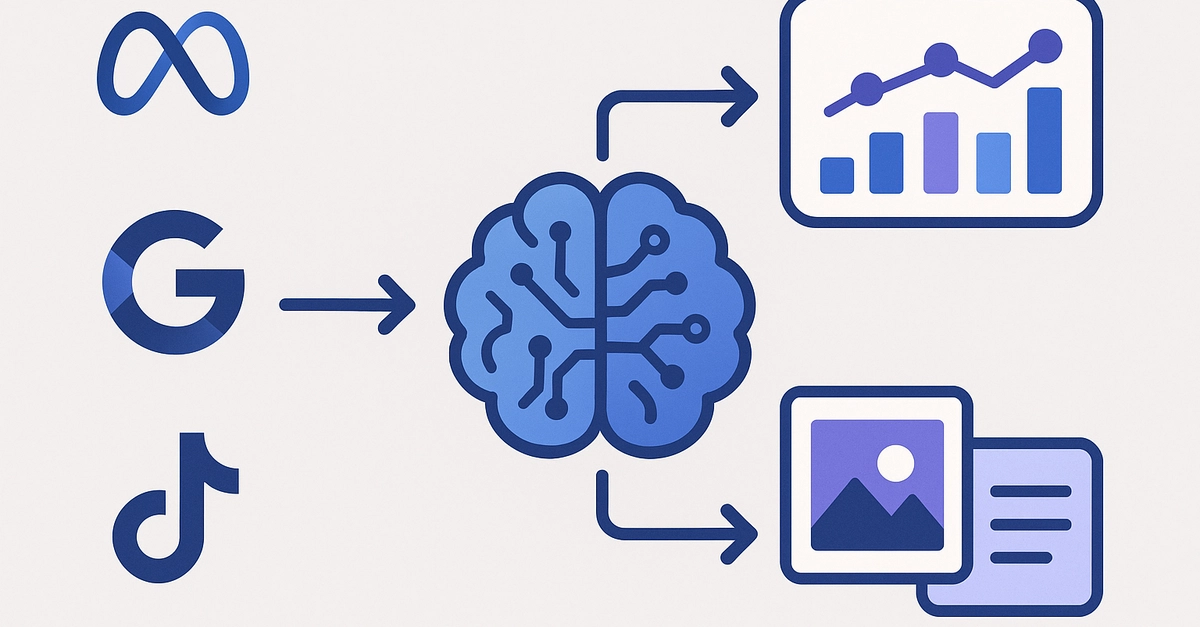
A detailed AI-generated persona can look sophisticated. gettyMarketers already use generative AI to develop campaign concepts, audience personas, advertising copy and visual briefs. It produces campaigns that run faster, cost less and feel more personalized, yet it can describe the women brands want to reach less accurately than the marketers who once built those campaigns by hand.When a team gives a model no reliable customer evidence, the model fills the gap with a familiar maternal archetype: the primary caregiver and household organizer who runs short on time and carries responsibility for domestic purchasing decisions. Models reach for that archetype for a structural reason. State of Brand notes that LLMs are trained to produce the statistical average of everything ever written, so a system with no evidence about a specific mother returns the most common version of one. The flattening is already visible elsewhere in corporate writing. Drawing on a Barron's analysis of an AlphaSense document library, State of Brand reported that 73 corporate documents used the identical "not just X, it's Y" construction in a single quarter of 2025, after the phrase barely surfaced across the previous two decades. Marketing personas converge the same way. Give the model no customer, and it hands back the average mother.Four Types of DataA detailed AI-generated persona can look sophisticated. The model gives her a name, a job, an income, shopping habits and a polished biography. It tends to place her inside a heterosexual, two-parent household with young children, and it assumes she prioritizes convenience, affordability, wellness and her child's outcomes over ambition, pleasure, identity or personal growth.That’s great, but AI generates synthesized data without any direct customer input, and a model cannot verify on its own that its themes represent the intended audience. That is why marketers need grounded sources instead. Observed data comes from actual behavior, such as purchases or website activity. Declared data comes from customers directly. Modeled data uses existing datasets to predict behavior.MORE FOR YOUThe 2026 National Parent Survey found that families are diverse, and important stories get lost in “averages.” So here’s some declared data: the U.S. has about 85 million moms who hold between $11 trillion and $15 trillion in annual spending power. They control more than 84% of household spending decisions. But in 45 states and Washington, D.C., the average annual cost of childcare for two children in a center now exceeds annual mortgage payments. 43% of working parents in KPMG’s 2025 survey identified guilt as their second biggest challenge, just behind time management. Tech has shifted from a luxury to a survival tool, with 56% of parents surveyed using two or three parenting apps or devices to manage cognitive overload.How Outputs Can DivergeIn an illustrative test, I gave OpenAI’s GPT‑5.6 Sol and Claude Opus 4.8 the same brief. I asked (in detail) both LLMs to develop a back-to-school campaign targeting mothers of middle school students.OpenAI treated mothers as one group of caregivers rather than a single uniform audience. The campaign accounted for differences in income, culture, family structure, shopping behavior and caregiving responsibilities. It included fathers, grandparents and other guardians, and it framed value, convenience, style and practicality as possible motivations rather than universal truths.Claude, on the other hand, built a campaign around "Renee," a mother who manages the back-to-school budget, compares retailers, researches products and wants to finish the shopping list in one trip or one online order. The model also assumed that starting middle school marked an emotional milestone and that helping her child feel confident drove her decisions.Interestingly enough, the second campaign held together emotionally, but it also leaned harder on a traditional view of who performs household labor and why mothers shop. Of course, outputs shift with the model, the prompt, the language, the system instructions and the safety tuning, so the comparison isn’t intended to prove one platform carries more bias than the other. But it does show how quickly a marketing brief can turn into a story about motherhood that feels correct before a human subject matter expert verifies it.Micro-Targeted StereotypesPersonalization can correct stereotypes when it draws on consented signals, such as an expressed need, a life stage or product behavior. But it can also amplify them. AI systems may infer preferences from gender, race, age, ZIP code or family structure, then use historical conversion data to predict what a customer is likely to want. Generative AI may create the persona or message, while advertising and recommendation systems determine who sees it.If mothers are repeatedly shown family-centered content, their engagement reflects the narrow set of options the system offered. The system may then interpret that behavior as confirmation that its original assumption was correct.This is also a form of cognitive offloading. When marketers use AI to interpret customer evidence, define an audience or decide which messages are relevant, the technology does not merely support their judgment; it begins to structure it. The result is a feedback loop: prediction shapes exposure, exposure shapes engagement and engagement strengthens the original prediction. A mother who never sees a message about her career, pleasure or personal interests cannot click on it. The system may then count that silence as proof it understood her correctly.Human Oversight Must Mean MoreResponsible oversight is not a marketer who clicks "approve" after reading AI-generated copy. Teams should document the model, the prompt, the data sources and the assumptions they used. They should separate observed information from modeled or generated information, test counter-stereotypical cases and validate claims against primary evidence.Consumer-insights specialists, data and AI owners, cultural strategists, legal or privacy teams and people from the actual customer segment should all review campaigns aimed at mothers. The National Institute of Standards and Technology (NIST) also recommends involving sociocultural and domain experts and using representative participants in structured feedback exercises. Most importantly, employees who happen to be mothers cannot automatically represent the intended market.Generative AI can help marketers organize evidence, identify themes and develop hypotheses. It can speed up production and help marketers explore options. But it should not become the final authority on who a mother is, what she values or why she behaves as she does.
AI Mom Marketing—How Automation Scales Outdated Stereotypes
Generative AI can scale outdated stereotypes about mothers, turning cultural assumptions into personas, targeting and campaigns that feel precise but lack human insights.
1,017 words~5 min read