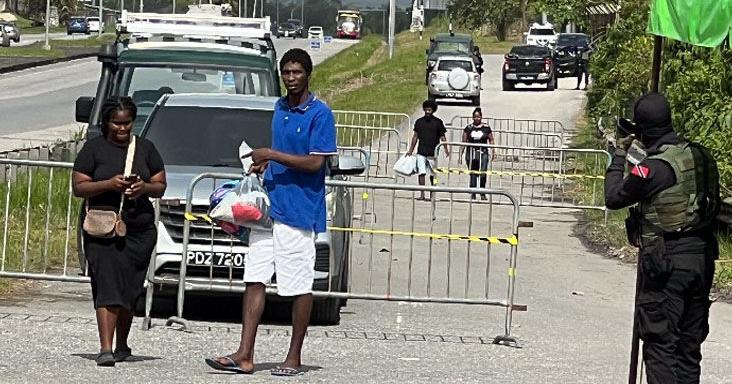
CRIMINOLOGIST Akinee Harry said the concerns raised by the Inter-American Commission on Human Rights (IACHR) over the repeated use of states of emergency (SoEs) in the Caribbean highlighted the need to balance public safety with the protection of constitutional rights.Speaking with the Express on Saturday, Harry said democratic states had a responsibility to protect citizens from violent crime while also safeguarding the rights guaranteed under their constitutions.'The Inter-American Commission on Human Rights raises an important principle,' Harry said. 'Every democratic state has both a duty to protect its citizens from violent crime and an equally important duty to safeguard constitutional rights. These responsibilities should not be viewed as competing objectives.'The criminologist was responding to a 2025 IACHR report on the use of 'prolonged SoEs' by Trinidad and Tobago and the impact of such measures on civil liberties was flagged as a concern.In its 2025 annual report, the IACHR 'observed that the continued reliance on states of emergency in Belize, Jamaica and Trinidad and Tobago, raised several concerns regarding the impact of these emergency measures on persons' fundamental rights and freedoms, including their rights to expression, association and personal liberty within these states'.Harry said Trinidad and Tobago, Belize and Jamaica continued to face significant security challenges arising from organised criminal networks, the trafficking of illegal firearms and high homicide rates. He said governments could lawfully invoke emergency powers when the legal threshold of necessity had been met, but agreed with the Commission's position that such measures should remain exceptional rather than becoming a routine aspect of governance.'Under such circumstances, governments may legitimately invoke emergency powers when the legal threshold of necessity is met. However, the Commission correctly reminds us that these powers should remain exceptional rather than becoming a routine feature of governance,' he said.Harry argued that the longterm response to violent crime in small island developing states (SIDS) could not depend primarily on recurring States of Emergency. Instead, he said sustainable reductions in crime required improvements across the criminal justice system, including stronger policing, better intelligence gathering, more effective prosecutions and higher conviction rates. He also called for greater investment in violence prevention initiatives and measures aimed at addressing the social conditions that contributed to violent crime.'The long-term solution to violent crime in SIDS cannot depend primarily on recurring states of emergency,' Harry said.He added that without broader institutional reforms criminal organisations often adjusted their methods once emergency measures came to an end.According to Harry, the central issue for countries such as Trinidad and Tobago, Belize and Jamaica was not simply whether states of emergency should be used, but how they were implemented.He said emergency powers should remain lawful, proportionate and transparent, while being subject to parliamentary and judicial oversight.Harry also said governments should establish measurable objectives to determine whether emergency measures were producing lasting improvements in public safety.'The Commission's intervention should therefore be viewed as an invitation to strengthen democratic accountability and explore alternatives to implementing states of emergency to confront violent crime,' he said.
Support for IACHR SoE concerns
CRIMINOLOGIST Akinee Harry said the concerns raised by the Inter-American Commission on Human Rights (IACHR) over the repeated use of states of emergency (SoEs) in the Caribbean highlighted the need
496 words~2 min read