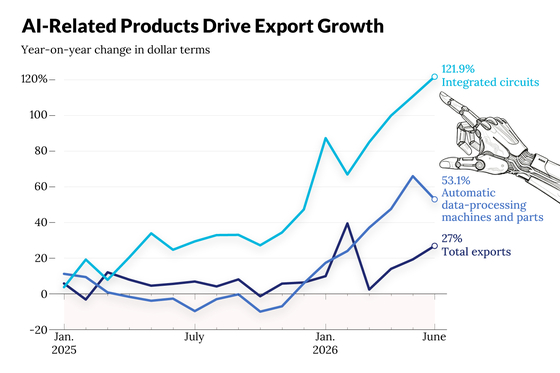
A global rush to build out artificial intelligence (AI) infrastructure has turned the technology into a key pocket of growth in China’s economy during one of its weakest stretches in years.Electronics and information technology contributed over half of the economy’s expansion during the April-to-June period on a quarter-on-quarter basis, according to Capital Economics. Earlier estimates from China International Capital Corp (中國國際金融) showed AI-related exports alone accounted for 1.1 percentage points in the growth of nominal GDP during the first four months, nearly triple their share for the full year of last year.“The emergence of AI as the new engine of Chinese growth could prove to be a key source of economic resilience over the rest of the year and into 2027,” Capital Economics Ltd head of China economics Julian Evans-Pritchard said. At the same time, such AI-driven growth “alone is no panacea for China’s wider economic challenges,” and could leave the country exposed if the AI investment boom stalls, he added in a report.
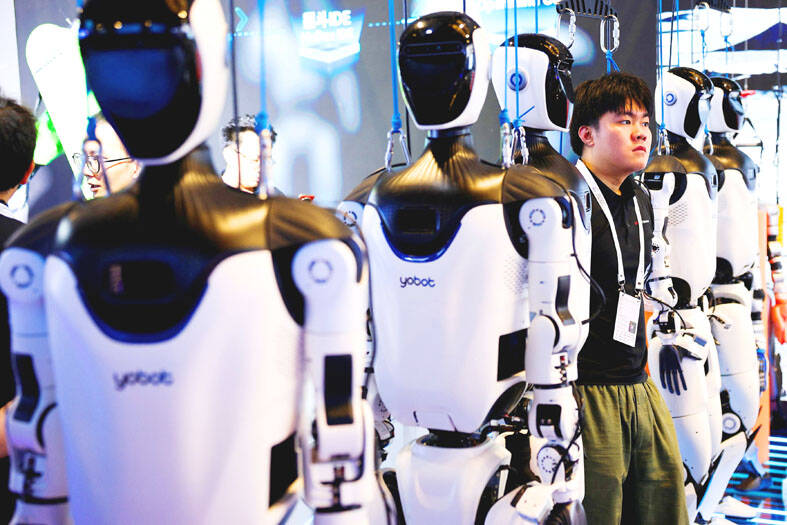
A staff member stands among humanoid robots on display at the World Artificial Intelligence Conference in Shanghai, China, on Friday last week.
The technology has abruptly gone from near irrelevance to economic dominance as hundreds of billions of dollars flow into the buildout of data centers in the US, driving up prices and demand for hardware made by the world’s manufacturing powerhouse. Roughly a quarter of the AI spending in the US leaks offshore, according to Bloomberg Economics, lifting trade across Asia.As new models released by Chinese start-ups rattle markets, AI is also fast moving to the front of the policy agenda, with Chinese President Xi Jinping (習近平) looking to shape the technology’s global rules and assert influence through a new group of nearly 30 countries.