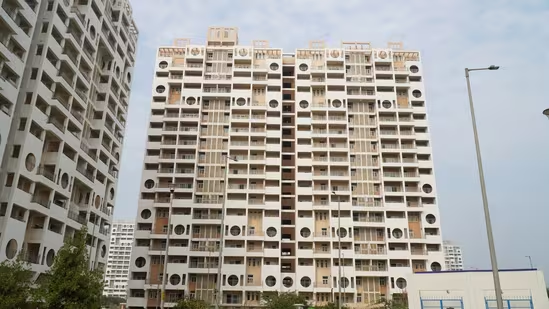
The draft amendments will apply to buildings and building complexes with a proposed built-up area of 20,000 square metres or more
| Photo Credit:
Benjamas Deekam
In a significant development, the Centre proposed to bring all new large commercial, residential and office buildings under mandatory energy consumption and sustainability norms, marking a significant expansion of India’s energy efficiency framework as electricity demand from the building sector continues to rise.The development assumes importance as buildings account for roughly one-third of India’s power consumption, which is expected to increase significantly in the next 10-15 years as the country’s economy and household usage expands coupled with growing demand for cooling.The draft amendments, issued by the Power Ministry in consultation with the Bureau of Energy Efficiency (BEE), will apply to buildings and building complexes with a proposed built-up area of 20,000 square metres or more.Energy demand in buildings is primarily driven by electricity used for lighting, space cooling, heating, and cooking.The reason behind the latest draft norms is that currently there is presently no mandatory, nationally harmonised framework for assessing, benchmarking and publicly disclosing the energy performance of large buildings.Consequently, implementation of energy-efficient building practices remains uneven across States and building categories, and the energy performance of buildings is not readily visible to consumers or other stakeholders, the Ministry pointed out.Stakeholders can share their responses on the draft norms till August 10, 2026.FrameworkThe proposed draft framework applies only to new buildings and building complexes for which construction commences after the date of publication of the notification in the Official Gazette.The framework recognises established building rating systems such as GRIHA, IGBC, LEED and GEM, thereby leveraging existing institutional capacity while harmonising their implementation under the Energy Conservation Act.Building rating agencies operating in the country shall mandatorily register with BEE. The Rating shall be awarded on the basis of the specified energy performance criteria, providing a nationally consistent and credible benchmark for evaluating building energy performance.RationaleThe Ministry emphasised that the building sector is one of the fastest-growing energy-consuming sectors in India, driven by rapid urbanisation, increasing commercial activity, expanding infrastructure, and rising demand for thermal comfort.Large commercial, institutional and Residential buildings account for a significant share of the country’s electricity consumption, contribute substantially to peak electricity demand, and are an important source of greenhouse gas emissions.Improving the energy performance of buildings is therefore critical for enhancing energy security, reducing energy intensity, lowering carbon emissions, and supporting India’s commitments towards sustainable development and climate change mitigation, it added.Buildings account for roughly one-third of India’s cumulative electricity consumption, which is expected to increase significantly in the future considering the growing urbanisation in India as well as its expanding commercial and industrial profile.BEE’s latest national energy data survey and analysis report points out that the combined residential and commercial building sector in India accounts for 33.5 per cent of the total electricity consumption in FY25. Consumption from the combined residential and commercial buildings grew at CAGR of around 6.3 per cent, over the past decade.In terms of total final energy consumption, residential buildings consumed about 72.8 million tonnes of oil equivalent (Mtoe), accounting for 12.1 per cent, while commercial buildings consumed around 16.7 Mtoe, representing 2.8 per cent of final energy consumption.Published on July 20, 2026