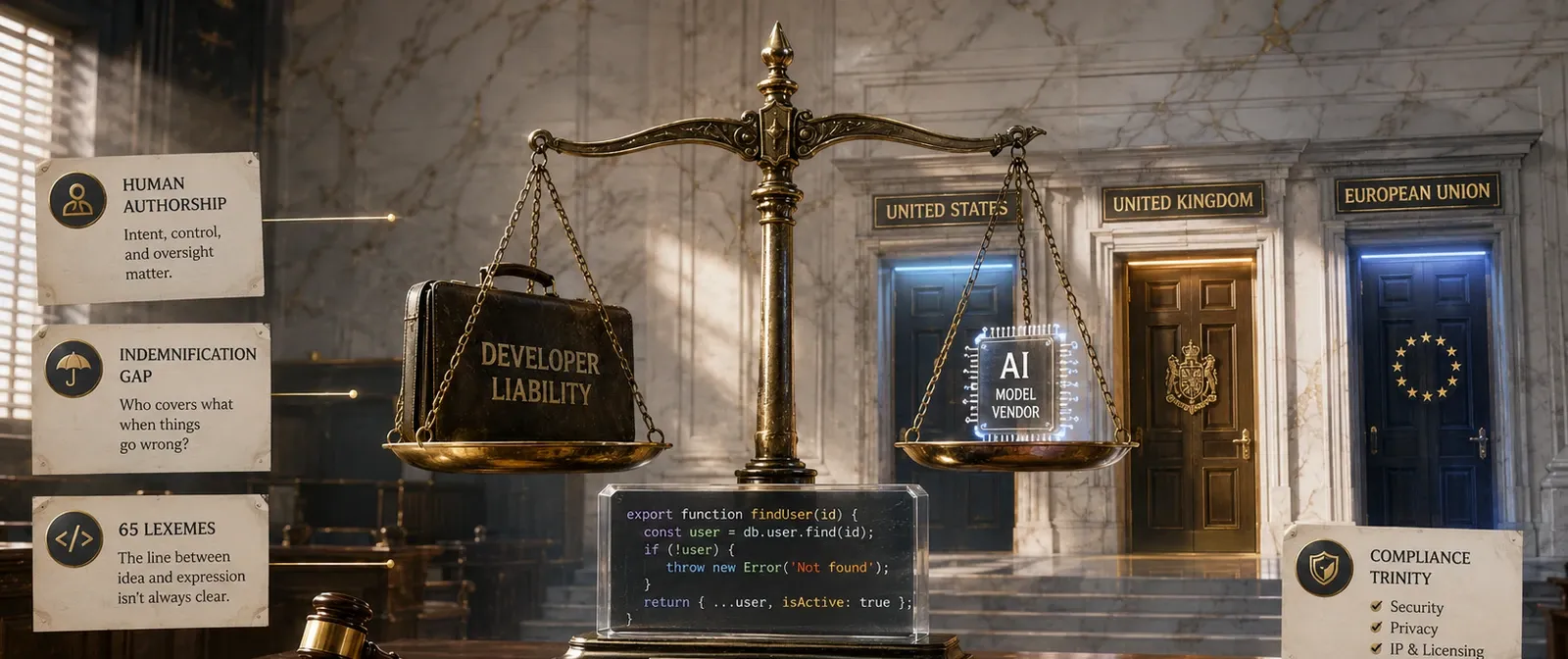
Imagine your AI assistant just produced 200 lines of code. Legally, you may not own a single line of it but legally, you're still on the hook for every bug it ships. Here's the gap between those two sentences, and what it means for the code you merge tomorrow.
That's the gap this whole topic lives in. The tool that produced the code can't be sued. The model can't be held accountable. The vendor's contract has already made it clear, in language most developers never read, that responsibility flows downhill, to the human who pressed Tab.
The interesting part isn't that this gap exists. It's that almost nobody in engineering treats it like it does. We've spent two years celebrating the productivity, and a much smaller fraction of that time figuring out what to do when the velocity meets a copyright claim, a compliance audit, or a production incident. Let's break it down: what courts have actually said, what your tool's contract actually says, where the legal cliffs are, and how a sane engineering team handles the whole thing without either banning AI or pretending the question doesn't exist.
The Handoff That Nobody Signed
Software ownership used to be a settled question. You wrote the code, your employer paid you to write it, your employment contract assigned the copyright to them, the company shipped it under whatever license they preferred. Three parties (you, your employer, the user) and the lines between them were clean. If something broke, the user complained to the company, the company looked at the commit history, and someone got a quiet conversation in a one-on-one.